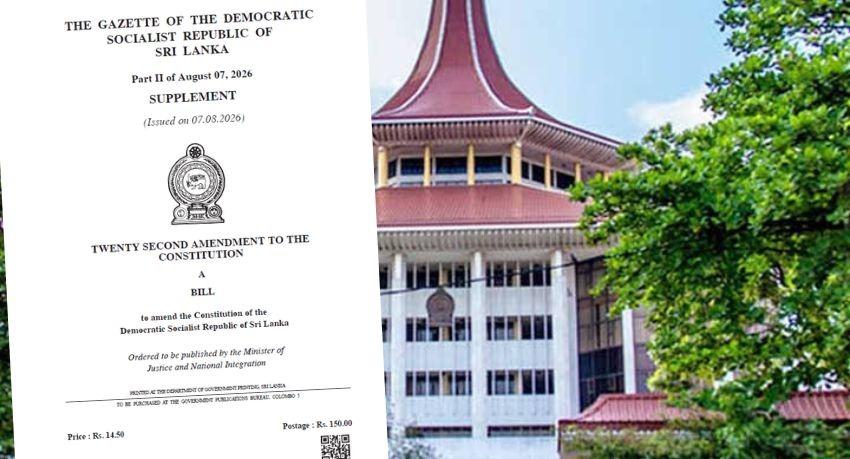
The bill for the proposed 22nd Amendment to the Constitution has been published in the government gazette, setting out the increases to judges’ retirement ages that have been contested for months.
Under the bill, judges of the Supreme Court would retire at 67, up from the present 65, and judges of the Court of Appeal at 65, up from 63, according to Ada Derana. The Daily Mirror reported that the change is made by amending Article 107(5) of the Constitution.
The amendment also introduces a separate rule for the Chief Justice, whose tenure would end either on reaching 67 or on completing six years in office, whichever comes first.
A further provision amends Article 137 to raise the maximum number of Court of Appeal judges from 19 to 24. The Daily Mirror noted the bill states that where the Sinhala and Tamil texts differ, the Sinhala text prevails.
NewsFirst reported that publication was ordered by the Minister of Justice and National Integration. The bill now moves to Parliament, where a constitutional amendment requires a two-thirds majority.
A second bill widens the lower courts
The Judicature (Amendment) Bill was gazetted the same day, NewsFirst reported. It proposes raising the number of High Court judges from 110 to 120 and extending retirement ages in the lower courts by two years — to 63 for High Court judges and 62 for District Court and Magistrate’s Court judges.
Senior counsel warn of “tough action”
A group of senior President’s Counsels warned of tough action to force the government to abandon the amendment, the Daily Mirror reported after the gazette was issued.
Anura Meddegoda PC, a former President of the Bar Association, said members of the legal fraternity would move against the amendment in stages. “We will take to the streets if it is necessary but we will take action to prevent the enacting of the legislation step by step,” he said.
Meddegoda argued that a new constitution would be a better route than piecemeal amendments, noting that the National People’s Power manifesto had itself pledged one. He said a dialogue should be opened on whether the country should return to a Westminster system or adopt another form of governance with the executive presidency abolished.
Responding to the government’s stated rationale, he said existing vacancies in the Supreme Court and Court of Appeal should be filled and the number of High Court judges raised to 110 from the current 93.
Thisath Wijegunawardene PC said the 22nd Amendment must be approved by the people at a referendum, asserting that the Supreme Court has already so ruled. That claim has not been independently confirmed; the Attorney General cleared the bill as constitutional earlier this month.
Sudath Wickramaratne PC said the government should be addressing other priorities. “The Government should first resolve the issues faced by paddy farmers and arrest the high cost of living first,” he said.
Meddegoda’s figures do not align with those in the Judicature (Amendment) Bill as reported: he described the current number of High Court judges as 93 and called for it to be raised to 110, while the bill is reported as raising the number from 110 to 120. The two accounts have not been reconciled.
Opposition presses for a halt
The UNP working committee approved a resolution on Thursday calling for the amendment to be suspended, the Daily Mirror reported. The party argued that the European Union’s assessment of Sri Lanka identifies the backlog of cases — not retirement ages — as the judiciary’s most serious problem, citing roughly 45,000 pending cases in the Colombo District Court alone.
The gazetting follows Cabinet approval of the bill and the Attorney General’s clearance. The proposal has drawn objections from the Bar Association, the chief prelates and the International Association of Judges.
Sources: NewsFirst, Daily Mirror, Ada Derana, NewsFirst, Daily Mirror, Daily Mirror.