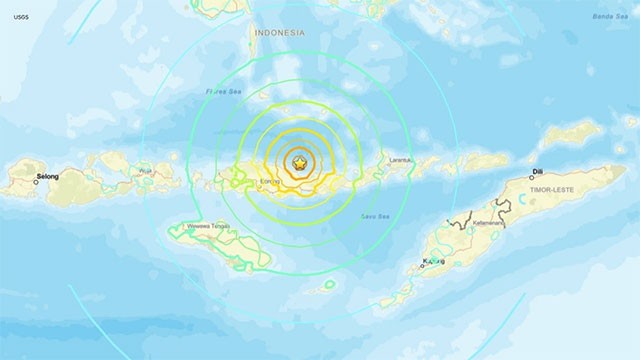
Update, August 17: A magnitude 5.9 earthquake struck the same Flores region early on Monday. Details below.
Update, August 16: The death toll has risen to at least 51 and Sri Lanka’s Foreign Minister has expressed solidarity with Indonesia. Details below.
Magnitude 5.9 quake strikes Flores again
A further earthquake of magnitude 5.9 hit the Flores region at 0046 GMT on Monday, 17 August, the GFZ German Research Centre for Geosciences said, in a report carried by Ada Derana.
The epicentre was initially determined to be at 8.57 degrees south latitude and 121.55 degrees east longitude, at a depth of 10 kilometres — close to the area already hit by the 7.7-magnitude quake and its aftershocks. No new casualty figures or tsunami advisories had been issued for the latest tremor at the time of reporting.
Toll rises to 51 as Sri Lanka offers condolences
At least 51 people have been confirmed dead, more than 100 injured and thousands displaced, Ada Derana reported on Sunday. Rescue operations were continuing amid landslides, blocked roads and disruption to communication networks.
The quake struck at a depth of around 10 kilometres and has been followed by more than 235 aftershocks. Around 5,000 people are now staying in temporary shelters, with relief teams working to deliver essential supplies and restore electricity and communications.
Rescuers are concentrating on the three worst-affected regencies, which Ada Derana identified as Manggarai, East Manggarai and Nagekeo, where access remains difficult. Earlier reporting by AP News had named Sikka among the worst-hit areas alongside the two Manggarai regencies.
Minister of Foreign Affairs, Foreign Employment and Tourism Vijitha Herath expressed condolences to the Indonesian government and people in a post on X. He extended sympathies to the families of those killed, wished a speedy recovery to the injured and voiced concern for those still missing and their families.
Herath commended the work of Indonesian authorities, rescue teams and humanitarian workers involved in the search and relief operations, and said Sri Lanka stands in solidarity with Indonesia during the difficult period.
The Department of Meteorology has issued a No Tsunami Threat Bulletin for Sri Lanka following a magnitude 7.7 earthquake that struck off eastern Indonesia in the early hours of Saturday.
Sri Lanka’s National Tsunami Early Warning Centre confirmed that the island’s coastal areas remain safe for normal day-to-day activities, NewsFirst reported. The department said the bulletin was issued in consultation with relevant national and international agencies.
The quake was recorded at about 3.28 a.m. Sri Lanka time (2158 GMT), Hiru News reported. The Met Department placed it in the Flores region of Indonesia at 8.51°S and 121.39°E, at a depth of 14 kilometres.
Death toll rises to 47
Indonesia’s National Disaster Mitigation Agency (BNPB) has sharply revised its casualty figures upward from initial reports of two deaths, raising the toll to 47 from 40 late on Saturday. Rescue official Fathur Rahman said 50 people were injured in the quake, Ada Derana reported, citing AFP.
Rescuers were still combing through debris for survivors on Saturday. Fathur said the focus was on locating victims who may be buried under rubble, but that landslides cutting off roads had complicated the effort. Many parts of Flores were left without electricity and telecommunications.
Nearly 160 houses were damaged along with dozens of educational and health facilities and other public buildings, the BNPB said. The government dispatched 50,000 aid packages weighing a total of 275 tonnes, and the International Federation of Red Cross and Red Crescent Societies said preparations were under way to reach some 2,000 people in temporary shelters.
European Commission President Ursula von der Leyen offered assistance from the bloc’s Copernicus Earth observation satellites. “Europe stands ready to deploy Copernicus, our eyes in the sky, to support search and rescue efforts. Indonesia, we stand with you,” she wrote on X.
“I have never felt an earthquake this big,” said Yulian Juita Ekalia, a 37-year-old university lecturer in Ruteng city, more than 100 km west of the epicentre, who was jolted awake at around 5.30 a.m. local time. “It felt like we were on a trampoline; it was really scary.”
“As I rushed to get outside, everything in the house fell down: The television, my son’s trophies, the dish racks, suitcases on top of the wardrobes,” she told AFP. “When I got outside, my son and neighbours were already there, screaming in fear.”
At an earlier stage of the response, when the toll stood at 38, agency chief Suharyanto told a news conference: “Thirty-eight people have been confirmed dead, two were seriously injured, 11 sustained minor injuries, and approximately 2,000 people have evacuated on their own,” Daily Mirror reported.
Most of the bodies were recovered in the three worst-hit regencies of Sikka, Manggarai and East Manggarai, AP News reported. Sixteen were pulled from a landslide in the village of Reok in Manggarai. Two people were known to be trapped alive under rubble in Manggarai regency, and rescue efforts have been complicated by landslides cutting off several roads.
Suharyanto said three helicopters and a rescue vessel were deployed to support the emergency response, given that East Nusa Tenggara consists of numerous islands and presents significant transport and access challenges.
Dozens of aftershocks have been felt, the strongest measuring magnitude 6.1. Residents have been warned not to return to damaged buildings for fear that further tremors may bring them down.
Buildings collapse across Flores
Estimates of the quake’s depth vary between monitoring agencies. The US Geological Survey put it at 10 kilometres, with an epicentre 68 km north-northwest of the city of Ende in East Nusa Tenggara province, while Indonesia’s Meteorology, Climatology and Geophysics Agency (BMKG) recorded a depth of 15 kilometres followed by several aftershocks.
The earliest reports, from the Maumere Search and Rescue Agency cited by Indonesia’s disaster management agency, put the toll at two dead and two injured. Buildings collapsed across Flores island, and hospitals in the Ende district moved patients, beds and oxygen cylinders outdoors as a precaution.
Students at St. Peter Major Seminary in Sikka fled during morning Mass when the roof of an assembly hall gave way. “Our students and nuns ran out in panic beneath a collapsing roof,” said the seminary’s rector, the Rev. Guidelbertus Tanga. “At least one priest suffered a broken leg after jumping from the second floor of a building during the quake.”
Warning lifted
Indonesian authorities initially issued a tsunami warning for parts of East Nusa Tenggara, West Nusa Tenggara, South Sulawesi and Southeast Sulawesi, urging coastal residents to move to higher ground. Waves of less than one metre were recorded in several areas, Ada Derana reported, citing Reuters. Indonesia’s BMKG geological agency later put the waves at up to 1.6 metres in some coastal regions of Flores.
Residents in Nagekeo, the area closest to the epicentre, raced for higher ground early on Saturday as the sea retreated — a possible sign of an approaching tsunami — AFP journalists witnessed. Rescue teams were slow to reach Nagekeo because landslides had blocked road access.
BMKG later lifted the warning after monitoring showed no significant sea-level changes. Australia’s tsunami warning centre said the quake posed no threat to the Australian mainland, its islands or territories.
Indonesia, an archipelago of more than 17,000 islands, sits on the Pacific “Ring of Fire” and is among the world’s most earthquake-prone nations. Flores was struck by a similarly powerful quake in December 1992, when the tremor and the tsunami it triggered killed more than 2,500 people, Al Jazeera reported.
A second strong earthquake, of magnitude 6.8, struck northern Sumatra later on Saturday. The Met Department issued a separate bulletin confirming no tsunami threat to Sri Lanka from that quake either.
Sources
- No Tsunami threat to Sri Lanka following 7.7-magnitude Indian Ocean earthquake — Ada Derana, August 15
- No tsunami threat to Sri Lanka following 7.7-magnitude Indonesia Earthquake — NewsFirst, August 15
- No tsunami risk to Sri Lanka from Indonesia earthquake — Hiru News, August 15
- Magnitude 7.7 quake strikes off coast of Indonesia and tsunami warning issued — AP News, August 14
- Indonesia quake death toll rises to 38 — Daily Mirror, August 15
- Sri Lanka expresses solidarity with Indonesia after deadly Flores earthquake — Ada Derana, August 16
- Rescuers search for survivors as Indonesian quake death toll rises to 47 — Ada Derana, August 15
- 5.9-magnitude quake hits Flores Region, Indonesia – GFZ — Ada Derana, August 17