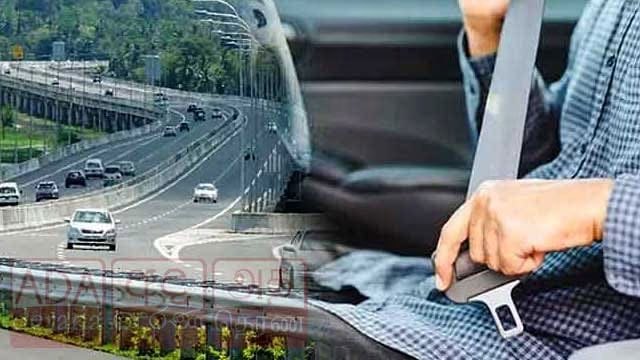
Wearing a seatbelt will be mandatory for every driver and passenger travelling on Sri Lanka’s expressways from September 19, with police warning that the requirement will be strictly enforced from that date.
Senior Superintendent of Police Manoj Ranagala, who heads traffic management and road safety, announced the measure at a media briefing held to raise public awareness. Anyone found travelling without a seatbelt may be fined Rs. 1,000, and the rule applies to all passengers — including those travelling in expressway buses, for which separate legal provision exists to fine non-compliant passengers.
“Hereafter, when entering an expressway, the police will strictly monitor whether the driver and passengers are wearing seat belts properly. Vehicles will not be allowed to enter expressways without the required seat belts being worn,” SSP Ranagala said.
September 19 also marks the end of the one-year grace period granted to owners of vehicles that were not fitted with seatbelts at the factory to have them installed. Manjula Kularatne, who chairs the National Council for Road Safety, confirmed that the installation deadline expires on the same date.
NewsFirst reported that the council announced the requirement will apply to all vehicles operating on expressways, making seatbelt use mandatory for every occupant.
The requirement stems from Extraordinary Gazette No. 2455/29, issued on September 25, 2025, which provides for mandatory seatbelt use by all passengers in vehicles travelling on expressways. Daily Mirror reported that the measure also draws on legal provisions introduced through Gazette Notification No. 1718/12 of August 9, 2011.
SSP Ranagala said the step was introduced to save lives, citing a significant increase in injuries and deaths in road accidents where passengers were not wearing seatbelts. Authorities have urged motorists to ensure seatbelts are properly worn before entering an expressway.
Update (September 14): five days out, the NTC says it will go ahead this time
With the date five days away, the National Transport Commission has confirmed enforcement will begin on September 19 and has run an awareness programme near the Peliyagoda expressway entrance, the Daily Mirror reported on Monday.
NTC Chairman P.K. Chandrapala acknowledged directly that the programme “had been postponed for various reasons,” and said it would now be implemented without further delay.
“Our main objective is to provide a safe and comfortable journey for passengers who use public transportation,” he said, appealing for public cooperation.
The postponements are worth stating plainly. The Daily Mirror’s own related-article links carry three earlier filings on the same measure — “Seat belt law comes into force across Sri Lanka from today,” “Seat belt law to be strictly enforced on expressways from September 19” and “Seat belt rule to be strictly enforced on Expressways from September 19.” The September 19 date has been announced more than once, and the chairman’s phrasing concedes the slippage. Readers have reason to treat this as the third or fourth announcement of the same rule rather than a new one.
What is new: buses carry the obligation too
The clearest addition is the treatment of public passenger buses operating on expressways.
Bus operators are required to install the necessary seat-belt facilities, and passengers in equipped seats must wear them. The NTC warned that legal action, including fines where applicable, could follow against:
- bus operators who fail to provide the required facilities
- drivers or passengers who fail to comply
That places the compliance burden on operators before the journey starts, not only on passengers during it — a shift from the August announcement, which set out the passenger obligation without spelling out the operators’ installation duty or the penalty attached to it.
The programme is being run with the Ministry of Transport, Highways and Urban Development and the Traffic Police. NTC Director General Nilan Miranda and Director of Situation Control Sherin Athukorala attended the Peliyagoda event. The NTC said awareness programmes for highway bus operators and passengers will continue both before and after enforcement begins.
Update (September 18): the minister puts it at midnight
On the eve of the deadline, Transport Minister Bimal Rathnayake said seat belts will be compulsory for all passengers travelling in vehicles on Sri Lanka’s expressways effective from midnight tonight, the Daily Mirror reported on Friday afternoon.
Two things are new in a single sentence.
The commencement is now a time, not a date. Every previous announcement gave September 19 without saying when on that day enforcement starts. “From midnight” places it at the very start of the 19th, meaning the first expressway journeys subject to the rule are overnight ones.
The confirmation now comes from the minister himself. The August announcement came from a police SSP and the National Council for Road Safety; the September 14 restatement came from the NTC chairman. Given that the chairman conceded the programme “had been postponed for various reasons,” a direct commitment from the minister responsible is the strongest signal so far that the date will hold — and the one hardest to walk back.
Ada Derana also carried the announcement on Friday.
Update (September 19): the rule is in force
The requirement took effect on Saturday. Wearing a seat belt is now mandatory for every passenger travelling in a vehicle on Sri Lanka’s expressways, NewsFirst reported at 7.34 a.m.
Transport Minister Bimal Rathnayake said the regulation will now be strictly enforced, with legal action to be taken against both drivers and passengers who fail to comply — the first statement to put drivers and passengers on the same footing for enforcement, rather than describing the passenger obligation alone.
The grace period ended a day earlier than August’s account implied
The minister said the grace period for vehicles manufactured without seat belts to have them installed ended on Friday, 18 September.
August’s announcement, which cited National Council for Road Safety chairman Manjula Kularatne, placed that installation deadline on September 19 — the same date as enforcement.
The two accounts reconcile rather than conflict. A grace period running through the end of 18 September and enforcement beginning at midnight — as the minister said on Friday — describe the same boundary from either side: the last day to fit a belt was Friday, and the first hour of liability was the start of Saturday. Owners had no overlap day in which the rule applied but the deadline had not yet passed.
After repeated postponements, this is the first report describing the requirement in the present tense rather than as something forthcoming.
Still unresolved
NewsFirst does not report any enforcement activity, fines issued, or compliance levels on the first morning, and does not repeat the Rs. 1,000 figure announced in August. It makes no mention of the obligations placed on bus operators in the September 14 NTC announcement — neither the installation duty nor the penalty attached to it — so it remains unclear whether operators faced the same Friday deadline as private vehicle owners.
The Daily Mirror does not say what fine a non-compliant bus operator faces, as distinct from the Rs. 1,000 announced in August for an individual without a seatbelt. It does not say how many expressway buses currently lack seatbelts, whether any grace period applies to operators still fitting them, or what happens to a passenger in a bus seat that has no belt installed. It does not say who checks operators’ compliance, or explain why the measure was postponed. No other verified newsroom had filed on Monday’s announcement at the time of writing.