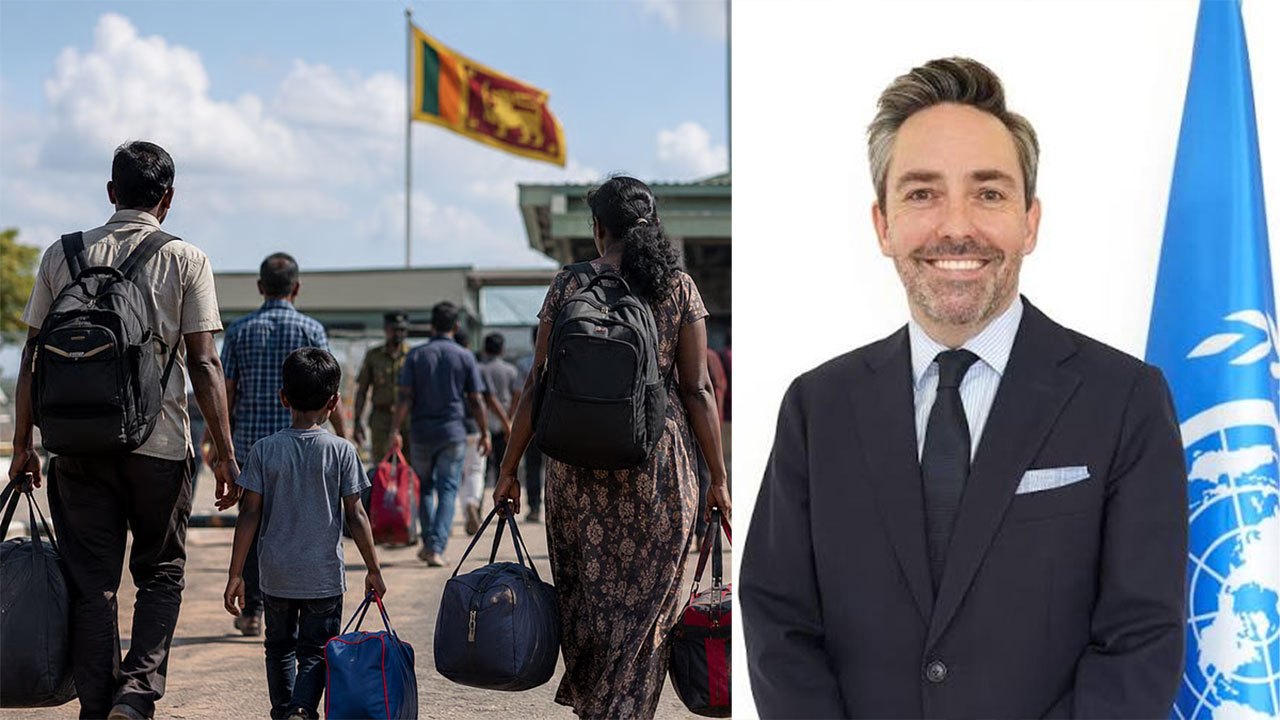
The United Nations has welcomed Sri Lanka’s decision to simplify immigration procedures for Sri Lankans registered as refugees in India, a move intended to speed up their voluntary return home.
The endorsement came on Saturday, eleven days after Cabinet approved the arrangements. It applies to people who left the island without valid travel documents during the decades-long civil war.
Marc-André Franche, the Resident Coordinator and representative of the UN Secretary-General in Sri Lanka, said the organisation would continue to facilitate the return and resettlement of those refugees through the United Nations High Commissioner for Refugees.
“I welcome the Cabinet’s decision on procedures for the voluntary return of Sri Lankan refugees — a key step towards a safe and dignified return after years of displacement,” he said in a post on X.
The remarks were carried by both The Hindu and Ada Derana, each running the same PTI dispatch from Colombo. No Sri Lankan newsroom had published independent reporting of the UN statement as of late Saturday.
What the government approved
The Cabinet decision, taken earlier this month, cleared a path for Sri Lankans in Indian refugee camps to come home without prosecution for having left the country irregularly.
Returnees must first have their citizenship verified through Sri Lankan diplomatic missions in India and obtain a clearance report from the State Intelligence Service. Those who pass both checks are issued temporary passports and admitted through an authorised port of entry without action under the Immigrants and Emigrants Act No. 20 of 1948, the law that makes irregular departure an offence.
Separate but comparable arrangements cover two groups: those who left before August 1, 2006, and those who left between that date and May 19, 2009, when the war ended.
The clearance is not unconditional. Anyone found to have committed or been involved in murder, treason or other specified offences is to be detained at the port of entry and handed to the authorities.
A long-running repatriation effort
Sri Lankans began arriving in Tamil Nadu in large numbers after the ethnic violence of 1983 and the escalation of the armed conflict between government forces and the Liberation Tigers of Tamil Eelam, which ran for close to three decades. Most were Tamils from the north and east who crossed the Palk Strait, and many have remained in Indian government camps for years.
Around 18,000 returned home between 2002 and 2022 under arrangements facilitated by UNHCR. Approximately 90,000 refugees still live in the southern Indian state. For those who remain, livelihoods, documentation and long-term legal status are among the unresolved questions surrounding any return.
Franche did not set out a timetable, and neither the government nor the UN has said how many people are expected to return under the streamlined process.