Nepal Police put the confirmed death toll from the flash flood that tore through the country’s northern valleys on Wednesday at 547 by Friday evening, after it climbed through Thursday from 270 to 332 and on to 389, and through Friday from 469 to 489. A further 1,473 people were injured. United States government scientists have withdrawn their initial finding that an earthquake caused the disaster.
The US Geological Survey had first recorded the event as a magnitude 4.4 earthquake. On Thursday morning it said that “additional analysis of nearby seismic stations, long period seismic waves, and satellite imagery led to the determination that the seismic event was instead a glacial collapse and debris flow, and that no earthquake had occurred”. The agency said the collapse “caused subsequent catastrophic impacts downstream”.
The correction contradicts the explanation given by Nepal’s own foreign minister, who said earlier that the landslide had been triggered by an earthquake. Nepali authorities had separately told the BBC that a large mass of ice may have broken away from a mountain, dragging rock and sediment with it. Scientists are still reconstructing the sequence of events.
More than 1,380 missing
The missing are counted on both sides of the border. In Nepal the figure rose to 826, including 517 foreign nationals, while Chinese state broadcaster CCTV put the number in Tibet’s Gyirong county at 558, including 260 foreigners. Together that is at least 1,384 people unaccounted for. Reuters reported the combined total as “nearly 1,500 people including almost 800 foreigners”; the component figures published by each side sum to the lower number.
China has confirmed three deaths on its side of the border.
Nepal’s Tourism Board said 644 people were out of contact, comprising the 517 foreigners — drawn from 32 countries — and 127 Nepalese. Indians account for the largest group at 178, followed by 65 Americans, 53 Ukrainians, 51 Malaysians, 35 Australians, 33 Britons and 25 Canadians. The board said no Sri Lankan nationals appear on the list, confirming Colombo’s earlier assessment that no Sri Lankans were known to be affected.
”Entire villages swept away”
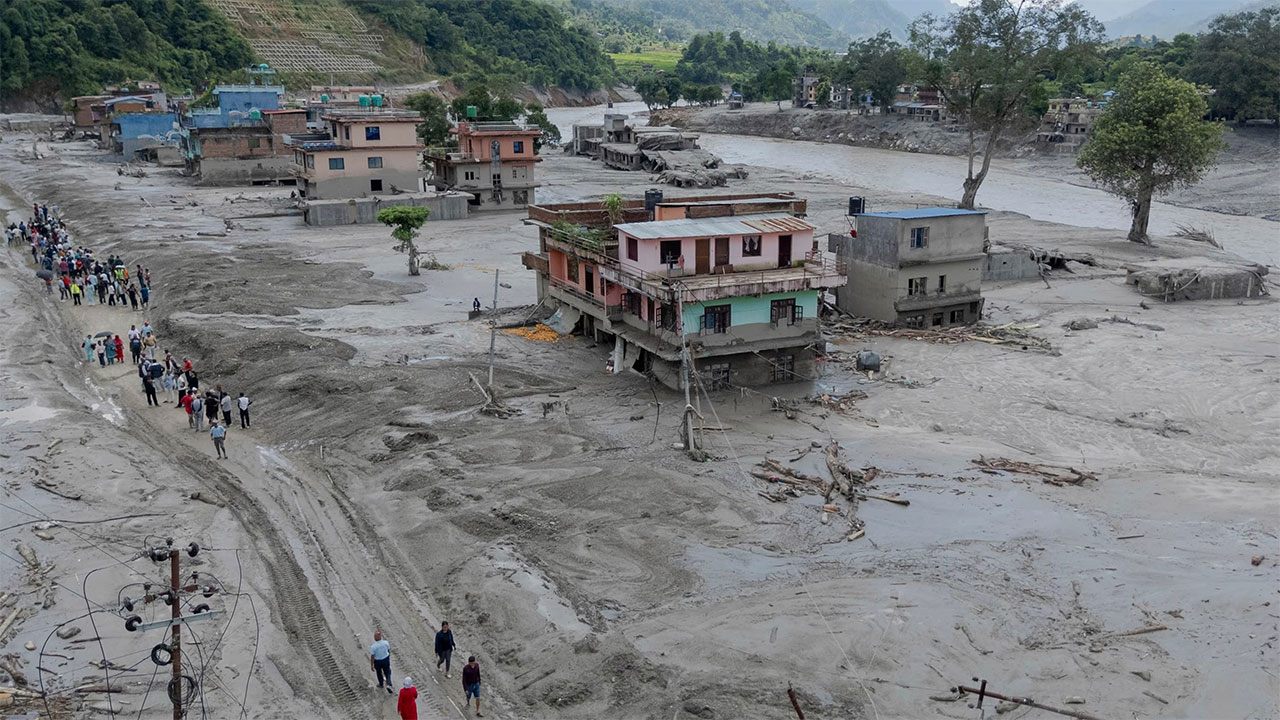
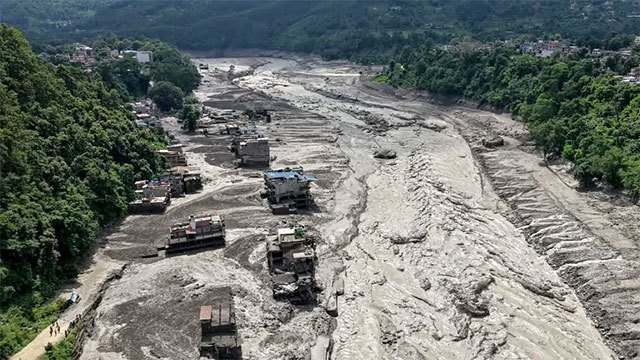
The flood struck the Bhotekoshi river in Rasuwa and Nuwakot districts, a corridor heavily used by trekkers heading for Langtang and Gosain Kunda and by pilgrims travelling the Kailash Mansarovar route into Tibet.
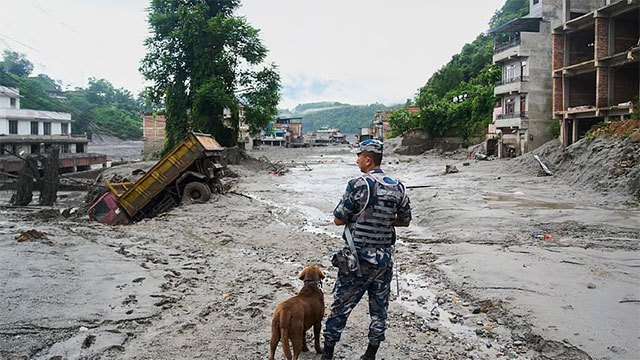
David Fisher, who heads the International Federation of Red Cross and Red Crescent Societies delegation in Nepal, said there was “still an extreme situation” in the affected regions. Parts of northern Nepal “are only accessible via helicopter because the flood has knocked out bridges and roads”, he said, adding that entire villages and marketplaces had been “swept away” and that many people had slept “in the elements”. He said he feared the death toll “could continue to go up”.
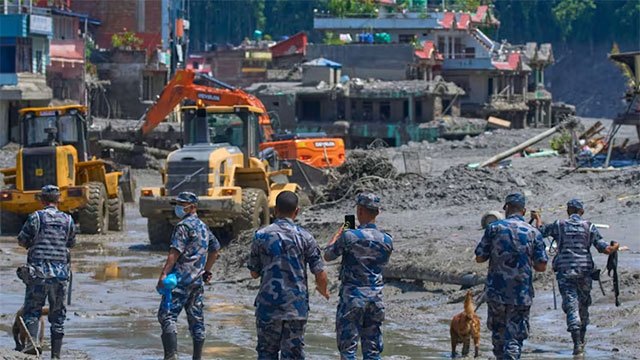
More than 5,000 army and police personnel are deployed. Nepal’s army said 125 people, including 20 foreigners, were retrieved on Thursday, and helicopters are dropping tents and food supplied by India. Prime Minister Balendra Shah travelled by road to Bidur in Nuwakot to assess the damage.
Sri Lanka has offered rescue and clearance assistance to Kathmandu, and later on Thursday committed USD 1 million to the relief effort.
The World Wildlife Fund estimates Nepal’s glaciers are retreating by up to 15 metres a year, destabilising slopes and creating unstable bodies of meltwater.
Update: toll reaches 332
Nepal police issued two further updates through Thursday afternoon, putting the toll at 289 as of 14:30 local time and then at 332 as of 15:50 local time, Ada Derana reported. Hiru News carried the same two timestamps and figures.
The count has now more than tripled since the 95 deaths reported late on Wednesday, and Fisher’s warning that it “could continue to go up” has held for every update issued since.
The Nepal Army said it had rescued more than 350 people over the course of Thursday, revising up the 125 reported earlier in the day. Its spokesperson said 50 of those rescued were foreign nationals: 30 Indians, eight Chinese, eight Koreans, two Americans and two Italians.
Update: August 28 — toll reaches 469
Nepalese police put the confirmed toll at 469 early on Friday, up from the 389 given in the previous update. Police said 1,545 people have been injured and rescued by authorities, and that 84 injured people are either receiving treatment or have been discharged across hospitals in the Kathmandu Valley. The toll in Tibet remains at three.
Almost 1,000 people are still missing across Nepal and Tibet, of whom at least 540 are foreigners, Reuters reported via the Daily Mirror. Rescue teams worked with heavy machinery through mud and debris as hopes of finding survivors faded.
Update: August 28 — police put the toll at 547 as two agencies diverge
Nepal Police put the confirmed death toll at 547 later on Friday, with a further 1,473 people injured. The force said 4,473 police personnel are deployed on the disaster. The count moved twice during the day, from the 469 reported early on Friday to 489 and then to 547.
For the first time the two Nepali bodies issuing updates are publishing different numbers. The National Disaster Risk Reduction and Management Authority said 538 bodies have been recovered — nine fewer than the police figure — and put the missing at 977, including 517 foreign nationals. Ada Derana noted that both organisations have been issuing separate updates as the operation develops, which is the likeliest explanation for the gap: recovered bodies and confirmed deaths are counted at different points in the process.
The toll on the Chinese side has also risen. Chinese state media now confirm five deaths in Tibet, up from the three reported on Thursday, taking the combined total to at least 552, the Daily Mirror reported carrying RTÉ copy. The Daily Mirror’s headline still read “nearly 500 killed” against the 547 figure in its own text.
The missing figures do not reconcile
Counts of the missing depend on which side of the border is being measured. Nepal’s own disaster authority gives 977 unaccounted for, of whom 517 are foreign nationals. Wire copy covering both countries puts the combined total above 1,400 with at least 540 foreigners, while Chinese state broadcaster CCTV separately gave 558 missing in Gyirong county including 260 foreigners. Adding Nepal’s 977 to Tibet’s 558 produces 1,535, but the two foreign-national components sum to 777 rather than 540. No outlet has reconciled the difference.
Two of the missing foreigners have been named by Nepal’s tourism department as Irish citizens Santosh Sahu, 46, and Spandan Sahu, 18. Ireland’s Department of Foreign Affairs said it was working with partners “to account for two Irish citizens visiting the area”.
A tunnel rescue and a district morgue
The Nepali army is trying to reach about 100 people trapped in a tunnel at the Trishuli 3A hydropower project. “Two helicopters have been dispatched but it is challenging because it is tough to even locate the entry points of the tunnel,” an army spokesperson told AFP. Some 350 workers and residents have already been brought out of the same area.
Ganesh Aryal, the administrator of Chitwan district — about 100km downstream in the plains from the worst-hit Trishuli corridor — said 103 bodies had been recovered from the river system there. With local hospitals unable to hold them all, the district is setting up tents so families can identify and claim their dead.
Nepal has now declined foreign help with the search itself. “The offer for help is natural. Our security agencies are doing the search and rescue operation. For now we don’t require such help,” foreign ministry spokesperson Lok Bahadur Chhetri said. A South Korean rapid response team is already in Kathmandu but has not been deployed. The Kathmandu Post reported that India, China, the United States, Britain, Japan, South Korea, Sri Lanka and Bangladesh had all asked to send search-and-rescue teams.
A second flood risk is now the priority
The volume of water and debris the collapse stirred up has created a fresh hazard. Nepal’s disaster management authority warned that a lake formed by debris blocking the Bhotekoshi River was rising and at risk of bursting.
On the Chinese side, about 3 million cubic metres of water — roughly 1,200 Olympic-sized swimming pools — was expected to flow into an already dammed lake over three days, with Chinese state media citing the water resources ministry as putting peak flow at around September 1 and describing a high risk of a breach.
China has mobilised an eight-member engineering team to carry out aerial surveys and 3D modelling of the barrier lake, though access is difficult. “After the glacier collapse created the lake, many isolated cliffs and steep cliffs appeared along it,” engineer Chen Hanxiao told CCTV. The standard remedy is to excavate a drainage channel at a low point of the dam, but its width and depth depend on calculations of flow rate and fill speed still being worked out.
Chinese rescuers had not reached the worst-hit area on their side, the Gyirong border crossing, by Thursday evening, as crews cleared debris from the access road. Premier Li Qiang travelled to Gyirong on Thursday afternoon, a signal that Beijing is treating the disaster as a national priority.
Dibga Tamang, among the last people rescued from the hard-hit town of Rasuwa and airlifted to an army camp in Nuwakot, told Reuters: “All of our people have gone. They are dead. I have no one left waiting for me. Everything and everyone is gone. The end.”
Sources
- Nepal floods: USGS says ‘glacial collapse’ caused ‘catastrophic’ impacts — Ada Derana, August 27
- Nepal flood death toll rises to 270 as more bodies recovered — Ada Derana, August 27
- Nepal flood death toll rises to 332, Nepal police says — Ada Derana, August 27
- Nepal floods death toll climbs to 332 — Hiru News, August 27
- Death toll in Nepal flood reaches 469, police say — Ada Derana, August 28
- Nepal flash flood death toll rises to 469 — Daily Mirror / Reuters, August 28
- Nepal flood death toll rises to 469 — Hiru News, August 28
- Nepal Police say 547 people confirmed dead — Ada Derana, August 28
- Nearly 500 killed, over 1,400 still missing due to Nepal floods — Daily Mirror / RTÉ, August 28
- Over 350 people rescued so far today — Nepal Army — Ada Derana, August 27
- 644 tourists still out of contact after deadly floods, says Nepal Tourism Board — Ada Derana, August 27
- No Sri Lankans among foreigners reported missing so far in Nepal flash floods — Ada Derana, August 27
- Nepal in ‘an extreme situation’ and ‘much more support is needed’ — Ada Derana, August 27
- Nearly 1,500 missing in Nepal and China after devastating Himalayan flash flood — Daily Mirror / Reuters, August 27
- Live updates: More than 1,300 missing after deadly floodwaters wipe out villages on Nepal-China border — CNN, August 26