Global oil prices rose more than a dollar a barrel on Monday after United States forces struck an Iranian island in the Strait of Hormuz and Iran retaliated against American bases in Jordan, pushing the six-month Middle East war into a fresh escalation.
Brent crude futures climbed $1.08, or 1.23%, to $89.18 a barrel as at 0040 GMT, while US West Texas Intermediate was at $84.32, up 92 cents or 1.10%. The gain widened as the session went on: by 1120 GMT Brent was up $2.87, or 3.26%, at $90.97, with WTI up $2.91, or 3.49%, at $86.31.
Latest (Monday afternoon): the rally more than doubled through the day. Jump to the intraday movement.
The strike and the response
A US official said American forces hit two Iranian launchers on Larak Island on Sunday — the first known US strikes on Iran since late July. “Islamic Revolutionary Guard Corps forces were observed preparing to launch rockets with sea mines into Strait of Hormuz,” the official said. Iran’s semi-official Tasnim news agency reported the attack was carried out by drone.
The Revolutionary Guards said the strike killed and wounded several soldiers and civilians and would draw “response and punishment” from Tehran. Iran then fired on US forces in Jordan. A US official told Al Jazeera that American forces intercepted the retaliation, describing the weapons as medium-range ballistic missiles and saying the attack “proves that Iran is no longer the power it once was.” A separate US source cited by Fox News said nearly all incoming missiles had been intercepted with no significant impact.
President Donald Trump said last week that all mines had been detonated or removed from international waters in the Strait of Hormuz, and that Iran had been told any vessel laying new mines would be destroyed. Sunday’s strike, aimed at minelaying capability, follows directly from that warning.
Why the market moved only modestly
Roughly a fifth of the world’s oil passed through the Strait of Hormuz before the war began at the end of February, and talks to reopen it remain deadlocked. Yet crude is still on course for a small monthly decline in August after falling more than 4% last week — its first weekly drop in three — because flows through the strait have been recovering, keeping supply fears contained, ANZ analysts said.
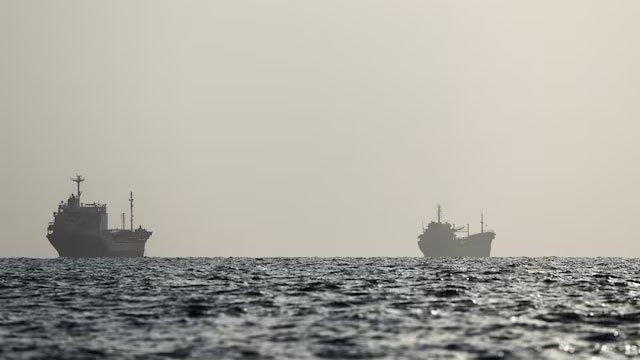
Shipping remains wary. The number of visible commodity vessels transiting Hormuz fell to five a day over the weekend, and the United Kingdom Maritime Trade Operations reported that a tanker was struck by a projectile while sailing inbound on Saturday.
“Looks like we are in another escalation phase. How long that lasts is impossible to determine. Could be days, could be weeks,” IG market analyst Tony Sycamore said. He put the next technical hurdle for WTI at $85.80 to $85.90 a barrel, above which last week’s $87.69 high and July’s $93.50 high would come into view.
How the rally built through Monday
Three separate wire snapshots through Monday show the move steepening rather than fading, and together they give an intraday series no single report set out.
| Time (GMT) | Brent | Change | WTI |
|---|---|---|---|
| 0040 | $89.18 | +$1.08 (1.23%) | $84.32 |
| 0733 | $89.87 | +$1.77 (2.00%) | $84.85 |
| 1120 | $90.97 | +$2.87 (3.26%) | $86.31 |
The midday figures come from the Daily Mirror, which carried the 0733 GMT snapshot, and Ada Derana’s later filing at 1120 GMT. All three are Reuters copy.
Part of the size of Monday’s move was mechanical. The reaction was amplified by thin trading volumes because of a United Kingdom public holiday, Saxo Bank analyst Ole Hansen said. “Renewed military strikes in the Middle East and concerns of further oil supply disruptions have lifted oil prices,” UBS analyst Giovanni Staunovo said, adding that markets would now focus on whether the situation de-escalates.
Not every analyst read it as the start of a sustained run. “We see more chances of contained confrontation rather than any sustained escalation in the conflict. What continues to be impacted with every flare up are the timelines for Hormuz ‘reopening’,” said Suvro Sarkar, head of energy research at DBS, who added that hopes of returning to US-Iran negotiations by the end of the third quarter now looked unlikely.
Even after the rally, both benchmarks remained on track for a modest loss over August as a whole.
Trump’s Kharg Island claim
Trump said in a social media post on Sunday that Iran’s energy hub of Kharg Island was being “blown to smithereens”. There was no evidence the island was under attack. The post included an AI-generated video clip and gave no further details. Iran denied any attack on Kharg and said oil operations there were continuing.
Kharg handles the bulk of Iran’s crude exports, and an actual strike on it would be a far larger supply event than the Larak Island attack. No outlet reported any corroboration of the claim.
US Treasury Secretary Scott Bessent separately told Reuters on Sunday that the United States was likely to impose new secondary sanctions on Iran every week. Trump also said oil secured under a deal with Venezuela would be used to replenish the US Strategic Petroleum Reserve, which has fallen to near its lowest level in 44 years.
The Sri Lankan angle
The war has already reached Sri Lankan waters. Iranian fuel tankers have been anchored off Galle since the blockade tightened, and the government said last week it was monitoring vessels sitting just outside the exclusive economic zone.
Sources
- Oil jumps more than 1% after US attack on Iran’s Larak island — Ada Derana, August 31
- US forces strike two Iranian launchers on Iran’s Larak island, US official says — Ada Derana, August 31
- US strikes Iranian missile launches near Hormuz — Hiru News, August 31
- Oil rises as US, Iran resume military attacks — Daily Mirror, August 31
- Oil rises over 3% as US and Iran resume military attacks — Ada Derana, August 31