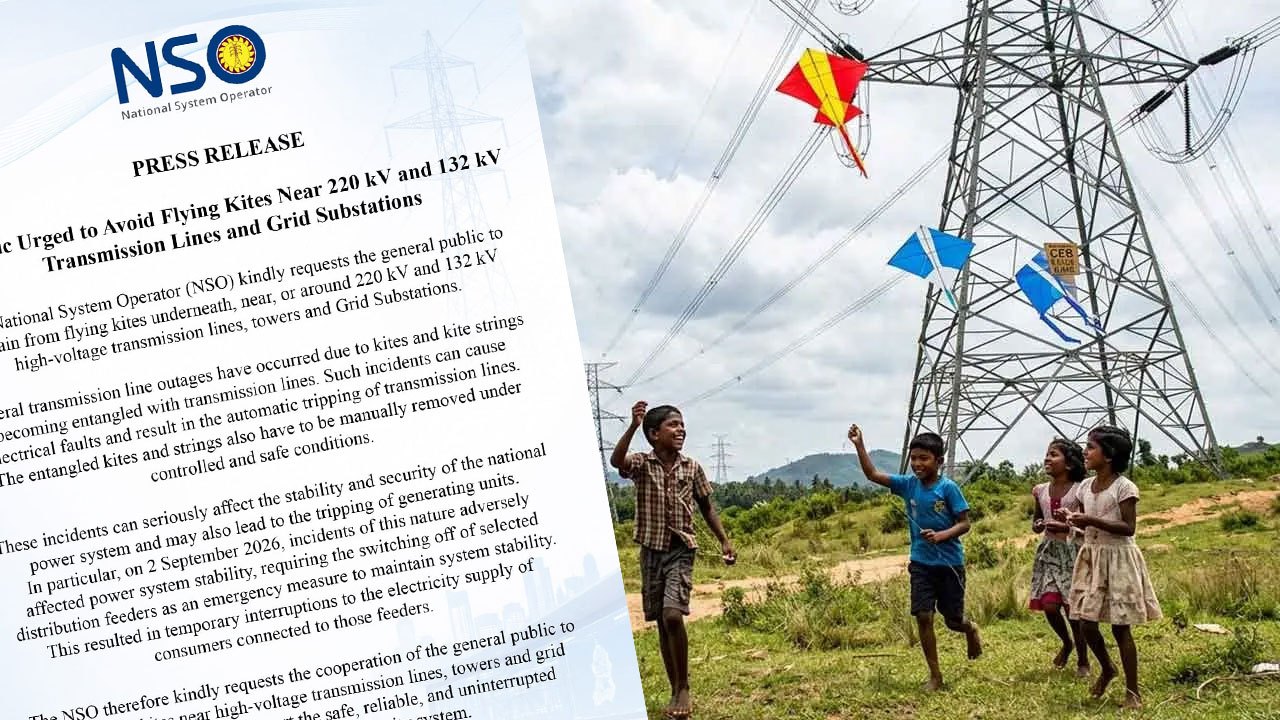
The National System Operator has urged the public to stop flying kites underneath, near or around 220 kV and 132 kV high-voltage transmission lines, towers and grid substations, after kite strings disrupted the national grid badly enough this week to force emergency shutdowns.
In a statement reported by Ada Derana and the Daily Mirror, the NSO said several transmission line outages have occurred after kites and kite strings became entangled with transmission lines.
What happened on Wednesday
On 2 September 2026, incidents of this kind adversely affected power system stability, the NSO said. To maintain stability, selected distribution feeders had to be switched off as an emergency measure — cutting electricity temporarily to consumers connected to those feeders.
Neither report says which feeders were switched off, which areas lost supply, how many consumers were affected, or how long the interruptions lasted.
Why a kite can trip a transmission line
Entanglement can cause electrical faults and trigger the automatic tripping of transmission lines — the protective disconnection that isolates a fault before it damages equipment. The entangled kites and strings then have to be removed manually, under controlled and safe conditions, which keeps the line out of service until crews can reach it.
The NSO warned that such incidents can seriously affect the stability and security of the national power system, and may also cause generating units to trip — the failure cascading back from the transmission network to the plants feeding it.
The operator asked the public to cooperate in ensuring the safe, reliable and uninterrupted operation of the national electricity system.
A separate strain on the system this week
The warning lands in a week when the grid was already under scrutiny for a different reason. The Energy Minister said on Thursday that no power cuts would be needed despite a coal shortage that has limited generation at Norochcholai, with hydropower covering the gap and shipments due on 4 and 12 September.
Those are distinct problems. The coal shortage is a question of generation capacity; Wednesday’s interruptions were a transmission-stability event caused by physical interference with live lines. Neither report links the two, and the NSO statement does not mention coal.
Kite flying is seasonal in Sri Lanka and concentrated in open ground, which in built-up and semi-rural areas often means the cleared corridors beneath transmission lines — the reason the warning names towers and substations specifically rather than kite flying in general.
Update, September 4: a third outlet, without the Wednesday detail
NewsFirst carried the NSO statement a day later, reporting the same appeal to stay clear of 220 kV and 132 kV lines, towers and grid substations, and the same explanation of how an entangled string trips a circuit and forces a manual, safety-regulated removal.
Its account is thinner in one respect that matters. Where Ada Derana and the Daily Mirror tied the warning to a specific event — the incidents of 2 September that destabilised the system and forced selected distribution feeders to be switched off, cutting supply to consumers — NewsFirst refers only to “numerous incidents” reported over time and does not mention Wednesday, the feeder shutdowns or the loss of supply.
NewsFirst does carry the operator’s warning that such incidents “may even result in the shutdown of electricity generation units,” matching the other two reports. No outlet has added which feeders were switched off or how many consumers lost supply.
Sources
- Avoid flying kites near high-voltage transmission lines, towers and grid substations: NSO — Ada Derana, September 3
- Public urged to avoid flying kites near high-voltage lines — Daily Mirror, September 3
- Kite Flying Near Transmission Lines Threatens National Electricity Supply, Warns NSO — NewsFirst, September 4