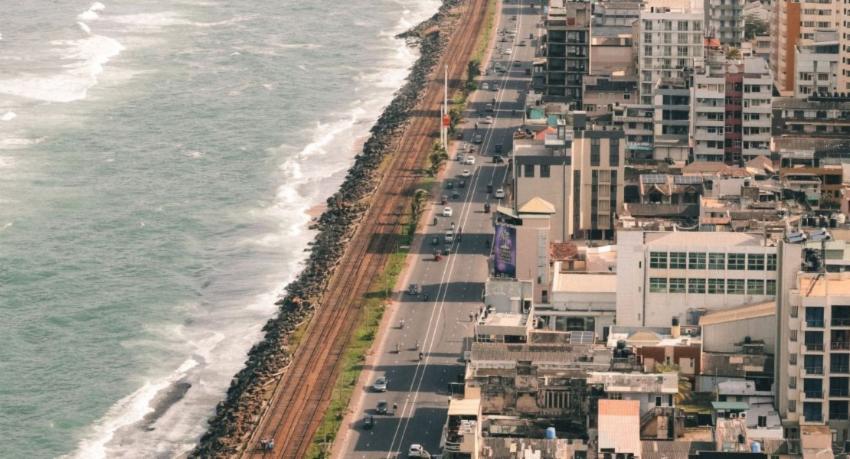
The removal of unauthorised structures along the Colombo District coastal belt will begin this month, Environment Minister Dr. Dammika Patabendi said on Friday.
The operation covers the stretch from Galle Face to the Bolgoda River, which has been divided into five zones, NewsFirst reported. Legal advice on the removal process has already been obtained from the Attorney General.
The minister said plans are under way to clear all illegal structures along the coastline and redevelop the area as a tourist destination.
A separate order appears to set the first deadline. Hiru News reported — citing a newspaper report rather than its own reporting — that Coast Conservation authorities have instructed the removal of unauthorised hotels, business establishments and other structures along the coastal stretch from Bambalapitiya to Dehiwala before September 10. That stretch falls inside the Galle Face–Bolgoda corridor the minister described.
According to that report, the instruction forms part of wider action on construction and businesses operating inside the coastal zone without permission, and authorities are preparing to take legal and administrative action against any establishment that does not clear its structures within the period given.
Construction inside Sri Lanka’s coastal reservation requires a permit from the Department of Coast Conservation and Coastal Resource Management. Enforcement has historically been uneven, and hotels, restaurants and cafés built inside the reservation have been demolished elsewhere on the coast in recent months.
Update (September 13): 83 structures in Zone 2 — and the September 10 deadline passed with nothing demolished
Eight days on, the Sunday Times reported from the coast in a dispatch by Nidarshani Wickramasinghe that answers several of the questions below — and undercuts the timetable.
The zones, and a number. The coastal area has been divided into five zones extending up to the Beira Lake area. Under Zone 2, covering Wellawatte to Mount Lavinia, some 83 structures have been identified for removal. Patabendi said the work would be carried out in stages, with dates allocated according to how many officers the Coastal Protection and Restoration Authority can field — the first time the executing agency and the pace-limiting factor have been named.
The legal thresholds. “No construction can be carried out within the 10-metre coastal reservation measured inland from the sea,” the minister said. The area extending 25 metres from the limit reached by the waves, or the limit prescribed for the relevant zone, is public ground on which people may gather, bathe and move freely. “Therefore, no hotel has the right to fence off such areas, claim them as private property or restrict them exclusively to tourists. We are acting in accordance with the Coast Conservation Act. We will not act outside the law.”
No court order needed — but an appeal route exists. Deputy Environment Minister Anton Jayakody said the Coast Conservation and Coastal Resource Management Act No. 57 of 1981 empowers the department to remove unauthorised buildings without first obtaining a court order. Patabendi said owners who believe they have been treated unjustly may appeal to the department or go to court, and that the authorities would be bound by any order the courts issue.
The deadline slipped. Despite the instruction that structures between Bambalapitiya and Dehiwala be removed by 10 September, the Sunday Times found on a visit that none had been demolished as of Friday 11 September. Most owners said they had received no demolition notice. Some restaurants were already abandoned, having been damaged by erosion months or more than a year ago. The Court of Appeal had separately halted the demolition of a Wellawatte restaurant on 9 September.
Owners are split. One restaurateur, speaking anonymously, said he had already removed beach huts belonging to his premises and supported the clearance, alleging that “numerous drug promotions” are run in the area under the guise of beach parties and that drugs are sold inside establishments operating as restaurants; he argued the state should take the land over and put it to revenue use. A Marine Drive operator refused outright: owners had agreed not to speak individually, he said, no written notice had been received, “and we are not leaving, and no one can force us to leave.”
Not reported
The Sunday Times does not say how many of the 83 Zone 2 structures are businesses as opposed to dwellings, when Zone 2 demolitions begin, or what the other four zones cover and how many structures they contain. It does not explain why no notices had been served ahead of a stated deadline, or whether the deadline has been formally extended.
Neither the number of Coastal Protection and Restoration Authority officers available nor any completion date is given, and no compensation or relocation route is mentioned for occupants of structures that are removed. The minister’s allegation-adjacent claim about drug sales comes from an anonymous business owner and is not corroborated by police or by the ministry.
The three accounts also leave the agency picture unsettled: the minister now attributes the removals to the Coastal Protection and Restoration Authority, while the earlier reports and the governing Act refer to the Department of Coast Conservation and Coastal Resource Management. No outlet reconciles the two names.
Separately, the same minister ordered work suspended on a gabion sea barrier at Pamunugama in Wattala on 13 September after officials found it built beyond its approved boundary — a different action on a different stretch of coast, under the same enforcement drive.
Earlier: what the first two reports left open
Neither of the September 5 reports said how many structures are affected, how many are businesses, or what the five zones are. Neither reported whether owners have been served individual notices, what appeal or compensation route exists, or whether any structure holds a permit that is disputed rather than absent.
NewsFirst gave no start date beyond “this month” and did not say which zone goes first, whether the September 10 Bambalapitiya–Dehiwala deadline is the first of five, or which agency carries out the demolition. Neither outlet named the Attorney General’s advice or said what question it answered.
Hiru News attributes its account to an unnamed newspaper rather than to Coast Conservation directly, and does not date the order. No outlet has linked the enforcement drive to the redevelopment plan the minister described, or said who would develop the cleared land.
NewsFirst spells the minister’s name Dhammika Patabendi; this site uses Dammika, the form that predominates in prior coverage.