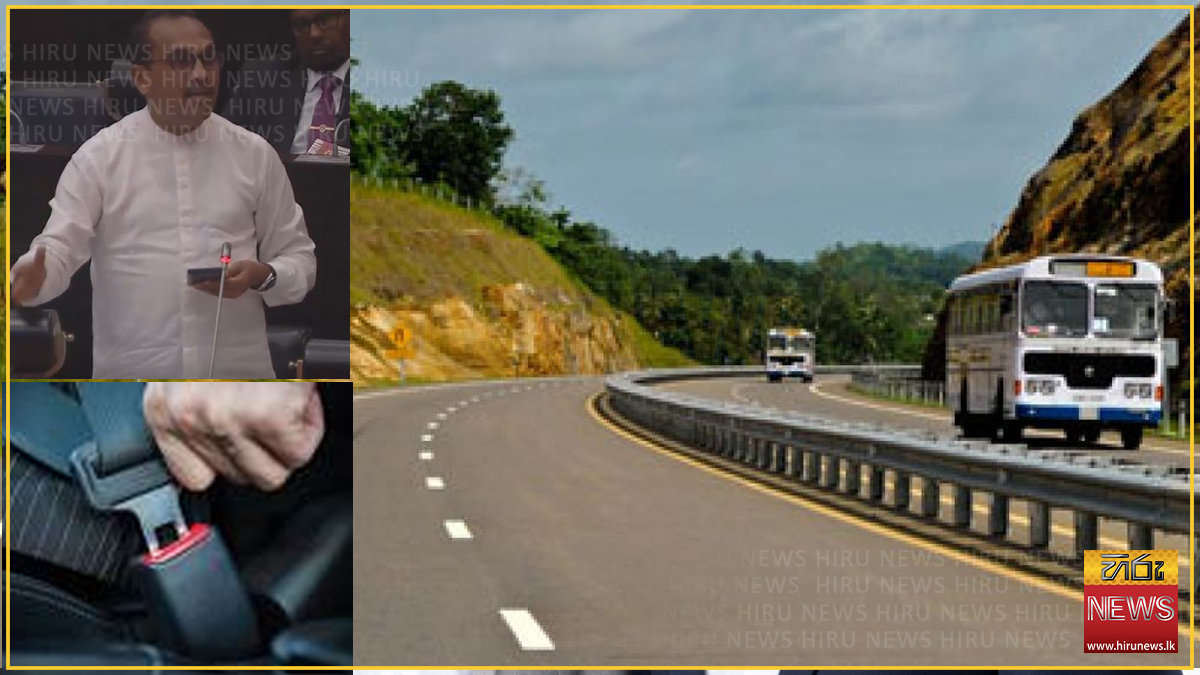
The mandatory seat belt rule on Sri Lanka’s expressways will be strictly enforced from September 19, with no further extensions, Minister of Transport, Highways and Urban Development Bimal Rathnayake told Parliament on Tuesday.
Both front-seat and rear-seat passengers in vehicles travelling on expressways are required to wear seat belts.
Why it took this long
The Minister was candid that the rule has been on the books far longer than it has been enforced. “This rule was introduced over a year ago, but its implementation was delayed due to practical reasons, as some used vehicles were not installed with seat belts,” he said.
Implementation has been postponed several times, with vehicle owners given repeated grace periods to install or repair belts. An earlier deadline expired on June 19. “Since it has been over a year, we have now decided to strictly implement this rule from September 19,” Rathnayake said, adding that no further excuses or extensions would be granted after that date.
He confirmed the rule also applies to school vans travelling on expressways.
A second measure: three-monthly roadworthiness tests
Rathnayake used the same answer to announce a broader vehicle safety requirement. From the end of this year, all passenger transport vehicles including buses and vans will have to undergo a roadworthiness test every three months, or after every 5,000 kilometres travelled.
He tied the measure directly to crash causation. “This is to ensure that vehicles transporting passengers are in good driving condition. We have observed that some of the major accidents that have occurred were due to faults in vans and buses, including brake and tyre issues,” he said.
Context
The announcement follows a run of expressway incidents, including a car that struck the central barrier at Dodangoda on the Southern Expressway last week.
Update, 8 September: the roadworthiness detail
Later reporting of the Minister’s remarks filled in most of what was missing on the inspection regime.
Rathnayake said a gazette containing the proposal has been presented to Parliament for approval. That matches the week’s order paper, which listed orders under Extraordinary Gazettes No. 2489/22 and 2493/19 for debate on Tuesday — the roadworthiness regulations and the seat belt extension respectively. Cabinet cleared both for Parliament in early August.
What it covers. Passenger buses, school and staff transport, office vans and vehicles hired for trips or long-distance excursions. Private vehicles used only for personal travel are exempt.
What it costs. The Minister put the fee at roughly Rs. 1,500 to Rs. 2,000, describing the check as considerably cheaper than the standard annual fitness inspection.
Who does it. Any technician holding an NVQ Level 4 certification will be permitted to carry out the checks at registered garages — which the Minister presented as a source of new employment in the automotive trade.
Why. Rathnayake said investigations into major crashes, including the fatal accidents at Ella and at Garandi Ella in Kothmale, identified brake failure as a primary cause. In one case investigators found a vehicle whose brakes had been closed off on one side for an entire year; police have recently impounded vehicles with brake lines improvised from garden watering hose.
Still unstated: the penalty for non-compliance, and a start date more precise than “the end of the year.”
Update, 9 September: the instrument is named, and the first inspection results are in
The Department of Motor Traffic has now put its own Commissioner General behind the scheme, and the numbers from the first field inspections are worse than the Minister’s account implied.
The legal instrument. Cabinet has approved presenting the Motor Vehicles (Inspection) Regulations No. 03 of 2026 to Parliament for approval, establishing a formal system for testing the roadworthiness of vehicles used for passenger transport and other special services. That names the instrument the gazettes were carrying.
Who is running it. Commissioner General of the Department of Motor Traffic, Vice Marshal (Retd.) Thushara Idunil Fernando, said legal provisions will be introduced to make the fitness tests mandatory for passenger transport vehicles. He restated the interval as a full service every 5,000 kilometres or three months, and put the maximum charge for the test at Rs. 2,000 — the top of the Minister’s Rs. 1,500–2,000 range, and the first firm ceiling given. Tests are to be carried out at registered garages.
What the first inspections found. Two field exercises have already been run, and both suggest a fleet in poor condition:
- At Bastian Mawatha, 136 passenger buses were inspected. Two were issued prohibitory orders and 107 were issued maintenance orders after being found unsuitable for road use. That is 109 of 136 buses — roughly 80 per cent — failing at a Colombo terminus.
- In the Kilinochchi District on 7 September, 103 vehicles were inspected and 31 were issued maintenance orders, a failure rate near 30 per cent.
The gap between the two rates is itself unexplained: it may reflect a different vehicle mix, a different inspection standard, or simply which operators use which terminus. Neither the Department nor the report accounts for it.
Officials said regular inspection and maintenance are essential to ensure passenger vehicles on public roads are safe and roadworthy.
Still unanswered. The penalty for failing an inspection remains unstated, as does what happens to the 107 buses issued maintenance orders — whether they were taken off the road pending repair or allowed to continue. The report also does not say when the Bastian Mawatha inspection took place.
Update, 19 September: the rule is in force, and passengers can be prosecuted too
The deadline held. Seat belts became mandatory for passengers in every seat of all vehicles on expressways from midnight on Thursday 18 September, Hiru News reported on Saturday.
Transport, Highways and Urban Development Minister Bimal Rathnayake said the grace period given to vehicles manufactured without seat belts to have them fitted ended the previous day, according to NewsFirst. The two descriptions — a grace period ending on the 18th and the law coming into force on the 19th — are the same boundary read from either side, since enforcement begins at midnight.
Passengers, not only drivers. The enforcement detail is new and it is the one that matters to travellers: Rathnayake said the regulation will now be strictly enforced with legal action taken against both drivers and passengers who fail to comply. Earlier reporting had left open whether liability sat with the driver alone.
The three phases, set out for the first time. Hiru gives the staging that none of the earlier filings assembled in one place:
- 1 June 2025 — mandatory for drivers of buses on all roads.
- Passengers in the rear seats of light vehicles on all expressways.
- From 18 September 2026 — all passengers in every seat of all vehicles on expressways.
That confirms what the Minister told Parliament in September: the rule has been on the books since mid-2025 and the delay was about fitment, not policy. It also makes clear the scope has widened at each step, from bus drivers on all roads to every occupant of every vehicle on the expressway network.
Still unstated. Neither outlet gives the fine or the penalty on conviction, says how a passenger would be cited, or explains how compliance is to be checked on a moving expressway. Neither reports whether the Road Development Authority or the police will run enforcement, and no outlet says how many vehicles took up the grace period to have belts retrofitted. The rule for school vans confirmed in September is not mentioned in either filing.
Update, 20 September: enforcement is at the entrance, and fines have not started yet
Two of the questions left open above are now answered, and the mechanism is simpler than expected.
Compliance is checked before you get on. Police said vehicles carrying passengers who are not wearing seat belts will be denied entry to the expressway, NewsFirst reported on Sunday morning. That resolves the practical difficulty this desk flagged on Friday: enforcement does not depend on catching an unbelted passenger at speed, because the check happens at the entry point, where traffic is already slowing to a stop.
The police are running it. The filing attributes the measure to police throughout, with no mention of the Road Development Authority — answering the second open question.
No fines yet. The rule took effect at midnight on 18 September, but Sunday is an awareness period, not a penalty regime. Police said efforts to make the public aware of the requirement would continue through the day, and that fines will be issued after the awareness period ends — against both drivers and passengers, consistent with the Minister’s position on Friday. Police also restated that the grace period for fitting belts to vehicles manufactured without them closed on 18 September.
Still unanswered. Police did not say how long the awareness period runs or on what date fines begin, and still gave no figure for the fine itself. It remains unstated whether a vehicle turned away at an entrance is recorded, whether drivers refused entry may rejoin after belting up, and how many vehicles have been denied entry since the rule took effect.
Update, 22 September: who is exempt
Police have set out the categories of passenger the requirement does not cover, under the terms of the relevant gazette notification.
Height and age. The rule does not apply to young children, or to passengers below four and a half feet in height, Deputy Inspector General W.P.J. Senadheera said, Daily Mirror reported on Tuesday evening.
Medical grounds. Passengers who have been medically advised not to wear a seat belt are also exempt.
Senadheera said officers would take such circumstances into account when enforcing the rule and grant the exemptions accordingly. He urged drivers to make sure children and passengers who cannot belt up for medical reasons are still carried safely, particularly on expressways.
Still unanswered. Police did not say whether a medical exemption must be documented or produced at an entrance, what counts as proof, or how the height threshold is to be assessed in practice. The date fines begin, and the amount of the fine, remain unstated three weeks after the rule took effect.