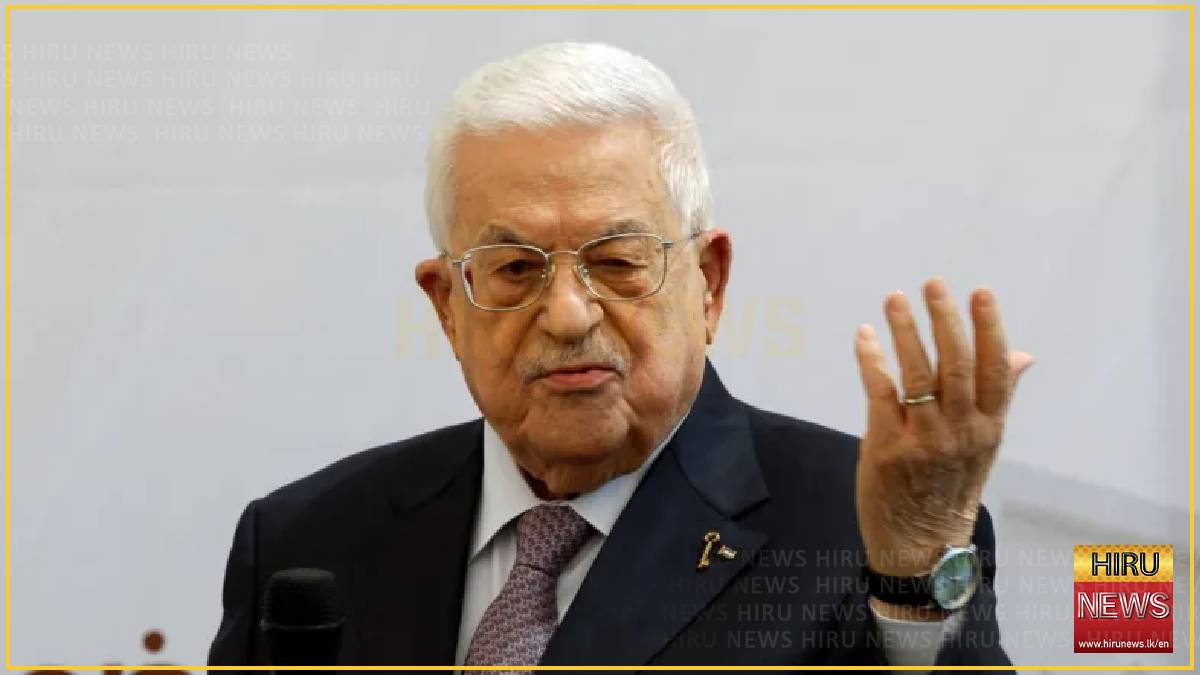
The United States has denied Palestinian President Mahmoud Abbas an entry visa to attend the UN General Assembly in New York next week, Hiru News reported, citing two Palestinian sources who spoke to the BBC.
The State Department said it was extending visa sanctions against Palestinian Authority and Palestine Liberation Organization officials, without naming Abbas. It is the second consecutive year he has been blocked from addressing the assembly in person, Al Jazeera reported.
The stated grounds
The department cited the Palestinian Authority’s “failure to reform, contrary to their commitments to the United States, and their ongoing activities that undermine the prospects for peace.”
Al Jazeera reported that those activities were identified as pursuing international recognition of Palestinian statehood outside direct negotiations, taking disputes with Israel to international courts, and making payments to people the US and Israel describe as convicted attackers and their families. Hiru News reported the US accusing the PA and PLO of “glorifying terrorism” and of attempting to “internationalize” the conflict.
The sanctions were first imposed in August last year, when 80 Palestinian officials were denied visas for the annual meeting. The PA’s mission to the UN retains a waiver under the UN Headquarters Agreement, so its regular staff can continue to operate.
Abbas had been expected to press for recognition of Palestinian statehood — following recognitions this month by the United Kingdom, France, Canada and other Western governments — and to raise the humanitarian situation in Gaza and settlement expansion in the occupied West Bank.
Palestinian authorities had not responded when Hiru News filed. UN human rights experts have previously argued the bans breach US obligations to admit people invited to UN headquarters.
The same day, the opposite decision
Hours apart, the State Department approved visas for Iranian President Masoud Pezeshkian and Foreign Minister Abbas Araghchi, along with essential staff, Al Jazeera reported separately.
“Consistent with our host country obligations, the core delegation from the Iranian regime will be able to attend UN General Assembly High Level Week,” the department said.
The Iranian delegation is to be scaled down in size, placed under tighter travel restrictions, and barred from purchasing luxury goods. The approval was granted while the United States and Iran have been at war for seven months — a conflict in which Iran’s blockade of the Strait of Hormuz, carrying roughly 20% of global seaborne energy shipments, has driven oil prices up and fighting between the Houthis and the Saudi-led coalition continues to escalate in Yemen.
The two decisions rest on the same legal footing. Washington invoked its host country obligations to admit the leadership of a state it is actively fighting, and set them aside for a Palestinian president it accuses of undermining peace. Neither statement addresses the other.
Update (September 19): the Assembly voted, 152–3, to let him speak by video anyway
The question this article left open on Wednesday has been answered, and decisively.
The General Assembly voted on Thursday to allow Abbas to address next week’s gathering of world leaders via video — for the second year in a row — after the United States again refused him a visa, the Daily Mirror reported, citing Reuters.
The resolution passed with 152 votes in favour and three against, with four abstentions. The three votes against were the United States, Israel and Paraguay.
The resolution does more than cover one speech. It allows Abbas and any other high-level Palestinian officials to take part in UN meetings or conferences by video over the next year, if they are prevented from travelling to the United States. That converts a one-off workaround into a standing arrangement for the duration of the 81st session, and removes the leverage the visa refusal was expected to carry.
Abbas’s address is to be delivered at its scheduled time and date by televised broadcast.
Washington’s argument, and the reply
Deputy US Ambassador to the United Nations Tammy Bruce told the assembly before the vote: “If the PA wants to be treated as a partner, it must stop subsidizing terror and stop using diplomatic theater as a substitute for serious governance.”
Palestinian UN envoy Riyad Mansour told the assembly that Palestinian leaders rejected and condemned the US move. Palestine’s Ministry of Foreign Affairs and Expatriates said the resolution “represents a breaking of the attempt to prevent Palestine’s participation” in the annual session.
The State Department confirmed the extension in writing
The visa bans described in this article as reported by Palestinian sources were formally extended by the State Department on Wednesday. Without naming individual officials, it said it would extend visa sanctions over actions taken to “internationalize the Israeli-Palestinian conflict,” including pursuing cases against Israel at international tribunals.
That is the same reasoning given for the original sanctions in August last year, when Abbas and about 80 other Palestinians attached to the PLO and the Palestinian Authority were denied or stripped of visas.
The host-country obligation is now contested openly
Under the 1947 UN headquarters agreement, the United States is generally required to allow foreign diplomats access to the UN in New York. Washington maintains it can refuse visas on security, extremism and foreign-policy grounds — the position that lets it admit Iran’s leadership and exclude Abbas in the same week.
Two others have now put that reading in dispute. UN Secretary-General António Guterres said he was “concerned about its impact on the ability of the State of Palestine to participate fully in the work of the United Nations.” The European Union went further and asked Washington to reverse course: “In light of its existing headquarters agreements with the UN and its obligations as host state, we urge the United States for this decision to be reconsidered,” EU diplomatic service spokesman Anouar El Anouni said, according to Al Jazeera.
Not reported
No outlet gives the date or time of Abbas’s scheduled slot, or says which four countries abstained. None reports whether the Palestinian Authority formally asked Washington to reconsider, or whether the US has responded to the EU’s request. It is not stated whether the standing video provision has any precedent beyond last year’s one-off resolution.
A note on sourcing dates: this story recurs almost identically each September, and a search for it returns Al Jazeera’s 2025 report of the previous year’s vote under a near-identical headline. The discriminator is the session number and the tally — 81st session, 152–3–4, September 2026.