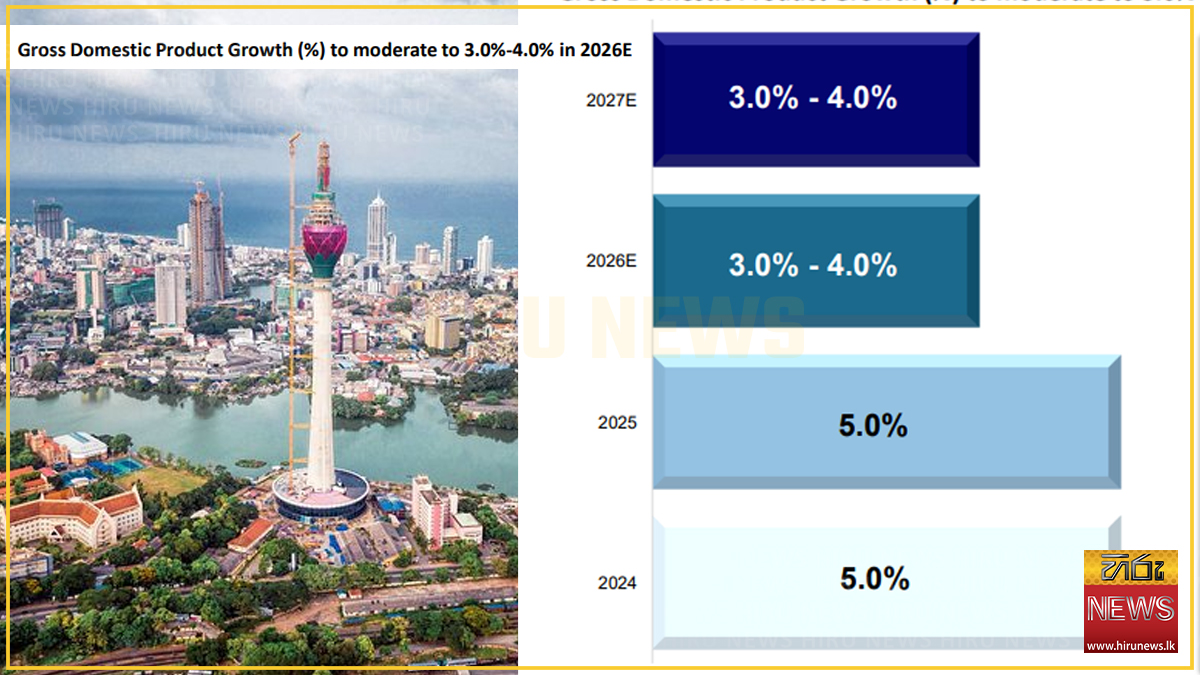
Sri Lanka’s GDP growth is expected to moderate to 3.0%–4.0% in both 2026 and 2027, First Capital Research said in its latest review, reported by Hiru News.
The research house attributes the slowdown to the lagged effects of the May 2026 policy tightening, which it says continue to weigh on consumption and investment as tighter financial conditions work through the economy.
What the forecast is measured against
Hiru’s text gives the forecast range but no baseline. The chart First Capital published with the review supplies it:
| Year | Growth |
|---|---|
| 2024 | 5.0% |
| 2025 | 5.0% |
| 2026E | 3.0%–4.0% |
| 2027E | 3.0%–4.0% |
Read against that, the call is a step down of one to two percentage points from two consecutive 5.0% years — and a forecast that the step down persists rather than reverses in 2027.
It is directionally consistent with the data already in: second-quarter growth slowed to 4.2%, the weakest print since 2024, with agriculture contracting and services growth halving.
The tightening it refers to
The “May 2026 policy tightening” is the Central Bank’s 100 basis point increase in the Overnight Policy Rate to 8.75% on 26 May — the first hike of the cycle, and one that exceeded the upper end of analyst expectations at the time. The rate was left unchanged in July.
The argument is really about rates, not growth
The forecast is framed throughout as an input to monetary policy rather than as a growth story in its own right. First Capital’s chain of reasoning:
- A softer growth outlook reduces the likelihood of further tightening, particularly given signs that policy rates may already have peaked.
- Slower growth therefore provides an additional basis for a policy pause and supports lower short-term interest rates.
- Lower short rates could in turn support credit conditions and activity — though the pace of any easing would depend on inflation and other macroeconomic developments.
The house is careful to say the expected slowdown does not point to a reversal of the broader recovery, only that the effects of earlier tightening are becoming increasingly visible in domestic demand.
Context: a second opinion the same week
The forecast lands in the same week that Fitch upgraded Sri Lanka’s sovereign rating to ‘B-’ with a Stable Outlook. The two are not in conflict — a ratings upgrade reflects debt and external metrics, not the growth rate — but they point in different directions on sentiment, and both were published on 22 September.
Not reported
Hiru does not give the date or title of the First Capital review, its inflation forecast, or the rate path it expects. There is no figure for how far short rates are expected to fall, or over what horizon.
The report does not reconcile the 3–4% call with official projections, does not quantify the drag from consumption versus investment, and carries no response from the Central Bank or the Treasury. No First Capital analyst is quoted by name.
First Capital Research is a commercial research house and the review is a sell-side product; the forecast is its own, not an official projection.