Sri Lanka will host the inaugural World Congress on Snakes (WCS 2026) in Kandy from 1 to 4 October at the Grand Kandyan Hotel, drawing more than 300 international delegates alongside over 100 Sri Lankan participants — a turnout the organisers say has surpassed original expectations.
CDC Events & Travels (Pvt) Ltd has been appointed official Professional Conference Organiser and is handling the operational framework, Hiru News reported. Its remit runs to venue and destination management, airport transfers, delegate transport, hotel bookings and local tour itineraries, plus pre- and post-conference excursions.
What the congress is for
The scientific programme is built around three aims: sharing new research, advancing clinical protocols for snakebite management, and driving international conservation strategies. It is led by Dr. Anslem de Silva, Dr. Julie Ray and Dr. Daniel Natusch, and is designed to bring wildlife biologists, medical professionals and conservationists into the same room.
The clinical half of that agenda is the part with the most direct bearing on Sri Lanka, where snakebite is a long-standing rural public health problem and antivenom supply and treatment protocol have been recurring policy issues.
What the photograph adds
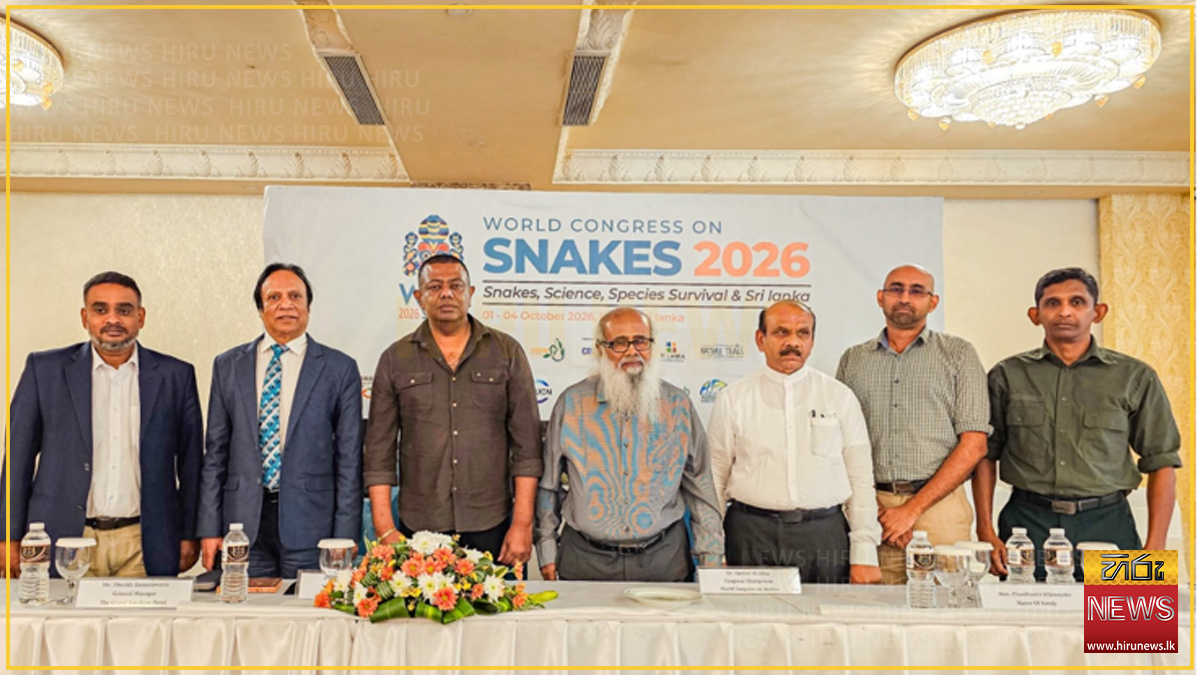
The press conference image released with the announcement carries detail the text does not. The backdrop gives the congress its full title and theme — “World Congress on Snakes 2026: Snakes, Science, Species Survival & Sri Lanka” — and independently confirms the 01–04 October 2026 dates. The nameplates on the table show Dr. Anslem de Silva seated as Congress Chairperson, flanked by the General Manager of the Grand Kandyan Hotel and the Mayor of Kandy, indicating municipal backing that the filing never mentions.
The tourism framing
Hiru carries the item on its business desk, and the announcement is explicitly pitched at Sri Lanka’s business-events and MICE tourism sector — CDC Events presents the congress as evidence that professional event management delivers value across the wider tourism chain, and Kandy as a workable venue for large international gatherings.
That framing is the company’s own. It is worth noting this is a PCO’s announcement of its own appointment, issued nine days before the event, rather than independent reporting on the congress.
Still unanswered. The filing gives no delegate fee, no estimate of the foreign exchange the congress is expected to earn, and no breakdown of which countries delegates are travelling from. It provides no Sri Lankan snakebite incidence or mortality figures, names no government ministry or university as a partner, and does not say what the post-congress field excursions cover. No other verified newsroom had carried this announcement at the time of writing; earlier coverage of the congress elsewhere dates from March and falls outside our sourcing window.
Update, 30 September: government backing confirmed
Environment Minister Dhammika Patabendi will take part in the congress’s inaugural ceremony, the Daily Mirror reported on Wednesday, in its own filing on the congress — the first independent confirmation of ministerial involvement, and an answer to one of the questions left open above.
The Daily Mirror confirms the theme as “Snakes, Science, Species Survival & Sri Lanka”, matching the backdrop at the September press conference, and describes the congress as being held in Sri Lanka for the first time. It says the programme will cover snake diversity, conservation and scientific research, and gives the event as a platform for local and international scholars, researchers, environmentalists and experts.
Two points the Daily Mirror does not supply: it names neither the venue nor the dates, so the 1–4 October window and the Grand Kandyan Hotel remain on Hiru’s account alone. It also does not repeat the delegate numbers. Patabendi is the same minister who said last week that Sri Lanka would seek international funding for drought preparedness under the UN desertification convention.
Update, October 2: the congress opens, and the numbers firm up
The congress opened on Wednesday, October 1 at The Grand Kandyan Hotel, and the Daily Mirror’s report from the opening settles several of the questions left above, filing it on the snakebite burden rather than the tourism angle.
The turnout is confirmed and consolidated. More than 400 scholars, researchers, environmentalists and field experts from 42 countries are attending — the first count taken at the event itself, and the first time the delegates’ countries of origin have been quantified. The September announcement’s “more than 300 international plus over 100 Sri Lankan” has resolved into a single 400-plus figure, so the two should not be added together. The theme is confirmed as “Snakes, Science, Species Survival & Sri Lanka”, matching both the press-conference backdrop and the Daily Mirror’s earlier filing, and the congress runs four days.
The Sri Lankan snakebite figures, absent from every earlier report, are now on the record. Nearly 10,000 snakebite cases are reported in Sri Lanka each year. A considerable number involve envenomation, and hundreds of victims die. Globally, roughly 138,000 people die of snakebite annually, with many survivors left permanently disabled — limb loss, disfigurement, kidney failure and severe psychological trauma.
Experts at the congress are drawing a distinction that matters for public response: the vast majority of Sri Lanka’s snake species are harmless to humans, and only a very small proportion pose a serious medical threat. Sri Lanka is home to 112 of the 411 snake species recorded in the region covered by the figure the Daily Mirror cites.
Those numbers answer the gap flagged above — that the original announcement gave no Sri Lankan snakebite incidence or mortality data despite snakebite treatment being half the congress’s stated purpose. The Daily Mirror still gives no delegate fee, no foreign-exchange estimate, and no breakdown of the 42 countries.
One date to note. The Daily Mirror’s October 2 copy says the congress “commenced yesterday”, placing the opening on October 1 — consistent with the 1–4 October window Hiru reported in September.