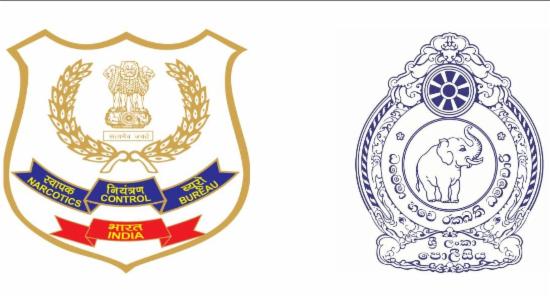
Indian and Sri Lankan drug-enforcement agencies met in Colombo on 23 September for the fifth round of Director General-level talks on cross-border trafficking, sharing intelligence on trafficking operatives and agreeing to deepen cooperation between their agencies.
Details of what the two sides discussed emerged a day later, in a statement from the Indian side. The full account is set out below.
How the meeting was first reported
Ahead of the talks, NewsFirst reported that a group of Indian police officers led by the Director General of India’s Narcotics Control Bureau was arriving that day, and that the delegation was scheduled to hold a programme in Colombo with Inspector General of Police Priyantha Weerasooriya, citing a senior police officer. The Indian statement issued afterwards gives a different account of who led the delegation, set out in the update below.
What was on the agenda
Three areas were named:
- Joint training for police officers who handle drug-related matters in both countries.
- Expanded intelligence sharing between the two states.
- A joint action plan aimed at eradicating the drug trade.
The stated purpose was to put in place measures against trafficking that moves between the two countries.
Context
The visit follows a sustained push by Colombo for Indian cooperation on narcotics. During Indian Defence Minister Rajnath Singh’s visit to Colombo this month, President Anura Kumara Dissanayake asked India to back Sri Lanka’s anti-drug campaign, in talks that also covered maritime security.
Indian and Sri Lankan agencies have also worked the same networks from opposite ends. Earlier this month India’s NCB dismantled a trafficking network running across Nepal, India and Sri Lanka.
The sea route between Tamil Nadu and Sri Lanka’s north and west coasts has been the principal channel in recent prosecutions on both sides, and Sri Lanka Navy interdictions of narcotics carried aboard fishing vessels have been a recurring feature of the past year.
Update (September 24): the talks were held, and were the fifth round
A statement issued by the Indian side and carried by Sri Lanka Mirror confirms the meeting went ahead in Colombo on 23 September, and identifies it as the fifth round of Director General-level talks between the two countries’ narcotics control agencies — a standing bilateral mechanism rather than a one-off visit.
The statement corrects two points in the original reporting:
- The Indian delegation was led by R. Sudhakar, Deputy Director General of the Narcotics Control Bureau — not by the bureau’s Director General.
- The Sri Lankan side was led by DIG K.D.G.L. Ashoka Dharmasena of the Police Narcotics Bureau. The statement does not mention the Inspector General of Police, whom NewsFirst had reported would host the programme.
Who was in the room
The talks were considerably broader than a police-to-police meeting. The Indian delegation included officials from Tamil Nadu Police, the Indian Coast Guard and the Ministry of External Affairs alongside NCB officers. The Sri Lankan side brought in the Attorney General’s Department, Sri Lanka Customs, the Sri Lanka Coast Guard, the Government Analyst’s Department, the Special Task Force, the Sri Lanka Navy, the National Dangerous Drugs Control Board and the Financial Intelligence Unit in addition to the PNB.
The presence of the Financial Intelligence Unit and the Attorney General’s Department points to an agenda reaching past interdiction into prosecution and money-laundering, and the Coast Guard and Navy representation on both sides reflects where the trafficking actually happens.
What was discussed
The two sides reviewed emerging trafficking trends, particularly movement by maritime routes, the tracing of organised criminals, and the coordination of intelligence and investigative work against organised crime. The statement says actionable intelligence on trafficking operatives, routes and methods was shared — the most concrete outcome disclosed.
Both delegations agreed to further strengthen institutional cooperation between their drug law-enforcement agencies.
The statement frames the meeting against Indian Prime Minister Narendra Modi’s state visit to Sri Lanka in April 2025, and against President Anura Kumara Dissanayake’s call for India’s fullest support against trafficking in the Indian Ocean region, made when he met Indian Defence Minister Rajnath Singh in Colombo on 9 September.
Caveats
No verified Sri Lankan newsroom has published its own account of the concluded talks. The description above comes from the Indian statement as reproduced by Sri Lanka Mirror, which LankaNewz does not count among its independently verified newsrooms — the text reads as an official release rather than reporting, and no outlet has tested it against the Sri Lankan side. Neither the statement nor the earlier NewsFirst report says whether any agreement was signed, when the sixth round is due, or what the joint training and action plan flagged before the meeting now amount to.