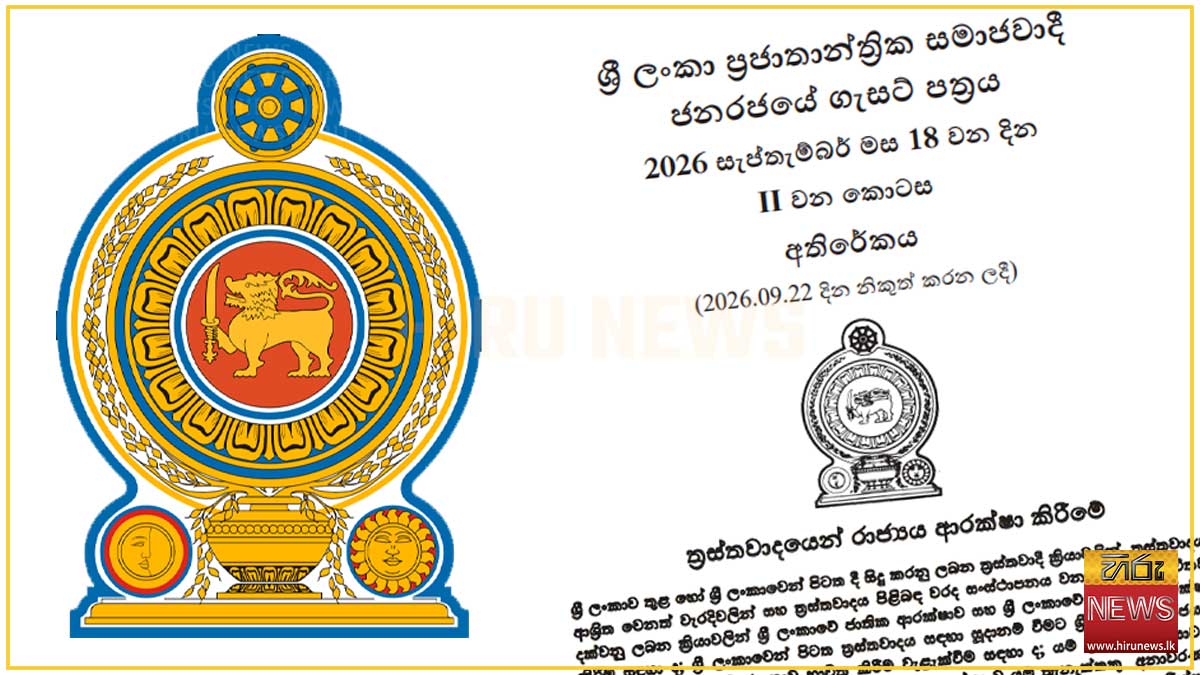
The government has gazetted the Protection of the State from Terrorism Bill, the legislation intended to repeal and replace the Prevention of Terrorism (Temporary Provisions) Act, No. 48 of 1979.
The Minister of Justice and National Integration ordered publication of the Bill, which sets out a framework for the detection, arrest, detention, investigation and prosecution of terrorism offences committed inside or outside Sri Lanka. The gazette supplement carries the date 18 September and was issued on 22 September.
What changes
Suspects must be produced before a magistrate within 48 hours — a requirement the PTA did not impose. Detention orders may be issued by the Secretary to the Ministry of Defence for up to two months at a time, but any extension beyond two months requires High Court approval, and total detention under such orders cannot exceed one year from the date of the initial order.
An Independent Review Committee chaired by a retired Supreme Court or Court of Appeal judge would review detention orders and recommend whether to confirm, vary or revoke them. Magistrates would be required to see suspects in camera, monitor their wellbeing, order medical examinations where torture is alleged or suspected, and visit detention centres monthly. Arrests must be notified to next of kin, the Human Rights Commission and the Inspector General of Police, and the Commission would be entitled to make unannounced inspections.
Speech and protest carve-outs
Participation in protests, advocacy, dissent, strikes, lockouts or humanitarian and medical work would not by itself be sufficient to infer terrorist intent. The Bill exempts journalism, academic research, legal proceedings, artistic expression and public-interest communication, stating that fair and accurate reporting and legitimate political discourse should not in themselves constitute offences.
Offences causing death could carry life imprisonment; other terrorism offences carry up to 20 years and fines of up to Rs. 20 million. The President retains the power to proscribe organisations, and investigations and prosecutions already begun under the PTA would continue under transitional provisions.
Cabinet approved the Bill for gazetting in August. It now goes to Parliament.
Update, September 23 — how the definition of terrorism changes
NewsFirst, reporting the gazettal separately, sets out the redrawn definition in more detail than the other accounts.
Under the draft, an act may constitute terrorism where it is intended to create fear among the public, to compel a government or an international organisation to act or refrain from acting, to cause death or grievous injury, to take hostages, to destroy public property or critical infrastructure, to cause serious environmental damage, or to launch cyberattacks on information technology and communication systems.
The categories of what the law protects have been widened alongside it. Sri Lanka’s cyber environment, computer networks, critical data systems and nationally significant cultural heritage assets are named among the protected sectors — none of which appear in the 1979 Act, which was drafted before any of them existed as policy concerns.
Separately from the principal offences, the Bill criminalises membership of a proscribed organisation, recruiting for one, and providing it with funds, financial services, equipment, training, logistical assistance or other material support, as well as organising or taking part in its activities.
NewsFirst also records the same speech and media carve-outs described above, listing journalism, commentary, analysis, academic and scientific research, public-interest communication, legal representation, artistic expression and lawful political discourse as expressly excluded from the offences.