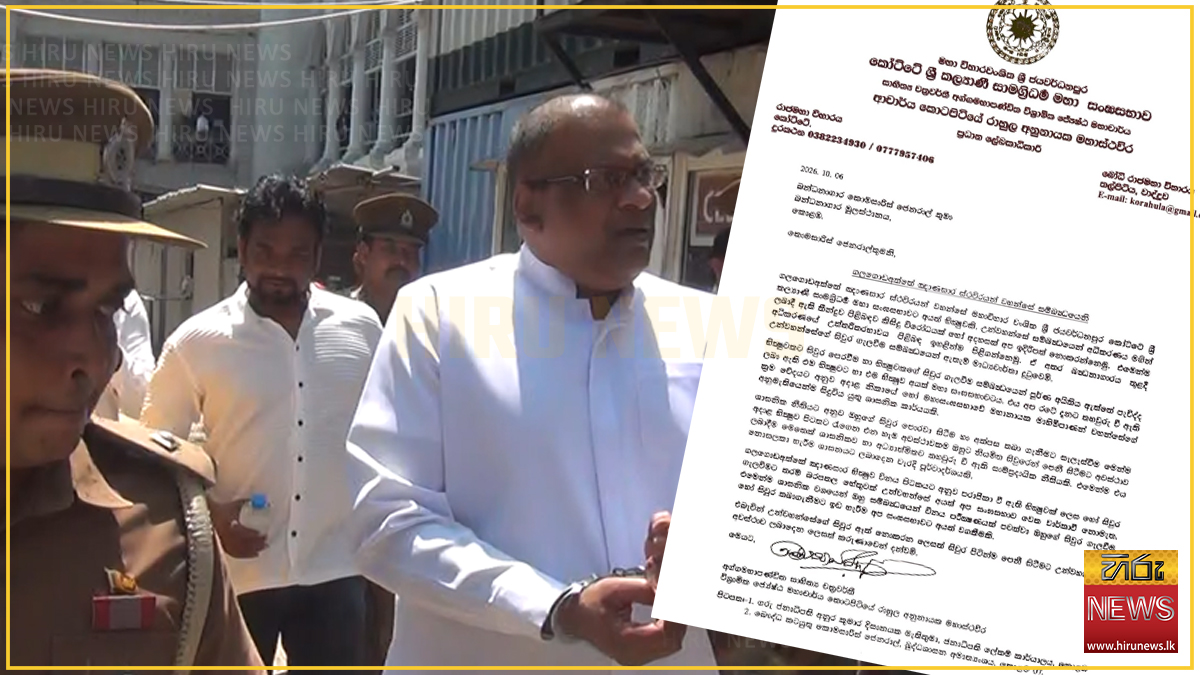
A senior Buddhist prelate has written to the Commissioner General of Prisons arguing that only an ordained monk and his own Maha Sangha Sabha may decide whether his robes are removed, after prison authorities issued Ven. Galagodaaththe Gnanasara Thera with standard prison dress and a prisoner registration number.
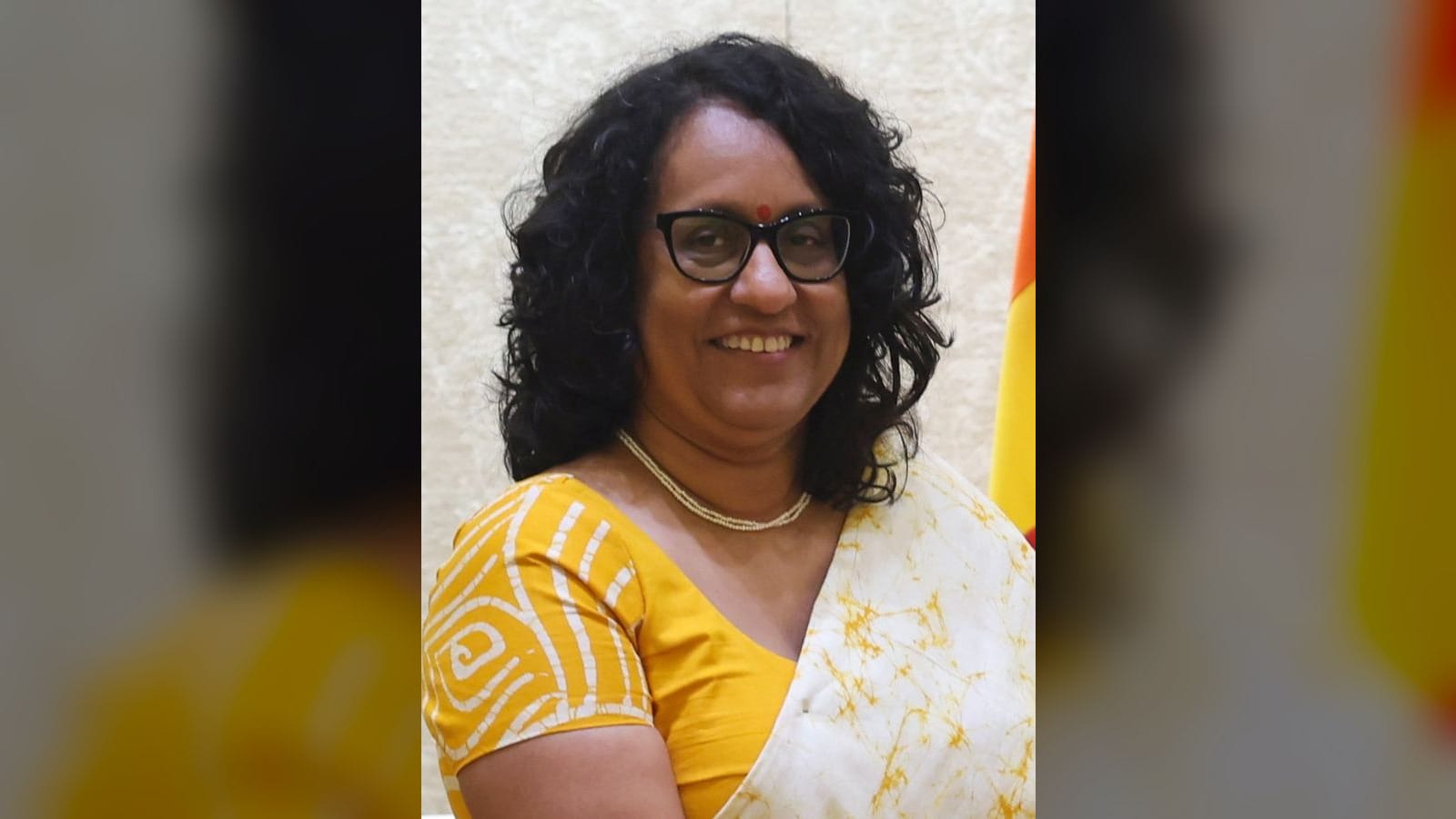
The letter is from Ven. Kotapitiye Rahula Thera, Anunayake of the Maha Vihara lineage Sri Jayawardenapura Kotte Sri Kalyani Samagri Dharma Maha Sangha Sabha and a retired senior professor, the Daily Mirror reported. Gnanasara Thera belongs to the same Sangha Sabha.
What the letter says
The Anunayake Thera opens by accepting the court’s authority outright. The Sangha Sabha raises no objection to the judgment and “fully accepts the supremacy of the judiciary,” he writes — the dispute is not with the sentence but with what happens to the robes inside prison, which he says he learned of from media reports.
His argument is a jurisdictional one. The right to robe a monk, and to disrobe one, rests with the monk himself and the Maha Sangha Sabha he belongs to, and under the practice established in Sri Lanka it is an ecclesiastical act requiring the approval of the relevant Mahanayake Thera. Allowing a monk to appear in his robes whenever he is brought outside his place of detention is, he writes, long-established traditional practice, and disregarding it sets a wrong precedent for the Sasana.
He then makes the specific claim on which the request turns: Gnanasara Thera has not been reported to the Sangha Sabha as having committed a Parajika offence under the Vinaya Pitaka — the category of transgression that ends monkhood — nor any offence serious enough to warrant removal of his robes. Determining that, after a disciplinary inquiry, is the Sangha Sabha’s own responsibility.
He therefore asks that the robes not be removed and that Gnanasara Thera be allowed to appear in them when taken outside detention. Hiru News, which published the letter in full, reports that copies were sent to President Anura Kumara Dissanayake and to the Commissioner General of Buddhist Affairs.
What the prison has already done
The step the letter objects to had been taken the previous afternoon. Prison media spokesman and Commissioner of Prisons (Operations) Senaka Pallegetenna said on Monday that Gnanasara Thera had been given a prisoner registration number and the jumper issued to inmates, that his robes had been removed, and that he is being held in a ward for ordinary prisoners, Hiru News reported.
That followed the Court of Appeal order directing the Commissioner General of Prisons to enforce the balance of the six-year contempt sentence, after the Supreme Court annulled the 2019 presidential pardon granted by then-President Maithripala Sirisena. He was returned to Welikada Prison on Monday, having been arrested on an open warrant on Sunday.
The effect of the prison’s registration is visible in court. When he was produced before the Colombo High Court on Tuesday in a separate case, he appeared in civilian white clothing rather than robes.
Two sets of rules meeting
The disagreement is narrow but unresolved: prison authorities say he has been registered and treated as an ordinary inmate in accordance with prison procedure, while the Sangha Sabha says the status being altered is an ecclesiastical one that prison procedure has no standing to change.
Update, October 6 — the objection is made in open court
The argument moved from a letter to a courtroom the same day. Appearing before the Colombo High Court in a separate case, counsel for Gnanasara Thera formally objected to the removal of his robe by prison officials and asked the court to issue an order on it, the Daily Mirror reported.
Counsel Sanjaya Marambe put the same jurisdictional claim the Sangha Sabha had made in writing, and added a constitutional one:
“My client suffered severe mental distress following the denial of the presidential pardon. That is why he had gone to the monastery. Furthermore, under Article 9 of the Constitution, this is a country where Buddhism is given the foremost place. Only the Mahanayake Theras have the authority to remove a Buddhist monk’s robe, not the prison authorities.”
Judge Buddhika C. Ragala did not rule on it, telling the court the defence had the opportunity to take the objection to a higher court. Marambe appeared with Pasan Karunaratne; State Counsel Supun Ranasinghe appeared for the Attorney General.
That answers one of the questions left open below — Gnanasara Thera has now made the request himself, through counsel — while leaving the Department of Prisons’ position unstated.
The case he was produced in
The hearing was not part of the contempt matter. The Attorney General brought this case under the Penal Code, alleging that remarks Gnanasara Thera made concerning the Holy Quran insulted Islam. A warrant had been issued against him at the previous hearing after he failed to appear in open court — counsel’s reference to his having “gone to the monastery” after the pardon was denied explains that absence. He was produced on Tuesday in prison attire, and the case was fixed for 23 October for further hearing.
Update, Tuesday evening — the Department of Prisons sets out the rule
The Department has now answered, and the answer turns on the type of sentence and its length rather than on monastic status.
Prison Media Spokesman and Commissioner of Prisons (Operations) Senaka Pallethenna said that under prison regulations anyone serving a prison sentence must wear standard prison attire, and that inmates sentenced to more than three years for serious offences wear it while serving their sentences, the Daily Mirror reported.
He then set out the distinction that decides this case:
“According to prison rules and regulations, if a venerable Buddhist monk has been sentenced to simple imprisonment by a respected court, they may remain in their monastic robes while serving the relevant prison sentence within the correctional facility. If the sentence involves rigorous imprisonment, any individual must wear the prison uniform. When producing individuals sentenced by a court to prison, if their prison sentence is less than three years, the prison superintendent may permit them to wear the civil clothing they were wearing prior to the sentence when being presented to court.”
Anyone sentenced to more than three years, he said, must be dressed in prison-issued attire when produced in court. Gnanasara Thera is serving a six-year sentence, which places him outside the discretion the superintendent would otherwise hold.
The Daily Mirror renders the spokesman’s name Pallethenna here, while Hiru gave it as Pallegetenna in the filing cited above; the office and role are identical and this appears to be a transliteration variant rather than two officials.
Pallethenna also said more than 63 senior clergy members have served prison sentences at various times, their detention and treatment managed under established administrative and legal procedures — a direct response to the suggestion that the Department was departing from precedent.
This supplies the rule that the Sangha Sabha’s letter and the defence’s courtroom objection were both arguing against without it being on the record. It does not resolve the underlying dispute, which is about which authority governs a monk’s robes, not about what the prison regulations say. The Department’s position is that it is applying a sentencing-based rule that makes no exception for ordination; the Sangha Sabha’s position is that ordination is not the Department’s to alter.
The objections widen
Two further interventions followed on Tuesday.
Ven. Thunhitiyawe Dhammaloka Thera, Founder and Convener of the Universal Buddhist Monks’ Conference and Chief Incumbent of the Sri Sambuddhaloka Vihara in Japan, said bringing a monk of Gnanasara Thera’s standing before court in civilian clothes could be perceived as signalling that the authorities may interfere in matters concerning the Buddhist Sasana, the Daily Mirror reported. He accepted the six-year sentence as a judicial decision that should be respected, while questioning whether the Commissioner General of Prisons had overstepped the authority traditionally exercised by the Nikaya and Sangha Sabha.
“Once someone enters the monastic order, the authority to disrobe lies with that individual,” he said. “If a monk has done something unsuitable for the Sasana or contrary to the rules of his Nikaya or Sangha Sabha, only the monks responsible for administering that body, with the approval of the Maha Nayaka Thero, have the authority to take action.” He noted that prisoners are generally seen appearing before courts in their own clothing, and said that although the decision had reportedly been taken by the Commissioner General of Prisons, responsibility ultimately rested with the government.
Opposition Leader Sajith Premadasa issued a statement saying that while courts operate strictly within a legal framework, a government must act with sensitivity towards social traditions and cultural identity, Hiru News reported. He said bringing a Buddhist monk or any religious leader to court in lay clothing — without their consent or the knowledge of their religious institution — is inappropriate, and that decisions on monkhood rest with the relevant religious authorities. He urged the government to act in such matters with the knowledge and approval of the Mahanayake Theras of the Three Nikayas or the leadership of the relevant religion.
Premadasa’s intervention moves the dispute into party politics for the first time. Dhammaloka Thera’s places it in the international monastic community.
The Government answers: no special treatment
The Government has now given its own position, and it declines the exception the Sangha Sabha asked for.
Speaking at the weekly briefing to announce Cabinet decisions, Cabinet Spokesman and Minister Nalinda Jayatissa said prison authorities had acted in accordance with the Prisons Ordinance in relation to Gnanasara Thera, and that no special treatment will be given to him, the Daily Mirror reported. He was responding to questions about the concerns raised by various parties over the prison attire issued to the monk.
Jayatissa said 63 Buddhist monks are currently serving prison sentences, and that Gnanasara Thera is being treated in the same manner as the others. He reiterated that prison authorities were following the relevant regulations and that the monk would receive no special privileges while in custody.
This is the response that had been missing from the record. Until Tuesday’s briefing the dispute ran between a prelate’s letter, a courtroom objection and a prison spokesman’s account of the regulations; the Government had not stated a position of its own. Its position is that the matter is settled by the Prisons Ordinance and that ordination does not create an exemption — which is the Department of Prisons’ argument restated at ministerial level, and a direct refusal of the jurisdictional claim rather than an answer to it.
A figure that does not match across the two filings
The same number appears in both government accounts with two different meanings, and only one of them can be right. The Prison Media Spokesman said more than 63 senior clergy have served prison sentences “at various times” — a historical total offered as precedent. The Cabinet Spokesman said 63 monks are currently serving sentences — a present-day count offered as evidence of equal treatment.
A historical cumulative figure and a current headcount that happen to be the same number is improbable, and the two statements were made the same day about the same point. The precedent argument is considerably stronger if 63 monks are in prison right now than if 63 have been over the department’s history, so the distinction matters to the claim both officials were making. Neither filing resolves it, and no source gives a period for either figure.
Update, 7 October: the dispute moves to the street
A peaceful protest was scheduled for 9 a.m. on Wednesday at the Colombo Courts premises, opposing the Prisons Department’s decision to remove Gnanasara Thera’s robes when he is produced before court, the Daily Mirror reported.
The timing is not incidental. He was due before the Colombo Magistrate’s Court the same morning in a third, separate case — the one in which he received a nine-month sentence for insulting Islam — so the protest was set for the hour and the place at which he would next be seen in prison dress.
This is the first street action in the dispute. Until Wednesday it had run through a prelate’s letter, a courtroom objection by counsel, statements by a monk in Japan and by the Opposition Leader, and the Government’s refusal at the Cabinet briefing.
In the same filing, Prison Commissioner and Media Spokesman Senaka Pallethenna restated the Department’s position: prison regulations require inmates sentenced to rigorous imprisonment to wear prison-issued clothing, and the regulations governing monks in prison and the clothing worn when prisoners are produced before court were being followed.
That restatement sharpens, without answering, the question flagged below. The Department’s rule turns on whether a sentence is simple or rigorous imprisonment; the spokesman again stated the rule in those terms, and again did not say which classification applies to Gnanasara Thera’s six-year contempt sentence. The classification is the fact on which the Department’s own justification depends, and no filing supplies it.
The production went ahead — but not what he wore
Gnanasara Thera was produced before court on Wednesday, the Daily Mirror confirmed, describing the appearance as taking place amid heightened attention over the Prisons Department’s decision to have him appear in prison attire.
The filing is a short one and does not say what he actually wore — the single fact the week’s dispute turns on, and the reason the protest was called for that hour and that place. It also does not report whether the protest took place, or its size.
The nine-month sentence is upheld on appeal, and goes to the Supreme Court
The Colombo High Court has dismissed Gnanasara Thera’s appeal against the nine-month prison sentence imposed on him for insulting Islam, and upheld the sentence, the Daily Mirror reported.
Colombo Additional Magistrate Lahiru Silva read out the High Court’s decision in open court on Wednesday. The Colombo Magistrate’s Court had sentenced the Bodu Bala Sena secretary on 1 January 2025 to nine months’ imprisonment and a fine of Rs. 1,500, after finding him guilty of making statements insulting Islam at a media briefing. The High Court’s dismissal, the Magistrate said, paves the way for that sentencing order to be enforced.
President’s Counsel Anura Meddegoda, appearing for Gnanasara Thera, then told the court that an appeal has been filed before the Supreme Court against the High Court’s order, and asked for a date to be fixed while the Supreme Court considers it. The Additional Magistrate fixed the case for 25 February and ordered prison officials to produce the monk before court on that date.
The report also notes that a warrant had previously been issued against him in this case for failing to appear — the warrant that lies behind the arrest described further down this article.
Three matters, not one
This development concerns a different case from the one Gnanasara Thera is currently serving, and the two are easily confused because both involve remarks about Islam. Three separate matters are live:
- The six-year contempt sentence — imposed over the Homagama proceedings connected to the Eknaligoda case, and the sentence whose remaining period he is now serving. The Daily Mirror’s report on Wednesday’s protest confirms this is the sentence being enforced.
- A Colombo High Court indictment brought by the Attorney General under the Penal Code over remarks about the Quran — still pending, and called for 23 October.
- The nine-month Magistrate’s Court sentence for insulting Islam — the matter decided above, now upheld on appeal and under appeal again to the Supreme Court.
In the third matter the Colombo High Court sat as the appellate court. In the second it would sit as the trial court. They are not the same proceedings.
A separate arrest: a bank officer accused of driving him from the warrant
A development on a different track of the same case: a bank officer from Kelaniya has been arrested and remanded, accused of helping Gnanasara Thera evade arrest, the Daily Mirror reported.
The Colombo Crimes Division told the court the suspect had knowingly driven the monk from Rajagiriya to the Elpitiya area in his private vehicle, while aware that an arrest warrant had been issued against him. Colombo Chief Magistrate Asanga S. Bodaragama ordered the suspect remanded until 9 October. The CCD is continuing to investigate the assistance allegedly given.
This concerns the period before Gnanasara Thera was taken into custody, not the robes question, and it is the first report of anyone else facing proceedings over that period. The suspect is not named in the report, and no plea or response on his behalf is carried. Nothing in the filing indicates how many others, if any, are under investigation on the same basis.
The Asgiri Chapter enters the dispute
One of the two chief chapters of the Siyam Nikaya has now taken a position, which moves the objection from a single Sangha Sabha and individual monks to the senior monastic establishment.
Most Ven. Medagama Dhammananda Thera, Secretary of the Asgiri Chapter of the Shyamopali Maha Nikaya, has raised legal concerns over the decision to remove Gnanasara Thera’s robe and present him before court in lay attire, the Daily Mirror reported.
The Chapter said it respected the court verdict against the Thera, but questioned whether the procedure prison authorities followed was consistent with the Prisons Ordinance. Its reading of the Ordinance, it said, suggested the Thera should have been produced before court in the same robes he had previously worn.
That is a narrower and more pointed argument than the one made so far. The Kotte Sangha Sabha’s letter and counsel’s objection in court both rested on ecclesiastical jurisdiction — that only the Maha Sangha may disrobe a monk. The Asgiri Chapter is instead disputing the Department of Prisons on the Department’s own chosen ground, arguing that the Ordinance the Prison Media Spokesman and the Cabinet Spokesman have both cited does not in fact authorise what was done.
The Chapter also said:
- the constitutional status accorded to Buddhism, together with traditional customary laws and ancient legal systems, should be taken into account in matters concerning Buddhist monks;
- the action was of grave concern and could set a detrimental precedent for the Buddhist Sasana;
- it is examining the relevant legal provisions and considering its next course of action, including the possibility of re-ordaining the Thera if deemed necessary;
- Buddhist principles emphasise forgiveness and guiding those who have erred back to the correct path, while it reaffirmed respect for the existing legal system.
It added that its immediate concern was not the Thera’s political affiliations or ideological positions, but whether the procedure adopted in producing him before court complied with the applicable law.
This answers one of the questions left open below. It is, however, the Chapter speaking through its Secretary rather than the Mahanayake Thera of Asgiri personally, and the Malwathu Chapter — the Siyam Nikaya’s other chief chapter — has still not been reported as taking a position. Neither have the Amarapura or Ramanna Nikayas.
The reference to possible re-ordination is the first indication from any monastic body that it may treat the robe’s removal as having had an effect requiring a remedy, rather than as a procedural wrong to be protested. No filing says what re-ordination would involve for a serving prisoner, or whether prison authorities would permit it.
All four Mahanayaka Theras go on the record together
The four Mahanayaka Theras have written jointly to the Commissioner General of Prisons, saying they were concerned and surprised by the decision to produce Gnanasara Thera in court in lay clothes, the Daily Mirror reported late on Wednesday.
The letter is signed by Most Ven. Thibbotuwawe Sri Siddhartha Sumangala Thera of the Malwatu Chapter, Most Ven. Warakagoda Sri Gnanarathana Thera of the Asgiri Chapter, Most Ven. Karagoda-Uyangoda Maithri Murthi Thera of the Amarapura Maha Nikaya and Most Ven. Makulawe Sri Wimala Thera of the Ramanna Maha Nikaya.
A correction on the count. The Daily Mirror describes these as the Mahanayaka Theras “of the four main Nikayas”, and an earlier version of this article repeated that figure in its headline. The signature list does not support it. The Malwatu and Asgiri Chapters are the two chapters of the Siyam Nikaya, not two separate Nikayas; with Amarapura and Ramanna that makes four Mahanayaka Theras across three Nikayas. The Daily Mirror’s own later filing uses the correct form, referring to the “Trinikaya” — the three Nikayas — Mahanayaka Theras. This article now counts prelates, not Nikayas.
That signature list is the development. Until Wednesday the objection had come from a single Sangha Sabha, individual monks, the Opposition Leader, and the Asgiri Chapter speaking through its Secretary. This is the four Mahanayake Theras themselves, acting together — including the Malwathu Chapter, the Amarapura and the Ramanna Nikayas, none of which had been reported as taking a position. It closes the last of the questions this article flagged as open on the monastic side.
They repeat the jurisdictional argument: they respect the Constitution and the judicial process, but removing a monk’s robes or ending his status as a monk is a religious matter for the Maha Sangha, not for prison authorities alone. The relevant Sangha Council, they say, has not found that Gnanasara Thera committed a Parajika offence or that he should be removed from the Order.
A specific regulation, cited against the Department
The letter then does what the Asgiri Chapter began — it disputes the Department on the Department’s own ground, and names the provision.
The Mahanayaka Theras cite Regulation 550 of the Prison Standing Orders, which they say provides that convicted prisoners should not be taken to court in prison uniforms and should be allowed to wear the type of clothing they normally wore before conviction. In the case of a Buddhist monk, they argue, that clothing is his monastic robes. They also invoke the United Nations Standard Minimum Rules for the Treatment of Prisoners, which allow prisoners to wear their own ordinary clothing when taken outside prison.
This is the first time in the dispute that a specific prison regulation has been quoted against the removal of the robes. Every official statement so far — the Prison Media Spokesman’s, the Cabinet Spokesman’s — has rested on the Prisons Ordinance and departmental regulations without identifying a provision. The Mahanayaka Theras have now identified one that, on their reading, points the other way.
No filing reconciles Regulation 550 with the rule the Department states below, and the Department has not been reported as responding to the citation. On the face of the two accounts the Standing Order and the Department’s practice are in direct conflict, and that conflict is now the substance of the dispute rather than the ecclesiastical question it began as.
They ask that the robes not be removed and that his status as a monk be maintained while he is in prison custody.
The Prisons Department restates the rule: “even the President”
Hours before the Mahanayaka Theras’ letter was reported, the Department had restated its position in its sharpest form yet.
Any individual serving a sentence of more than three years must wear the prison-issued uniform when appearing before court, regardless of position or status — “including the President of the country”, Prisons Media Spokesman and Commissioner Senaka Pallathtenna said, the Daily Mirror reported.
“Clergy members sentenced to more than three years are required to appear before court wearing the uniform provided by the prison.”
Clergy sentenced to less than three years may be permitted by the Superintendent to appear in religious robes instead. The Department, he said, had acted strictly according to the Prison Ordinance, departmental regulations and existing procedures, and the Ordinance clearly sets out the attire to be worn by clergy both inside prison and when produced before court.
Two things in this account are new.
The rule is now stated on length alone. In the Department’s earlier formulation the distinction turned first on whether a sentence was simple or rigorous imprisonment, and only then on the three-year threshold. This article flagged that the Department had never said which classification applies to Gnanasara Thera’s six-year contempt sentence — the fact its own justification depended on. Wednesday’s statement removes the need for it: on this formulation anything over three years attracts the uniform, and six years is over three years either way. The classification is still unreported, but the Department’s position no longer rests on it.
No orders came from above. Pallathtenna said no special orders had been received from any higher authority regarding Gnanasara Thera’s imprisonment, and that officials acted solely under existing rules. That is a direct answer to the suggestion running through the monastic statements — most explicitly Ven. Dhammaloka Thera’s — that the decision signalled State interference in the Sasana.
The figure of 63, a third time
The Department says around 63 clergy members representing various religions are currently serving prison sentences, all subject to the same attire rules and all serving in prison-issued uniforms.
That resolves part of the discrepancy this article flagged, and deepens another. The Prison Media Spokesman had earlier given 63 as a historical total of senior clergy who have served sentences; the Cabinet Spokesman gave it as a current count. Wednesday’s statement is unambiguously a current count, which tips the conflict toward the Cabinet Spokesman’s reading.
But it also counts a different population. The Cabinet Spokesman said 63 Buddhist monks; the Department now says 63 clergy of various religions. The same number has now been attached to three different descriptions across three statements by two officials in two days. No filing gives a period, a source or a breakdown for any of them.
Namal Rajapaksa calls for a presidential pardon
Opposition MP Namal Rajapaksa has urged President Anura Kumara Dissanayake to consider granting a presidential pardon to Gnanasara Thera, speaking in Parliament after being brought from remand custody, Hiru News reported.
His argument is built on a comparison with a separate case. Rajapaksa asked why the government is seeking clemency from Saudi Arabia for Sivarasa Anojan, the Sri Lankan on death row there, while not acting similarly at home — the President, he said, should set an example through local action before asking another country’s leader for a pardon. The government has announced it will make a formal diplomatic appeal to the King of Saudi Arabia alongside the legal avenues in that case.
Rajapaksa also criticised bringing Gnanasara Thera to court in prison clothing, said concerns raised by senior Buddhist clergy had been disregarded, accused the government of disrespecting the Maha Sangha, and warned against labelling expressions of concern over Buddhist traditions as racism. He urged the President to exercise his constitutional power of pardon.
The intervention is notable for what it asks rather than what it argues. Every other objection in this dispute has concerned procedure — who may remove a monk’s robes, and under what regulation. Rajapaksa is asking for the sentence itself to be set aside, by the same instrument the Supreme Court struck down when it annulled the 2019 pardon granted by then-President Sirisena. No filing reports any response from the President’s office or the government.
It is also the second time this week a Rajapaksa has invoked the Anojan case in Parliament, and the comparison is contested on its own terms: Anojan faces execution in a foreign jurisdiction after a criminal conviction there, while Gnanasara Thera is serving a sentence imposed by Sri Lanka’s own courts for contempt of those courts. No filing carries a government reply to the parallel.
A monk invokes an 1848 execution — and the headline inverts his point
Pitiduwe Siridhamma Thera, also known as Siri Samanthabhadra Thera, told a media briefing on Wednesday that it would be better for Gnanasara Thera to be shot dead, as Ven. Kudapola Thera was, the Daily Mirror reported.
Read as a demand, that is the opposite of what he said. Kudapola Thera was a Buddhist monk executed by firing squad near Bogambara Lake in Kandy on 26 August 1848, after the rebellion of that year — and, as the Daily Mirror’s own account notes, he was shot while wearing his monastic robes. Siridhamma Thera’s comparison is a rhetorical one about dignity: that to be killed in the robe would be less of an indignity to the Sasana than to be stripped of it. In the same briefing he said plainly, “Ven. Gnanasara Thera is not a criminal. He has never killed anyone or robbed anyone,” and he noted that Gnanasara Thera had previously been imprisoned while wearing his robes, urging authorities not to create unnecessary controversy over the matter.
This desk records the remark in the terms its speaker used rather than the terms of the headline. It is an intervention against the removal of the robes, not a call for anyone to be shot.
His wider argument is addressed to the government. Rulers, he said, should follow the Dasa Raja Dharma, the ten duties prescribed in Buddhist teaching for righteous governance, and he singled out its final two — Khanti (patience or forbearance) and Avirodhana (non-opposition, harmony):
“The ruler should always be patient and should not oppose the people. If rulers uphold ‘Khanti’ and ‘Avirodhana’, most issues can be brought under control.”
Monks had traditionally advised rulers on governance on that basis and would come forward when rulers went wrong, he said. He also characterised the imprisonment as not a new sentence but the extension of an earlier court order, criticised the handling of the matter under former President Maithripala Sirisena — who, he said, could have resolved it by examining the documents relating to the allegations — and said that while he accepted the court’s decision, the President had the opportunity to examine the accuracy of those documents and identify any shortcomings before considering a suitable pardon.
That places him, like Namal Rajapaksa below, among those arguing for executive clemency rather than on the procedural question of who may disrobe a monk. Unlike the four Mahanayaka Theras, he cites no regulation.
Update, Thursday: the President and the Maha Sangha are to meet
A discussion between President Anura Kumara Dissanayake and the Maha Sangha, representing the Trinikaya Mahanayake Theras, is scheduled for Thursday, the Daily Mirror reported early that morning.
That is the entire filing. It is a single sentence, and this desk is setting out plainly what it does and does not establish, because the temptation to read it as the sequel to everything above is considerable.
What is reported: that the meeting is to take place, that it is between the President and the Maha Sangha, and that the prelates are represented in their Trinikaya capacity — the same three Nikayas whose four Mahanayaka Theras wrote to the Commissioner General of Prisons the previous evening.
What is not reported: the agenda. No filing available to this desk states that the robes dispute is on it, or names any other subject. Nothing gives the venue, the time, the attendance, or whether the meeting was sought by the President or by the prelates. Nor is there any indication whether it was convened in response to this week’s events or had been arranged earlier.
The connection is therefore one of timing rather than of reporting, and the timing is striking. In the eight days since Gnanasara Thera was returned to Welikada, a copy of the Kotte Sangha Sabha’s letter was sent to the President, all four Mahanayaka Theras have written to his Commissioner General of Prisons, his Cabinet Spokesman has stated the Government’s position, and two separate monastic and political interventions — Ven. Siridhamma Thera’s and Namal Rajapaksa’s — have asked him personally to exercise the power of pardon. Through all of it the President’s office had said nothing publicly.
A meeting with the Trinikaya prelates is the first point at which the executive engages the Maha Sangha directly since the dispute began. Whether it engages this dispute is not yet on the record, and this article will not treat it as established until a filing says so.
A second filing puts the dispute on the agenda — and gives the venue and time
It is now on the record. A second newsroom filing the same morning states that the meeting “comes in the backdrop of a letter sent to the Commissioner General of Prisons regarding Venerable Galagoda Aththe Gnanasara Thera — who was remanded pursuant to a court order — being produced before court in lay clothes,” Hiru News reported.
That is the connection the Daily Mirror’s single-sentence filing left open, and it is stated by the newsroom rather than inferred here. The letter it refers to is the one all four Mahanayaka Theras sent to the Commissioner General on Wednesday evening, set out above.
Hiru also supplies the two logistical details the earlier filing omitted: the discussion is scheduled for 1:00 p.m. on Thursday at the Presidential Secretariat. The time is attributed to “reports” rather than to a named office, and should be read with that qualification.
One difference between the two accounts is worth marking. The Daily Mirror describes the participants as “the Maha Sangha, representing the Trinikaya Mahanayake Theras”; Hiru describes them as “members of the Buddhist Clergy representing the Chief Prelates of the tri-sects”. Both formulations point to delegates attending on behalf of the Mahanayaka Theras rather than to the prelates attending in person, which would be consistent with the Asgiri Chapter’s earlier intervention being made through its Secretary rather than its Mahanayaka. Neither filing names a single attendee.
A detail this desk could not verify
Reports circulated on Wednesday that Gnanasara Thera is to be assigned to the prison’s printing work party under standard work-allocation procedure. LankaNewz could not find this on any verified newsroom it was able to reach and fetch, and the claim rests on aggregator republication. It is recorded here as unconfirmed and is not treated as established.
Not reported
No filing carries a response from the Commissioner General of Prisons, the Department of Prisons or the Ministry of Justice to the letter or to the objection raised in court. — partly answered: the Prison Media Spokesman has set out the regulations, above. Further answered: the Cabinet Spokesman has now given the Government’s position, above. No response has come from the Commissioner General personally, nor from the Ministry of Justice, and neither the Department nor the Cabinet Spokesman has addressed the jurisdictional claim itself — both answered it by citing the Prisons Ordinance, which is what the Sangha Sabha argues has no standing over ordination. Whether the Department has a standing rule on ordained prisoners’ dress — answered: it does, and the rule turns on simple versus rigorous imprisonment and on whether the sentence exceeds three years. Still unreported: what was done when Gnanasara Thera served the first nine months of this same sentence in 2018–2019. and whether his present sentence is classified as rigorous imprisonment — the detail on which the Department’s own stated rule turns — overtaken: the Department has since restated the rule on sentence length alone, which catches a six-year sentence whichever classification applies. The classification itself is still not reported by any filing.
There is no indication of whether the Mahanayake Theras of the Siyam, Amarapura or Ramanna Nikayas have taken a position — answered in full: all four Mahanayaka Theras have now written jointly, above. It is not reported whether the Sangha Sabha intends to hold the disciplinary inquiry its letter describes, whether the Asgiri Chapter will proceed with the re-ordination it raised, or whether the defence will take the robe question to a higher court as the judge suggested. The President’s office has not commented on the copy sent to it, nor on Namal Rajapaksa’s pardon request. — partly overtaken: the President is to meet the Trinikaya Mahanayake Theras on Thursday, above. No comment has been issued on the letter, on the pardon requests, or on the robes question itself. and the meeting’s agenda is not reported — answered: Hiru News places the meeting in the backdrop of the letter to the Commissioner General about the lay-attire production, and gives the venue as the Presidential Secretariat at 1:00 p.m., above. Still unreported: who attends, whether the prelates come in person or send delegates, who sought the meeting, and what if anything is decided.
The newest open question is Regulation 550. The Mahanayaka Theras say the Prison Standing Orders forbid producing a convicted prisoner in prison uniform; the Department says a sentence over three years requires it. No filing puts the regulation to the Department, reproduces its text, or explains how the two provisions sit together — and that, rather than the ecclesiastical claim, is now the live dispute.