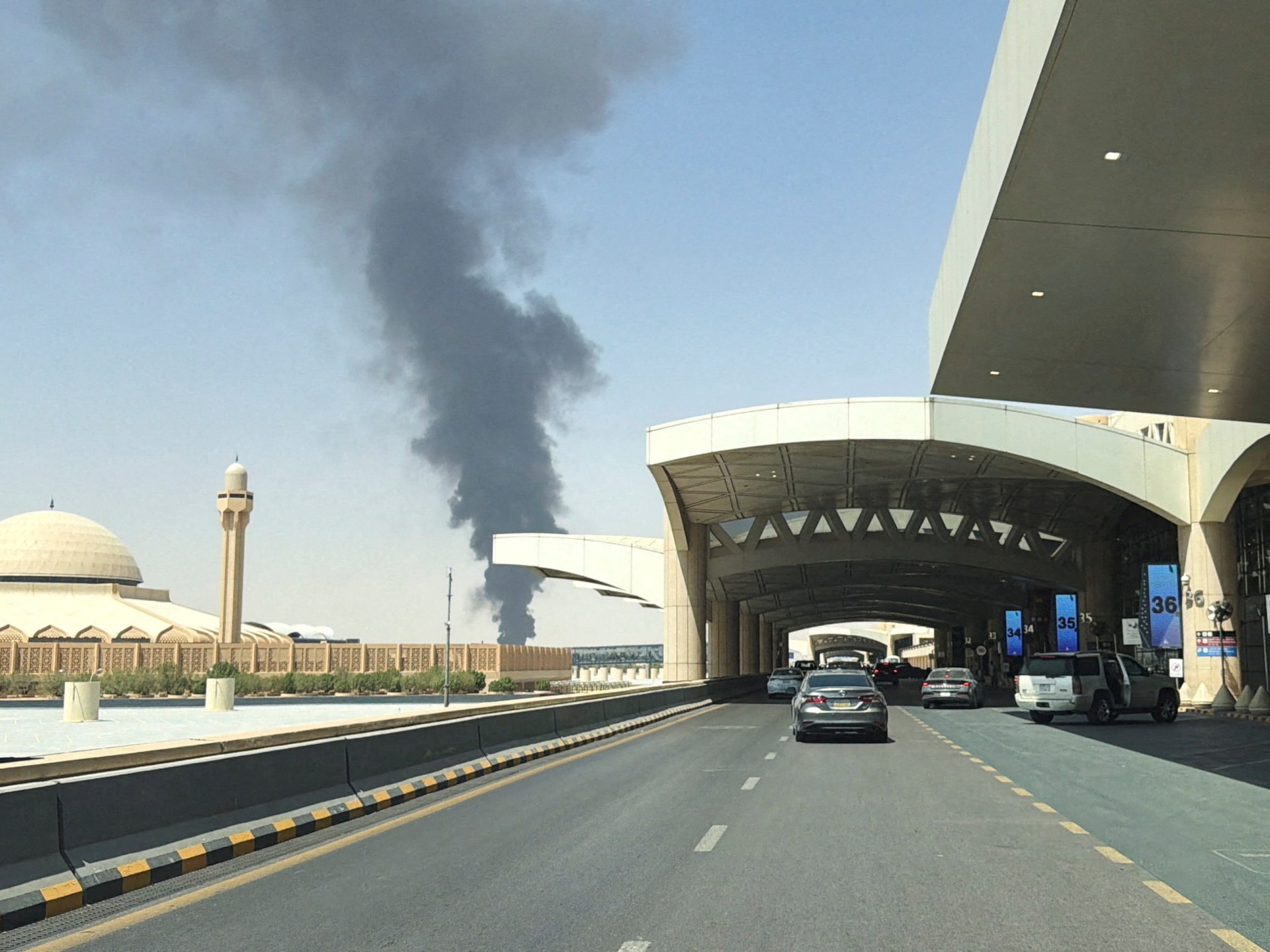
At least 12 people were killed and 309 injured in Saturday’s attack on King Khalid International Airport in Riyadh, Saudi Arabia’s civil aviation authority has said — figures released overnight that make it the deadliest attack in the kingdom in more than a decade.
The toll was carried on Sunday morning by the Daily Mirror and Hiru News, and by Al Jazeera, which described the attack as “the deadliest in the kingdom in more than a decade.” Some of the injured are in critical condition. Operations at the airport remain suspended and damage is still being assessed.
Who was killed
The civil aviation authority gave a nationality breakdown of the dead: four Saudis, two Bangladeshis, and one person each from the United States, Jordan, Palestine, Syria, Sudan and Egypt.
Those figures add to exactly 12. Because the published list accounts for every death reported, no Sri Lankan national is among the dead. That inference holds only for the dead: no nationality breakdown has been published for the 309 injured, and no filing addresses whether any Sri Lankan was among them.
The presence of two Bangladeshi workers among the dead is a reminder of how heavily the Gulf’s airports are used by South Asian migrant labour — the same corridor that carries Sri Lankan workers to and from the kingdom.
Coalition calls it a war crime
A Saudi-led military coalition has vowed to respond, blaming the Houthis. Coalition spokesman Major-General Turki al-Maliki said the attack on one of the passenger terminals caused deaths and injuries among civilian passengers and airport staff, and called it a “full-fledged war crime.”
An eyewitness in the domestic terminal said gate 401 was hit, describing “injured [people] in front of my eyes” and adding: “Everyone was running.”
The Houthis have still not claimed Saturday’s attack, though they claimed the earlier strikes this week. A projectile also fell near King Fahd International Airport in Dammam, in eastern Saudi Arabia, on Saturday, the coalition said.
International condemnation
Al Jazeera reported condemnation from the United States, the United Nations, Egypt, Qatar, Palestine and Japan. US Secretary of State Marco Rubio said “We stand with the Kingdom of Saudi Arabia and its people,” and confirmed that an American citizen was among the dead. President Donald Trump called the attack “terrible.” UN special envoy Hans Grundberg described it as “a grave escalation.” Qatar called it “a serious violation of Saudi sovereignty.”
Western embassies warned their nationals away from the airport, and the UK Foreign Office told British nationals to avoid the area “until the airport is secure.”
The week’s attacks, reconciled
This article previously noted that outlets reported the earlier death tolls differently and that we had not reconciled them. The figures now resolve into three separate rounds:
- Tuesday 6 and Wednesday 7 October — two airports, 3 killed, 36 injured. NewsFirst reported the civil aviation authority’s breakdown: at Abha International Airport, two female residents — a Moroccan and an Algerian — were killed and 28 injured; at King Khalid International Airport, a Sudanese citizen was killed and eight injured, five of them Saudis. Those components sum exactly to the 3 and 36 announced.
- Thursday 8 October — Riyadh airport, 3 killed. Three Saudi nationals, including a pilot.
- Saturday 10 October — Riyadh airport, 12 killed, 309 injured.
That gives 18 people killed at Saudi airports in a single week. One figure still does not fit: the Reuters account carried on Saturday put the week’s toll at four killed in two attacks, which matches neither the 3-and-3 breakdown nor any subset of it. It appears to have been an interim count, but no source reconciles it, and we have not.
A Sudanese citizen was killed in the 6–7 October round and another Sudanese citizen on Saturday. These are separate deaths in separate attacks and should not be read as one.
A note on sourcing
The Daily Mirror and Hiru News accounts of the toll are the same BBC wire copy, published in near-identical terms — the Daily Mirror’s version opens by attributing it to the BBC. They are two verified Sri Lankan newsrooms carrying one report, not two independent confirmations. The NewsFirst account of the earlier attacks likewise credits Al Jazeera as its source. Al Jazeera’s own Sunday filing is the independent reporting here, and the underlying figures in every version come from the Saudi civil aviation authority.
Flights diverted
Flight-tracking site Flightradar24 showed all flights to Riyadh either diverted or cancelled. Kuwait Airways cancelled flights to and from Riyadh citing the “security situation”, and Etihad Airways and Qatar Airways had already cancelled multiple flights, some extending into Monday. Organisers of major energy and investment conferences due in Riyadh said on Saturday they would go ahead as planned.
What this means for Sri Lanka
Saudi Arabia is among the largest destinations for Sri Lankan migrant labour, and the disruption has already reached Sri Lankan aviation. SriLankan Airlines suspended its Riyadh flights until 18 October and had separately relocated its Riyadh office.
The Foreign Ministry condemned attacks on Saudi civilian airports in a statement reported on Saturday. That statement referred to “recent attacks” without naming any event, and predates the casualty figures.
Separately, a Sri Lankan migrant worker, Anojan Sivarasa, is on death row in Saudi Arabia and his appeal to the Saudi Supreme Court was filed this week.
Not reported
No nationality breakdown has been published for the 309 injured, and no filing says whether any Sri Lankan was among them. No account states what munition struck the terminal: Al Jazeera’s video caption refers to ballistic-missile debris and the coalition reported intercepting a ballistic missile north of Riyadh during the earlier round, but neither establishes what hit gate 401 on Saturday. It is not reported whether air defences engaged, or whether warning sirens sounded.
It is not reported whether the Sri Lankan Embassy in Riyadh has issued advice to the community there, whether SriLankan Airlines will extend its suspension beyond 18 October, or when the airport expects to reopen. No filing says how the Saudi-led coalition intends to “respond”, and the Houthis have not explained their silence on an attack they are blamed for.
Update, 11 October: the Houthis break their silence, and condemnation widens
The Houthi silence noted above has ended. On Sunday the group’s military spokesman Yahya Saree warned airlines, aviation staff and travellers against using any Saudi airport or airspace, saying Saudi Arabia “bore responsibility” for failing to intercept the missiles that struck Riyadh. That is not a formal claim of the attack, but it is the group addressing it directly and treating Saudi airports as, in Saree’s words, “a theatre of operations for our forces”. Mecca and Medina were named as the only exemptions.
International reaction
NewsFirst reported a wide round of condemnation on Sunday.
US Secretary of State Marco Rubio said the attack killed an American — the first nationality to be individually identified in any filing — and called for an end to “these reprehensible attacks”. President Donald Trump, asked whether the United States would join the war against the Houthis, said: “We may. We’re gonna look at it. We just found out about the recent attack, so we’ll make a decision. We’ll move very quickly.”
UN special envoy for Yemen Hans Grundberg called the strikes on civilian airports “a grave escalation” posing “a serious threat to regional security”. Egypt, Qatar, Jordan and Oman condemned the attack; Pakistan, which recently activated a mutual defence pact with Riyadh, called it a “heinous act of terrorism”.
What this closes
Two items flagged above are now answered: the Houthis have spoken, and a nationality has been named among the dead — an American, per Rubio.
The nationality question is not fully closed. The published list referred to above accounts for all 12 dead and contains no Sri Lankan, but no breakdown has been published for the injured, and no filing says whether any Sri Lankan was among them. Still open too: what munition struck the terminal, when the airport will reopen, whether SriLankan will extend its suspension past 18 October, and what form the coalition’s promised response will take.
Sunday’s filings put the wounded at “more than 300” rather than the 309 given by Saudi authorities and used above; the two are consistent, the former being the rounder figure.
A second strike, on Sunday evening
The airport was attacked again on Sunday evening, after the warning described above. A projectile struck Terminal 4, starting a fire, and the coalition said air defences destroyed a cruise missile nearby; Al Jazeera reported further injuries, and the Riyadh Metro suspended service to two of the three stations serving the airport. That strike is covered in our report on the Houthi warning. It is a separate event from Saturday’s attack described here, and no death has been attributed to it. It also means the question raised above — when the airport expects to reopen — has moved further out of reach rather than closer to an answer.
Update, 12 October: the airport is still shut, and no reopening date has been set
King Khalid International Airport remained closed on Monday, two days after Saturday’s attack, Hiru News reported.
Saudi Arabia’s civil aviation authority said the airport would stay shut while engineers checked its facilities for safety, and that the suspension was later extended for further inspections. No reopening date was given. Hundreds of flights have been cancelled, with airlines diverting or grounding services.
This closes, negatively, one of the questions flagged above. The article asked when the airport expected to reopen; the answer as of Monday is that the authority has declined to set a date and has already extended the closure once. That matters for a second open item too: SriLankan Airlines has suspended its Riyadh and Dammam services until 18 October, a date that now rests on an airport with no published reopening schedule.
The travel-advice list has also grown. Saturday’s filings recorded warnings from the United States and the United Kingdom; Hiru’s Monday account adds Spain and Canada, bringing to four the number of governments telling their nationals not to use the airport.
One characterisation that does not match the record
Hiru’s Monday copy states flatly that “the Iran-aligned Houthis, who control much of Yemen, claimed the attack.” That does not sit easily with what has been reported so far, and this desk is not treating it as settled.
As recorded above, the Houthis had not claimed Saturday’s attack, and the group’s 11 October statement — Yahya Saree’s warning against using Saudi airports, in which he said Saudi Arabia “bore responsibility” for failing to intercept the missiles — was explicitly not a claim of responsibility. A warning framed around the kingdom’s failure to intercept is a different act from an admission of having fired.
Hiru’s filing is wire copy and may be compressing the warning into a claim. It is equally possible the group has since claimed the attack outright and Hiru is the first filing available here to carry it. No source fetched for this report resolves which. The attack continues to be blamed on the Houthis by the Saudi-led coalition; whether they have now formally claimed it remains open.
Hiru also notes that an earlier strike on the airport days before had likewise cancelled hundreds of flights, with operations returning to normal the following day — a contrast that underlines how much more damaging Saturday’s attack was.