Update, 11 October: A second verified newsroom has filed on the same rally. Hiru News reports a fifth commitment NewsFirst did not carry — a drug-eradication programme — and attaches two years of seizure figures to it. See The drug programme, and the figures behind it.
Second update, 11 October: Three further Hiru filings from the same platform carry the rally’s spending commitments — a public sector salary increase in January 2027 with named figures, a target of 2,000 wellness centres, and a plan to cut heart-surgery waits from seven or eight months to one. See The rally’s second half: what it commits money to.
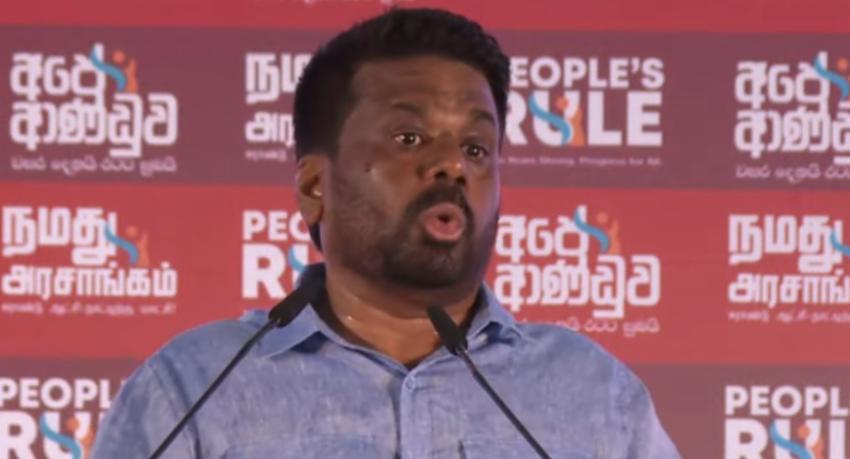
President Anura Kumara Dissanayake has said a Bribery Commission will be established in every province, and that those opposing the equal application of the law have yet to accept the principle of equality before it, NewsFirst reported.
Speaking at a rally in Nikaweratiya on Sunday, the President said the law was being enforced equally regardless of who was involved.
What was announced
Alongside the provincial Bribery Commission plan, Dissanayake made three further commitments:
- Those accused of stealing public assets will be brought back to Sri Lanka to face justice, “regardless of where they are hiding in the world”.
- Sri Lanka will pursue an independent foreign policy without aligning itself with any other country.
- Three expressways are being constructed using public funds alone, which he described as a first in the country’s history.
”Every province” is a smaller claim than what the Commission has already announced
The provincial pledge needs setting against what the Commission to Investigate Allegations of Bribery or Corruption has itself said it is doing — and the two do not line up neatly.
On 3 October this newsroom reported that CIABOC Director General Ranga Dissanayake told Parliament’s Committee on Public Finance the Commission is recruiting 971 staff and aims to open 23 regional offices before the end of the year, as part of an IMF-linked expansion. Those estimates were approved by the committee on 29 September.
Sri Lanka has nine provinces and twenty-five districts. A commission office in each province would therefore be a narrower network than the 23 offices CIABOC has already costed and begun to site through District Secretaries. No filing reconciles the two figures, and the President’s remarks do not say whether the provincial offices are the same programme described in different terms, a first phase of it, or something additional.
The funding point is less ambiguous. The expansion CIABOC described is already inside approved budget estimates rather than awaiting a new allocation.
The numbers behind the “equal application” claim
The President’s assertion that the law is being enforced equally has a figure attached to it from three days earlier. Deputy Minister of Public Security Sunil Watagala told Parliament on 8 October that 16 former ministers and three former state ministers have been convicted in CIABOC cases since the NPP took office, and that 226 people have been arrested over bribery and corruption allegations between October 2024 and October 2026, 55 of them politicians.
Those are convictions and arrests of former office-holders, which is the government’s answer to the charge that the drive is selective. It is not, on its own, evidence that the law is applied equally — the opposition’s complaint is about who is not being investigated, and no filing addresses that.
A pledge with a live test case
The commitment to repatriate those accused of taking public assets was made on the same day police confirmed steps to bring home an organised crime suspect arrested in Bulgaria under an Interpol Red Notice. That case concerns organised crime rather than public-asset theft, so it is not an example of the pledge in action — but it is the machinery the pledge would rely on, and it is currently being used.
Update: the drug programme, and the figures behind it
The President used the same Nikaweratiya platform to set out a programme to “completely eradicate” the drug menace, and gave two years of seizure figures for it, Hiru News reported.
This is a fifth commitment from the rally, alongside the four above, and it is the one the second filing is built around — an illustration of how differently two newsrooms can frame the same speech. NewsFirst led on equal enforcement of the law and did not mention drugs; Hiru led on drugs and did not mention the provincial Bribery Commission plan.
Dissanayake said the programme was launched under the leadership of Minister Ananda Wijepala, and that over the past two years it had seized:
- 3,511 kg of heroin
- 6,206 kg of ICE (methamphetamine)
- 308 kg of cocaine
The President reached for a deliberate comparison to convey the scale of the heroin figure, noting that a standard bag of fertiliser holds 50 kilograms. On that measure the seizure amounts to roughly 70 fertiliser sacks of heroin. He said the quantity demonstrated the severity of the problem the country faces, and that the volume of drugs entering Sri Lanka made eradication necessary.
How this sits against the rest of the speech
The seizure figures are presented as a record of enforcement over the government’s term, which puts them in the same category as the conviction and arrest numbers above: output figures offered as evidence that the machinery is working. They are, again, not a measure of the thing being claimed. Seizure volumes rising can mean interdiction is improving or that more is being trafficked, and the filing does not distinguish between the two or give a baseline from before October 2024 to compare against.
Hiru does not say where the figures come from — whether from the Police Narcotics Bureau, Customs, the Navy or a combination — or over what precise period they were compiled. “The past two years” is consistent with the government’s term but is not dated in the filing.
A second Sunday filing dates the programme, and it does not match the two-year window. The Sunday Times, reporting the same minister’s plan to buy container scanners for the ports, dates the launch of Ratama Ekata to 30 October 2025 — meaning the programme is about to complete its first year, not its second. The two-year seizure totals above therefore cannot all be programme figures; they span a period closer to the government’s full term. This newsroom’s own earlier reporting supports the October 2025 start date independently: police figures published at the end of July 2026 covered “nine months” of the operation, which counts back to the end of October 2025. The President’s attribution of the programme to Mr. Wijepala’s leadership is not in question; the arithmetic of the period attached to the figures is.
The drug commitment also connects to the repatriation pledge above. Several of the organised-crime suspects Sri Lanka has sought to bring home, including the suspect arrested in Bulgaria on the day of this speech, are wanted in connection with narcotics trafficking rather than public-asset theft — which makes the drug programme, not the asset-recovery pledge, the part of the speech that case actually belongs to.
The rally’s second half: what it commits money to
The same Nikaweratiya platform — a rally themed Ape Anduwa Vasara Dekai, Ratata Subhai (“Our Government, Two Years — Good for the Country”) — carried a set of spending commitments that the first two filings did not report at all. Three further Hiru filings cover them.
A public sector pay rise in January 2027
A second salary increase for public servants is scheduled for January 2027, following the one granted in the administration’s first budget, Hiru News reports. The President attached two worked examples:
- A teacher on a basic salary of Rs. 38,000 would rise to close to Rs. 65,000 — an increase of roughly 71%.
- An entry-level doctor on Rs. 50,000 would rise to Rs. 94,000 — an increase of 88%.
Dissanayake framed the increase as a retention measure rather than a reward, saying doctors, nurses and teachers need proper salary tiers and facilities “to prevent them from leaving the country”. Emigration of professionals, not pay equity, is the stated rationale.
These are basic salary figures. Neither filing says what the increases do to gross pay once allowances are counted, what the measure costs the Treasury, or whether it applies uniformly across grades.
This is the first time a date has been attached to the next increase in this newsroom’s coverage. The Salaries and Cadre Commission was launched on 4 August, and in September the Prime Minister told Parliament the commission’s work was still in progress without giving an implementation date. Whether January 2027 is the commission’s recommendation or a political commitment ahead of it is not stated in any filing.
2,000 wellness centres, and a one-month heart surgery target
The government intends to operate 2,000 wellness centres in total — the existing 1,000 plus 1,000 new ones — which would be one centre for every 10,000 families, Hiru reports. The stated purpose is control of non-communicable diseases, with diabetes, high cholesterol and high blood pressure named specifically.
This doubles a target this newsroom covered at its launch. The Arogya programme’s first 1,000 wellness centres were announced on 31 August. The rally does not say over what period the second thousand would be built, what they cost, or how they would be staffed — which is the binding constraint, given the same speech identifies health worker emigration as the problem the pay rise is meant to solve.
Dissanayake also said patients currently wait seven to eight months for heart surgery in a government hospital, and that the aim is to supply early-detection equipment and bring surgery within one month. No filing gives a target date for that, or says where the waiting-time figure comes from.
The public service as the constraint
The connecting argument across these filings is that money allocated is not money delivered, Hiru reports. The President put it in terms of two allocations:
“We allocated Rs. 35,000 million from the 2026 budget for the development of small tanks, ponds, and canals. That money can be allocated from the budget, and the Irrigation Minister can direct those activities. But who comes to the village to build the tank, prepare the required estimates, call for tenders, and award contracts? All of that must be done by the public service.”
He made the same point about disaster and development work, describing a process of selecting houses and paying Rs. 2 million as a first instalment and Rs. 3 million as a second, and concluded that “the main strength in building this country is the public service.”
That argument is the thread tying the rally together: the anti-corruption machinery in the first half of the speech and the pay and health spending in the second are both, on the President’s account, dependent on the same delivery capacity.
Update, 12 October: a third newsroom supplies the speech’s own structure
A Daily Mirror filing gives the architecture the first two accounts left implicit: the President set out five pillars he described as essential to national development, the paper reported in a filing by Darshana Sanjeewa Balasuriya.
The five are: the rule of law; the elimination of fraud and corruption; a strong public service; peaceful relations with other countries; and harmony among the Sinhala, Tamil and Muslim communities.
That list is worth setting against this article’s own construction. The five pillars map almost exactly onto what this desk had to assemble from five separate filings across two newsrooms — equal enforcement of the law and the anti-corruption machinery from NewsFirst, the independent foreign policy from NewsFirst, the public service as the binding constraint from Hiru, and the drug programme as the enforcement arm. The President had given the speech a stated framework; neither of the first two outlets reported it.
Dissanayake argued the sequence matters. While infrastructure development including roads and reservoirs was important, he said, the fundamental systems necessary for the country’s progress had to be strengthened first — a country could not move forward if its people remained divided, its relations with other nations deteriorated, or corruption and weaknesses in the legal system continued.
What the law-and-order pledge is buying
The Daily Mirror carries spending detail on the justice system that the earlier filings did not. The government is investing in facilities for the country’s approximately 80,000-strong Police force, including new headquarters, vehicles and communication equipment.
Alongside that, the President named three further commitments: strengthening the Attorney General’s Department, ensuring an independent and digitally equipped judiciary, and developing a prison system that prioritises rehabilitation. He said these investments were essential to establishing the rule of law.
This is the first figure attached to the enforcement side of the rally’s anti-corruption argument. The commitments above — a Bribery Commission in every province, repatriation of those accused of taking public assets — all depend on investigative and prosecutorial capacity, and the AG’s Department in particular is already carrying work such as the coal commission’s 18 notices alongside the CIABOC caseload described above.
Impunity, named by activity
The sharpest line in the filing identifies what political protection has meant in practice. Dissanayake said the era in which individuals enjoyed political protection from law enforcement was over, criticising past practice under which people wielding local political power allegedly engaged in illegal activities — unauthorised logging, sand mining and illicit liquor production — without facing legal consequences.
“There are no longer special laws for anyone,” he said.
Naming the activities changes the register of the claim. The equal-enforcement argument reported above is about former ministers and national office-holders, measured in convictions and arrests. This is about the local level, in a rural electorate, and about the three extractive and excise offences in which a provincial politician’s protection is most immediately useful.
He went on to criticise a political culture in which parliamentarians, ministers, presidents and their family members were accused of treating public wealth as personal property, and pointed to what he called a double standard in the administration of justice — large-scale corruption involving powerful individuals going unpunished while ordinary citizens faced consequences for minor offences. Eliminating that disparity, he said, was the primary objective of the NPP government.
That partly engages the objection this article raised above. The point made earlier is that conviction and arrest counts do not demonstrate equal application, because the opposition’s complaint concerns who is not investigated. The President’s own framing is about the same asymmetry read in the other direction — the powerful escaping while the poor do not. Neither account addresses the opposition’s version of the charge, but the Daily Mirror’s filing at least shows the President arguing about selectivity rather than only citing output figures.
One caveat on the date
The Daily Mirror does not date the speech. It places it at “a public gathering in Nikaweratiya” and was published on Monday 12 October. The rally reported above was held on Sunday 11 October, and this paper routinely files rally and press-briefing coverage a day or more behind. The venue and the themes match, and this desk treats the filing as a day-late account of the same rally. No filing states this, and if it proves to be a separate appearance in the same town the two would need to be distinguished.
Not reported
The Daily Mirror does not give a cost or timetable for the police headquarters, vehicles or communication equipment, say how the Attorney General’s Department will be strengthened or by how much, or explain what a digitally equipped judiciary involves in practice. It gives no figures for the prison rehabilitation commitment.
It names no individual and no case under the illegal logging, sand mining or illicit liquor claim, and does not say whether any prosecution has followed against a locally powerful figure for those offences — which is what would distinguish the pledge from the practice it describes.
Hiru does not break the seizure figures down by year or by agency, give a monetary value for them, or say how many arrests or prosecutions followed. Neither filing reports the number of drug-related deaths or treatment admissions over the same period, which is the measure that would show whether the programme is reducing harm.
NewsFirst does not say when the provincial commission offices would open, what they would cost, or whether legislation is required. It does not name the three expressways, give their cost, or say what “public funds alone” excludes — whether concessional loans, supplier credit or foreign grants.
No named individual is identified under the repatriation pledge, and no extradition request is cited. The filing carries no response from the opposition figures the President’s remarks about equality before the law were directed at, and does not name them.
Sources: NewsFirst, Hiru News.
Ada Derana also carried the provincial Bribery Commission announcement on 11 October. Its domain has been returning a CloudFront block to this desk for twenty-two days, so its account could not be fetched and is not cited here. The Island appears to have reported the same speech, but the page returned a redirect on every fetch route and could not be dated or verified.