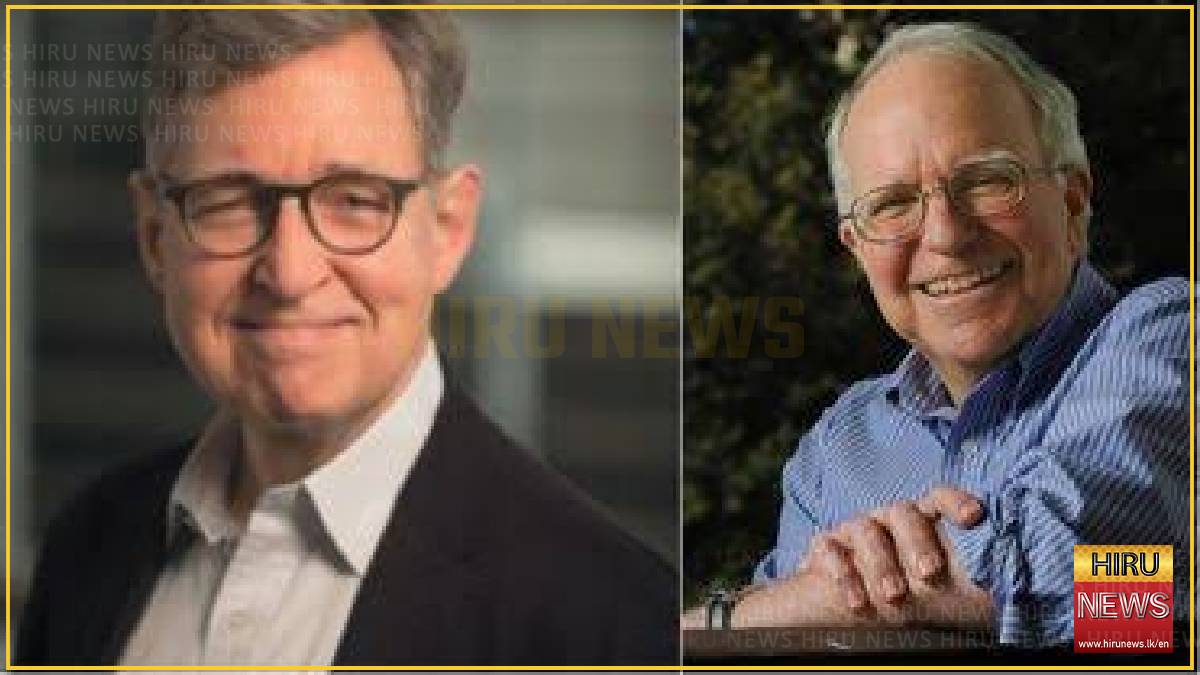
US academics Robert Hall and Michael Woodford have won the 2026 Nobel economics prize “for microeconomic foundations of macroeconomic stabilisation”, the Royal Swedish Academy of Sciences announced on Monday, according to Hiru News, which carried a Reuters report of the announcement.
The award is formally the Sveriges Riksbank Prize in Economic Sciences in Memory of Alfred Nobel, and is worth 12 million Swedish crowns — about US$1.2 million. It is the last of this year’s prizes to be announced.
What the work does
The academy said the two laureates developed macroeconomic models that improved the ability to implement effective stabilisation policy, allowing fiscal and monetary measures to be timed so they reduce the intensity of damaging swings in the economy.
“The laureates’ work has provided us with a stable theoretical foundation for the models that are now used by central banks and governments around the world,” said John Hassler, chair of the Committee for the Prize in Economic Sciences.
“With them, we are better equipped to deal with shocks in the economy, such as energy crises or sudden changes in how much households consume.”
The prize itself
The economics prize was first awarded in 1969. It is not one of the five original awards created in Alfred Nobel’s 1895 will, having been established later and endowed by Sweden’s central bank.
Most previous laureates have been from the United States. Only three women have ever won it, most recently Claudia Goldin in 2023, for work on how gender has affected pay and employment over time in the United States.
Last year’s prize went to Joel Mokyr, Philippe Aghion and Peter Howitt for work on “creative destruction” and how new technology and production methods can raise growth and living standards.
Analysis published before the announcement by the Institute for Scientific Information, part of Clarivate, had identified researchers working on monetary policy, the economics of information technology and evolutionary economic theory as possible recipients.
Update, 13 October: the affiliations, the split and the mechanism
The Daily FT has now filed its own account of the announcement, naming both laureates’ institutions and confirming how the prize is divided — three of the four items listed as unreported below.
Robert E. Hall is Professor of Economics at Stanford University and the Robert and Carole McNeil Senior Fellow at its Hoover Institution. He holds a BA in economics from the University of California, Berkeley and a PhD from MIT, taught at both, and joined Stanford in 1978. Michael Woodford is the John Bates Clark Professor of Political Economy at Columbia University, with a BA from the University of Chicago, a JD from Yale Law School and a PhD in economics from MIT; he has been named both a MacArthur Fellow and a Guggenheim Fellow.
The SEK 12 million will be shared equally between the two, who also receive a diploma and a medal. The awards will be presented in Stockholm in December, on the anniversary of Alfred Nobel’s death.
The Daily FT also supplies the mechanism the first account omitted. Central to the laureates’ models is that households and businesses look ahead when deciding how much to save or what prices to set — so by communicating their policy plans, governments and central banks can shape those expectations and steer the economy. The academy’s assessment is that recessions and bouts of high inflation have not disappeared but now tend to be shorter-lived.
By the Daily FT’s count the economics prize has now been awarded 58 times to 101 laureates.
One apparent discrepancy is not one. This article dated the prize’s first award to 1969; the Daily FT says it was established in 1968. Both are correct — Sweden’s central bank endowed it in 1968 and the first award was made the following year.
Sourcing note
This report was single-sourced when first published. Hiru News carried the announcement as a Reuters wire report; Reuters’ own site is not reachable for citation from this desk. At that time no other verified Sri Lankan newsroom had filed — the Daily Mirror’s international section, NewsFirst and Daily FT all showed nothing, and a verified-domain search returned only earlier editions of the prize (2021, 2023 and 2025). The Daily FT filed the next morning, and the report now rests on two verified newsrooms.
The citation wording above is reproduced as the academy issued it, including its own phrasing.
Not reported
Neither filing gives the laureates’ ages, and neither carries any reaction from either laureate.