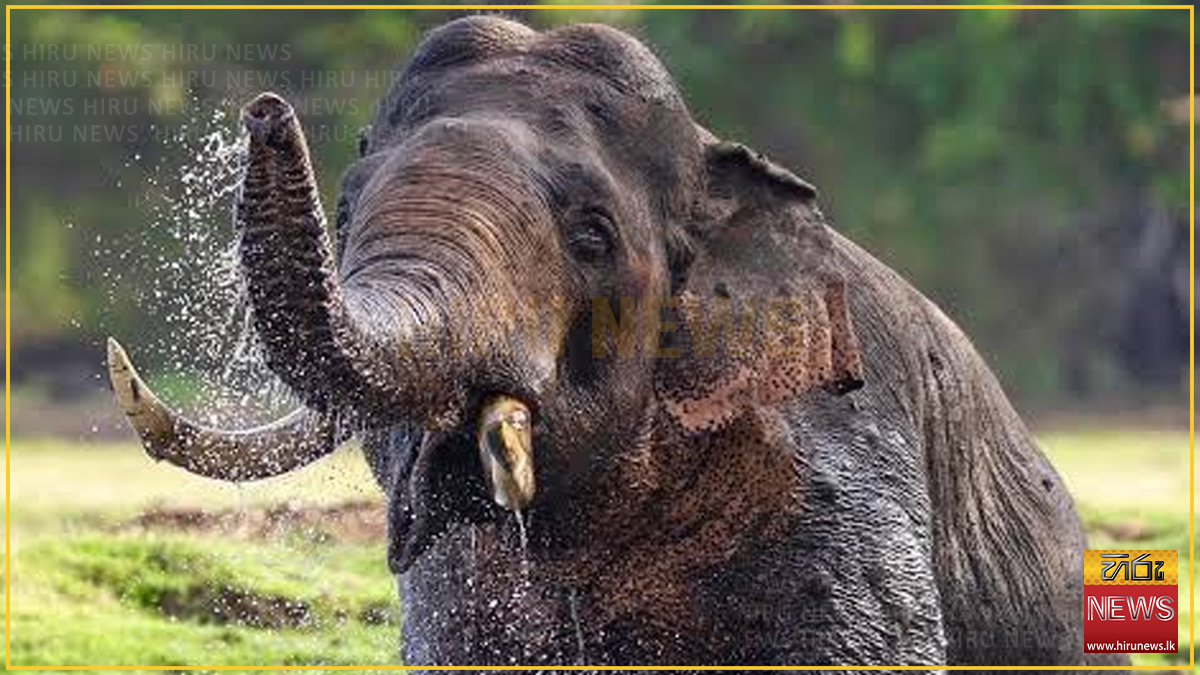
Update, 19 October, 1.10 p.m.: Agbo has been found. The Defence Secretary has confirmed the tusker was located in the Nachchaduwa reserve after the joint Army–Wildlife Conservation operation. Hiru’s filing gives no assessment of his condition and does not repeat the Daily Mirror’s description of him as injured, saying instead that the operation was launched to examine his “health condition and safety.” See the update at the foot of this article.
Update, 19 October: The search resumed on Monday with drones, and an SLAF surveillance drone is expected. The Daily Mirror now describes Agbo as injured and says the operation aims to give him “prompt medical treatment” — the first time any filing has said he is hurt. The two outlets also give irreconcilable team sizes: NewsFirst has 30 Army personnel, the Daily Mirror has 65 soldiers plus 10 wildlife officers. See the update at the foot of this article.
Update, 18 October evening: The search ran all day without finding him. Thirty Army personnel from the 21st Infantry Division are searching with wildlife officers; the operation was ordered by President Anura Kumara Dissanayake and Defence Secretary Air Vice Marshal Sampath Thuyyakontha (Retd) — both unnamed in the morning’s filings. A farmer reported Agbo passing his hut at 3 a.m. heading for Nachchaduwa Tank, and wildlife officials believe he is in musth. See the update below.
A special military team has been deployed to search for the wild tusker Agbo on the orders of the Secretary to the Ministry of Defence, the Ministry of Environment announced on Sunday.
The deployment followed a discussion between the Minister of Environment and the Defence Ministry Secretary held to speed up the search, Hiru News reported at 2.12 p.m. The Secretary then ordered the team out.
The ministry said the operation is intended to identify Agbo’s location quickly and to ensure his safety completely, and that all necessary operational work is being carried out with the full cooperation of the relevant state institutions, citing the national importance of protecting the country’s wild elephants.
The Daily Mirror carried the same announcement twenty minutes later, adding that the ministry stressed the importance of protecting Sri Lanka’s wild elephant population.
The ministry does not say where Agbo is
The central fact in both filings is contained in the purpose rather than stated outright: the state does not currently know where one of its best-known tuskers is. The Environment Ministry’s stated aim is to “identify the location where Agbo is” — language that only makes sense if his whereabouts are unknown.
Neither filing says when Agbo was last seen, where he was last recorded, how long he has been unaccounted for, or what prompted the ministry to escalate now. Neither gives the size or composition of the military team, which service it is drawn from, or what area it is searching. Neither explains what specific threat the phrase “ensure his safety completely” is meant to address.
Why a military team, two days after Kavantissa died
Deploying soldiers to look for a single wild animal is an unusual step, and the filings offer no reason for it. The archive supplies the context that both omit.
The tusker Kavantissa died on 16 October at Siyambalangamuwa — two days before this order — after months of treatment for a gunshot wound. His death is now the subject of a court-ordered post-mortem, a separate Environment Ministry inquiry, and a police investigation.
That police investigation was requested on the same morning as this deployment. The Ministry of Environment’s Secretary wrote to the Inspector General of Police asking for an immediate and comprehensive inquiry into Kavantissa’s death and into whether an organised group is involved in killing wild elephants in Sri Lanka. The Daily Mirror filed that story at 1.48 p.m. and the Agbo story at 2.32 p.m. — 44 minutes apart, both sourced to the same ministry, and neither mentions the other.
Agbo’s standing is also on the record in this archive. Opposition Leader Sajith Premadasa, speaking after Kavantissa’s death, named Agbo alongside Mahasen and Sando as among the country’s largest tuskers. These are a small and individually known group of animals.
So the sequence available to a reader is: one of that group dies on Thursday; on Sunday morning the ministry asks the police whether elephants are being killed by an organised group; and on Sunday afternoon the same ministry sends soldiers to find another member of the group and guarantee his safety.
No filing connects these three events, and this desk does not assert a connection. The ministry has not said Agbo is believed to be in danger, nor that his disappearance is linked to Kavantissa’s death. The proximity is recorded because it is visible only when the filings are read together, and because the question it raises — whether the search is precautionary or a response to something — is the one neither outlet asked.
Not reported
Beyond the gaps above: no filing names the Environment Minister or the Defence Secretary involved in the discussion, gives the date of that discussion, or says whether the Department of Wildlife Conservation — the agency with statutory responsibility for wild elephants — is leading, assisting or absent from the operation. None says whether a search was already under way before the military was brought in.
This desk was also unable to establish Agbo’s documented history against any reachable verified newsroom. Ada Derana reported this story but has been unreachable from this desk for 29 days, returning an HTTP 403 from its content delivery network, so it is not cited here.
Update, 18 October evening: a day of searching, no confirmed sighting
The joint Army and wildlife search ran through Sunday without establishing where Agbo is, and will resume on Monday, the Environment Minister said, the Daily Mirror reported at 9.01 p.m.
Two evening filings answer most of the questions this article listed as unreported a few hours earlier.
The team, the orders, and the names
The search party is drawn from the 21st Infantry Division and numbers 30 Army personnel working alongside wildlife officers, Hiru News reported at 6.11 p.m. Named officers include Major General Kaminda Silva, Brigadier Basnayake and Major Silva.
Hiru also supplies the chain of command the morning filings left blank. The operation was begun on the instructions of President Anura Kumara Dissanayake and on the orders of Defence Secretary Air Vice Marshal Sampath Thuyyakontha (Retd), acting on a request from the Environment Minister. That the President is personally in the chain was not reported anywhere on Sunday morning.
So three of the four gaps identified above are now closed: the team’s size and composition, the Defence Secretary’s identity, and the Department of Wildlife Conservation’s role — wildlife officers are searching jointly, not standing aside.
Where they are looking
The search is spread across a wide stretch of the Anuradhapura District, which is itself informative about how little is known.
Hiru places the Army party in forest land in the Thirappane area. The Daily Mirror has the 21st Division searching along the right bank of the canal carrying water from Eheiyiya Wewa to Mahakanadarawa — a different part of the district. A separate team received a report from a farmer in Thodamaduwa who said Agbo passed near his hut at around 3 a.m. on Sunday, heading towards Nachchaduwa Tank.
During the canal search a herd including a tusker resembling Agbo was spotted, but the animals moved into dense forest before wildlife officers and soldiers could get close enough to confirm the identification. No sighting has been confirmed.
Musth — and why that matters here
Wildlife officials believe Agbo is in musth, a period of heightened aggression in male elephants, and say he is moving rapidly, which is making the search harder.
That detail connects this search to the death it follows. Kavantissa was also in musth during his treatment, a fact the wildlife department disclosed the day before he died and gave as one reason treatment was difficult. A bull in musth ranges further, moves faster and is more dangerous to approach — which bears on both the difficulty of finding Agbo and on what anyone who does find him can safely do.
It also offers an ordinary explanation for a disappearance that the morning’s filings left looking ominous: an elephant in musth covering ground quickly is a reason for his location to be unknown that has nothing to do with the organised-killing question the ministry put to police the same morning. No filing draws either conclusion, and the ministry has still not said whether the search is precautionary or responsive.
Still not reported
No filing says when Agbo was last reliably recorded before the search began, how far the 3 a.m. Thodamaduwa sighting is from the areas being searched, or whether that sighting has been treated as confirmed. None says what the teams intend to do if they find him — whether he is to be tracked, collared, guarded or treated — or how long the deployment will continue.
Update, 19 October: Agbo is injured, drones are up, and the two outlets cannot agree on the team
The search resumed on Monday morning in the Nachchaduwa area, and the Daily Mirror’s account contains a fact no previous filing has carried: Agbo is injured.
The new fact is in the headline and the purpose
The Daily Mirror files the story under “Joint operation continues to locate injured elephant Agbo,” describes the target as “the injured elephant Agbo,” and states that the operation “aims to locate Agbo, monitor its condition and provide prompt medical treatment,” reporting at 10.26 a.m.
This changes what the search is. Every filing until now described an animal whose location was unknown, with the Environment Ministry’s stated aim being to “ensure his safety completely” — language this article read as unexplained. An operation to find an injured animal and treat it promptly is a different and far more legible undertaking.
The Daily Mirror does not say how Agbo was injured, how badly, when the injury was identified, or who established it. The word is introduced without explanation, in a report that otherwise reads as an operational update. NewsFirst, filing forty minutes later, does not mention an injury at all.
That omission matters because of what this archive already holds. Kavantissa died on 16 October after months of treatment for a gunshot wound, and the Environment Ministry asked police on 18 October to investigate whether an organised group is killing wild elephants. A second named tusker now described as injured, three days later, is a fact that invites an obvious question. No filing states the nature or cause of Agbo’s injury, and this desk does not infer one.
The team-size conflict
The two Monday filings give numbers that cannot both describe the same force.
| Source | Filed (Colombo) | Army | Wildlife | Total stated |
|---|---|---|---|---|
| Daily Mirror | 10.26 a.m. | 65 (9 officers, 56 other ranks) | 10 officers | 75 |
| NewsFirst | 11.06 a.m. | 30 | not given | 30 |
NewsFirst attributes its figure to the Ministry of Defence and places the team in forest land at Thirappane, reporting that the deployment was on the directives of President Anura Kumara Dissanayake and Defence Secretary Air Vice Marshal Sampath Thuyacontha. The Daily Mirror places the operation in Nachchaduwa and adds that the Officer-in-Charge of the relevant Wildlife Conservation Office is taking part.
Neither figure is adopted here. The obvious reading — that the force was reinforced overnight — does not survive the timestamps: the larger figure is in the earlier filing. NewsFirst’s 30 matches the figure Hiru reported on Sunday evening for the 21st Infantry Division party, which suggests NewsFirst is restating Sunday’s number against Monday’s operation rather than counting Monday’s. That is an inference, not a reconciliation, and the discrepancy stands unresolved.
A plausible alternative is that the two outlets are counting different things — one the original special team, the other everyone in the field on Monday across a search spread over several areas. No filing says so.
Drones
Drone technology is already being used to assist the search, the Daily Mirror reports, and a special surveillance drone from the Sri Lanka Air Force is expected to be deployed shortly. This is the first mention of aerial search assets in any filing, and it is a direct answer to the problem both Sunday reports described — a herd moving into dense forest before soldiers could confirm an identification.
The sighting is now corroborated by residents
Several wild elephants have been spotted in the search area, and residents have confirmed seeing Agbo there on Sunday afternoon, the Daily Mirror says. Authorities have still not determined his exact location, which the paper attributes to the size of the area being searched.
That firms up Sunday’s position considerably. The 18 October account rested on a single farmer’s 3 a.m. report at Thodamaduwa and an unconfirmed sighting of “a tusker resembling Agbo.” Residents placing him in the search area on Sunday afternoon is a second, later, independent line of evidence — though still not an official confirmation.
Still not reported
Beyond the injury questions above: no filing reconciles the team sizes, says whether the Thirappane and Nachchaduwa parties are the same operation, or gives the search area’s extent. None says what the SLAF drone adds over the drones already flying, or when it arrives. None says what the teams will do on finding him — the Daily Mirror’s “prompt medical treatment” is the first indication that treatment, rather than tracking or guarding, is the objective, and it is unexplained.
The question this article has carried since Sunday — whether the search is precautionary or responsive — is not closed by the word “injured,” because no filing says when or how the injury occurred.
Update, 19 October afternoon: Agbo has been found, and the word “injured” has quietly dropped out
The Defence Secretary has confirmed that Agbo was found in the Nachchaduwa reserve, ending a search that ran across two days. The filing announcing it does not say what condition he is in.
Hiru News reported at 1.10 p.m. on Monday that the Defence Secretary confirmed the tusker “was found while in the Nachchaduwa reserve” following the special joint search operation launched by the Sri Lanka Army together with the Department of Wildlife Conservation. It describes Agbo as having been missing in recent days, and says the operation was launched the previous day on the orders of the Secretary to the Ministry of Defence.
Hiru does not corroborate “injured”
This matters, and it should be stated precisely rather than smoothed over.
Hiru says the operation was launched to examine the tusker’s “health condition and safety” — the same hedged pairing the Environment Ministry used on Sunday, when its stated aim was to “ensure his safety completely.” It does not call him injured, does not mention an injury, and gives no condition assessment now that he has been located.
Only the Daily Mirror has used the word. Its Monday-morning filing titled the story “Joint operation continues to locate injured elephant Agbo” and said the operation aimed to “provide prompt medical treatment.” NewsFirst, filing the same morning, did not mention an injury. Hiru, filing on the moment the animal was actually found — the point at which anyone could see his condition — does not mention one either.
That is now one outlet out of three carrying the characterisation, and the outlet best placed to confirm it has declined to. This desk does not resolve the disagreement. The honest statement is that Agbo’s condition is unreported, and that a single filing’s description of him as injured remains uncorroborated.
The open question is still open
The question this article has carried since Sunday — whether the deployment was precautionary or responsive to something — is not answered by finding him. No filing says what the teams found, whether he was examined, whether any treatment was given, whether he will be monitored or tranquillised, or what happens to the operation now. None says where in the reserve he was, or at what time.
Nor does locating him touch the larger matter. Kavantissa died on 16 October after months of treatment for a gunshot wound, and on 18 October the Environment Ministry asked police to investigate whether an organised group is killing wild elephants. Agbo was named by the Opposition Leader as among the country’s largest surviving tuskers. Finding him alive is the first piece of good news in that sequence; it establishes nothing about why a military team was sent to look for him in the first place.
Not reported. No filing gives the size of the team that found him, reconciles the earlier conflicting figures of 30 Army personnel against 65 soldiers plus 10 wildlife officers, or says whether the drones or the expected SLAF surveillance aircraft played any part. None says whether the Thirappane and Nachchaduwa search parties were one operation. No veterinary statement has been reported.
Update — 20 October: good health, musth, and the origin of the word “injured”
The Daily Mirror reported on Tuesday morning that Agbo was spotted on Monday afternoon in the Nachchaduwa Tank Reserve by wildlife officials and military personnel together, and that officials observed him to be in good health and experiencing musth. Officers at Thirappane continue to monitor him.
That closes the question this article has carried since Sunday about the word “injured,” and the answer is that the injury was historical. Agbo, the filing says, is popularly known as the Thirappane elephant, and “recovered several years ago after receiving treatment from wildlife veterinarians and officials following a gunshot injury that left it in critical condition in the Thirappane area.” An old, healed gunshot wound is the most likely origin of the descriptor the Daily Mirror introduced on 19 October without explanation, and it explains why NewsFirst, filing forty minutes later, did not mention an injury at all.
Two things follow. First, the musth diagnosis that Hiru offered as a possible explanation for his ranging is now confirmed by observation rather than inference. Second, and more carefully: nothing here says the deployment was precautionary. Knowing that Agbo was healthy when found does not establish what the Defence Secretary knew when the order was given. That question stays open.
The nationwide picture the same filing sets out — a sick calf at Wewalketiya, a collapsed 12-year-old male at Gallalla, and an internal Wildlife Department investigation into Kavantissa’s treatment — is covered separately in this desk’s 20 October report. It also carries the first indication that Army involvement in elephant protection is being put on a standing footing rather than ending with this search.
Sources: Hiru News, 18 October, Daily Mirror, 18 October, Hiru News, 18 October evening, Daily Mirror, 18 October evening, Daily Mirror, 19 October, NewsFirst, 19 October, Hiru News — Agbo found (Sinhala), Daily Mirror, 20 October.