Update, 19 October: The toll this article could not verify on Sunday is now official. Four soldiers died and 39 people were hospitalised, at least 19 in critical condition. The dead are Sgt. Morgan Wong, Pte. Shaun Farrell, Pte. Aidan Goulding and Pte. Hayden Lykkemark. A grass fire had been burning a kilometre away for hours and the base’s range control judged it contained — then the wind shifted. See the update at the foot of this article.
People were killed and injured in a “serious incident” that set off a major fire at one of Canada’s busiest army bases on Saturday, the country’s defence minister has confirmed, without giving any casualty figure.
Defence Minister David McGuinty said in a video statement that “there have been both fatalities and injuries as a result of an incident at Canadian Forces Base Wainwright,” in eastern Alberta. He gave no number for the dead or injured and did not say what caused the blaze, calling it an “active and delicate situation” with an investigation to be launched shortly, CNN reported.
Asked by a journalist how the event compared with others, McGuinty said: “I cannot recall such an incident in my short time for sure as a minister … I cannot recall an incident like this in recent memory.”
What is known about the fire
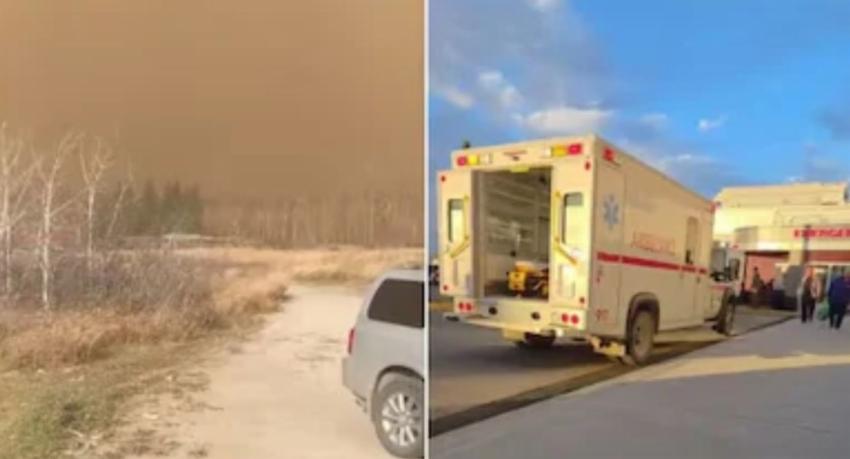
A call for assistance came in at about 4 p.m. local time, according to the Wainwright detachment of the Royal Canadian Mounted Police. The municipal district said in a Facebook post on Saturday evening that the fire “spread rapidly due to high winds,” and later that night said it was “being held at this time,” with crews continuing to monitor the area.
The municipality also reported that the fire had crossed the base fence into the neighbouring district, NewsFirst reported on Sunday morning, citing Reuters. No evacuation order has been issued. Residents have been asked to stay away from the area, keep roads clear, and avoid the Wainwright Health Centre except for critical medical needs.
The hospital response is the clearest indicator of scale
With no official toll, the medical response is the only published measure of how large this is.
A code orange — the emergency protocol declared when a hospital expects a high number of patients — has been declared in Edmonton. Dr. Warren Thirsk, an emergency department physician at the city’s Royal Alexandra Hospital, told a CNN affiliate that Wainwright’s own healthcare centres had been “completely overwhelmed” and that patients were being diverted to hospitals across Edmonton.
“It’s a one in every 15- to 25-year disaster,” Thirsk said.
Alberta Premier Danielle Smith called the event “significant and tragic,” saying it was “affecting many of our brave military personnel.”
The base
CFB Wainwright is one of Canada’s busiest army bases. It houses the Canadian Manoeuvre Training Centre and the 3rd Canadian Division Training Centre, and serves as a training ground for army field force units based in Edmonton. As of the 2021 census it had 1,310 military and civilian personnel. The town of Wainwright, population about 6,600, lies just north of the base.
The two sources differ slightly on its position: NewsFirst, citing Reuters, places it about 210 km (130 miles) east of Edmonton, while CNN gives the same distance southeast. Nothing else about the location is in dispute.
Prime Minister Mark Carney confirmed the fire stemmed from “a serious incident” without specifying details, and said the federal government was “working closely with the Government of Alberta and local authorities.” General Jennie Carignan, Chief of the Defence Staff, said Canadian forces were fully engaged with federal, provincial and local authorities: “Our priority remains the welfare of our members, their families and their community.” Opposition leader Pierre Poilievre said he had spoken to both McGuinty and Carney, thanked emergency responders and wrote: “Pray for Wainwright, everyone.”
The Canadian Armed Forces and the RCMP are investigating.
Not reported
Neither verified source gives a death toll, an injury count, or a cause. That is the central gap, and it is a gap in the official account rather than in the reporting — McGuinty was asked and declined to give figures.
Readers should be aware that Canadian domestic outlets were publishing both a specific death toll and a specific cause for the blaze during Sunday. This desk has not been able to verify either against a source on its verified list, and does not reproduce figures it could not confirm. Until a verified newsroom carries them, the toll here stands where McGuinty left it: fatalities and injuries, number unstated.
Also unreported: whether those killed were military personnel, civilian staff or contractors; whether a training exercise was under way at the time; how many people were on the base; and when the investigation’s findings might be published.
Update, 19 October: the toll, the names, and the decision to keep training
Every figure this article declined to publish on Sunday is now on the official record, and a verified source carries it. CNN’s report — already cited above — has been updated through Sunday’s briefings, which closes the gap this article recorded rather than requiring a new source for it. Hiru News carried the same account in Sinhala at 7.35 a.m. Colombo time on Monday, citing the BBC.
The toll
Four Canadian service members were killed. Thirty-nine people were in hospital as of Sunday afternoon and “at least 19 are in critical condition,” Alberta Premier Danielle Smith said at a press conference. A provincial health official said eight of the injured were stable and 12 were “ambulatory” with lesser injuries.
Prime Minister Mark Carney called it “one of the worst tragedies for the forces on Canadian soil in peacetime,” and said earlier on Sunday: “The nation is in mourning for those brave members of our armed forces whom we have lost.”
The dead
Canada’s military released the names on Sunday evening:
- Sgt. Morgan Wong, of the Loyal Edmonton Regiment
- Pte. Shaun Farrell, Pte. Aidan Goulding and Pte. Hayden Lykkemark, of the 3rd Battalion, Princess Patricia’s Canadian Light Infantry
The battalion was preparing to become a rapid-reaction force and to deploy to Latvia in the spring as part of NATO’s mission bolstering eastern European allies near Russia.
The sequence, and the judgement call inside it
This is the part that was entirely absent from Saturday’s reporting, and it is the heart of the story.
Maj. Gen. Wade Rutland said a grass fire had already been burning “for several hours” about one kilometre (0.6 miles) from the training area. The base’s range control decided the training activity could continue, because that fire was assessed as “contained” and was not expected to move “anywhere near” the soldiers.
Troops were then conducting “high-intensity combat training with live munitions,” including “throwing hand grenades on a hand grenade range” and running simulated attacks.
Then, in Rutland’s account, “uncommonly strong winds caused the fire to shift rapidly.” He said: “The fire was a kilometre away when the wind shifted; it is not normal for a fire to move a kilometre in 30, 60 seconds,” adding that he had never “seen anything like it.”
So the official account is not that a fire appeared without warning. It is that a known fire was judged safe to train beside, and then crossed a kilometre in under a minute. Rutland said an investigation would determine whether the tragedy was “preventable” — the word is his, and it frames the inquiry around the range-control decision rather than around the fire’s ignition.
What the military says it was not
The cause is under “active investigation.” The military does not believe the fire involved “any outside interference” or oil and gas infrastructure, and an official at the Department of National Defence told CBC there was no indication of terrorism.
On what ignited it, Rutland was explicitly non-committal: “There was a multitude of ordnance moving through the Wainwright training area yesterday. Grenade launcher, grenades, small arms, ammunition. Quite frankly, it could have been any of that, or none of it.”
That is a senior officer declining to rule out that his own exercise started the fire that killed his soldiers, while also declining to say that it did.
The medical response, quantified
Emergency Health Services Alberta deployed 30 units to Wainwright: 22 ground ambulances, six fixed-wing and two rotary-wing. The code orange recorded earlier in this article was lifted by Sunday afternoon.
Brandon Simmons, a resident of the Wainwright Health Centre’s long-term care unit, told Reuters the facility was quickly inundated with patients brought in military vehicles: “I heard people screaming inside of those vehicles that will never end up being out of my mind. It was just a scene from a war movie.”
Bruce Pugh, mayor of the neighbouring community of Wainwright, said the fire had crossed the base fence but was kept under control by firefighting teams.
A note on the Sinhala filing
Hiru’s Sinhala text renders the three privates’ ranks as “කෝප්රල්” — corporal — while reproducing the correct “(Pte …)” in parentheses beside each name. The ranks used above are those released by the Canadian military and carried by CNN: one sergeant and three privates.
Still not reported
No filing says what the four soldiers were doing at the moment the fire reached them, how far they were from the hand grenade range, or whether any warning was given. None reports the original grass fire’s cause, who at range control made the assessment, or against what wind forecast. None gives a timetable for the investigation, or says whether it is a board of inquiry, a military police investigation, or both — the Canadian Armed Forces and the RCMP were both reported to be investigating.
Sources: CNN, NewsFirst (citing Reuters), Hiru News (Sinhala, citing the BBC).