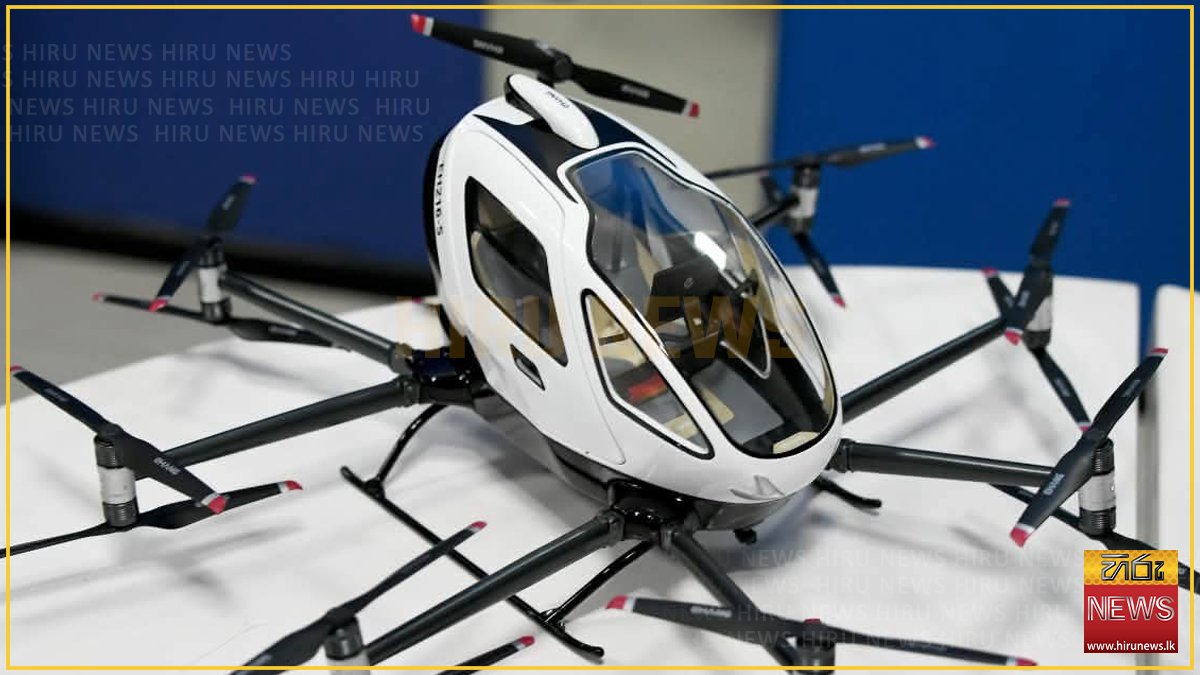
Sri Lanka’s first passenger-carrying drone has arrived in the country, and the Civil Aviation Authority expects to fly it for the first time from Colombo Port City before the end of this month.
The aircraft has landed at Bandaranaike International Airport, Civil Aviation Authority of Sri Lanka Director General Daminda Rambukwella told the Daily Mirror, which reported the arrival at 6.34 a.m. on Monday. He said the first flight is expected on 30 or 31 October, or during the first week of November, with Port City identified as the launch point.
The authority announced the arrival a day earlier, Hiru News reported at 5.47 p.m. on Sunday, saying the first flight had been arranged for the end of this month. Hiru adds the aircraft’s endurance: it carries two passengers at a time and can fly continuously for 30 minutes.
Hiru says Port City has been named the main operations centre for the service, and that flights for tourists at Sigiriya, Pidurangala and surrounding areas are also being planned. Sri Lanka obtained the opportunity through the “Global Fast Track Program” launched by EHang to speed the introduction of drone-based aircraft into international markets, according to that filing.
The destination has not been chosen
The launch point is settled; where the aircraft flies to is not.
Rambukwella said the destination will be decided after discussions with the Ministry of Defence scheduled for 23 October — four days from now, and a week before the earliest stated flight date. He also said an international team of experts is expected to visit Sri Lanka to discuss how the project should be implemented, “taking into account the country’s geography and transport needs,” despite the aircraft having already arrived.
On the regulatory side he said Sri Lanka has completed the necessary processes under the relevant United States certification standards for the selected aircraft, while local rules governing Advanced Air Mobility systems are still being finalised.
An archive discrepancy this filing resolves
This desk reported in August that the two-seat capacity EHang presented to the ministry was smaller than the six-passenger figure the Civil Aviation Authority’s director general had described when the authority first disclosed the pilot project in July. That gap is now explained.
The two-seater is the starter aircraft, not the plan. The CAASL intends to introduce larger aircraft carrying four to six passengers next year, Rambukwella said. Both figures were correct; they describe different phases, which neither of the earlier filings made clear.
The September pilot slipped by about two months
Set against this desk’s own record, the timetable has moved.
In August, Deputy Minister Ruwan Kodithuwakku said the pilot project was scheduled to start in September. The first aircraft arrived in mid-October, and the first flight is now expected at the end of October or in early November. Neither filing notes the slip, and no official quoted in either gives a reason for it.
The route plan has also changed. The August account had the first phase running Colombo to the southern coastal belt, and Katunayake to Port City Colombo. Port City is now the launch point and operations centre, and the destination is undecided — so the Katunayake leg that was to be one of the two opening routes is not mentioned in either of Monday’s filings.
Two cost figures that measure different things
Rambukwella said passenger-carrying drones could cost less than some premium electric cars. That is the price of an aircraft, and it should not be read against the only other figure this desk has published on the service: an indicative US$20–30 per passenger for a trip from the airport to Colombo hotels, reported in August. One is a capital cost and the other a fare, and no filing has given an updated fare.
How the service is meant to scale
The remaining detail comes from the Daily Mirror.
- A second shipment is expected on 28 November.
- The larger four-to-six-seat aircraft could operate like shuttle services, with flights every 30 minutes over distances of around 20 kilometres.
- Dedicated facilities known as vertiports will be required for take-offs, landings, charging and passenger handling.
- The aircraft are expected to operate at 400 to 500 feet and carry real-time tracking and monitoring systems.
Intended uses beyond urban transport include tourism, emergency medical transport and cargo delivery to hard-to-reach areas, plus scenic flights over the hill country and coastal areas including whale-watching destinations. Rambukwella said the project could also open the door for passenger-drone manufacturers to establish operations in Sri Lanka, depending on the business model agreed with the government; those discussions are continuing.
The Daily Mirror notes that China, Singapore and Thailand have already begun introducing the technology, and that Sri Lanka intends to assess its suitability through a pilot programme before expanding it.
That comparison is not new. Rambukwella named the same three countries, and framed the pilot the same way, when the authority first disclosed the project in July — so the authority’s stated rationale has held unchanged across three months while the timetable has not.
A note on the aircraft’s origin, and on a name
The aircraft was imported under the EHang brand from Thailand, the Daily Mirror says. EHang is a Chinese manufacturer, and the August coverage described it as such; the shipment route and the manufacturer’s nationality are separate facts, and this article states each as reported.
On the Director General’s name: this desk’s August article rendered it “Damith Rambukwella”, while its July report — also drawn from the Daily Mirror — and Monday’s filing both give “Daminda Rambukwella”. Six articles in this archive use “Daminda” against two using “Damith”, so the August rendering is the outlier and “Daminda” is the correct form. This article uses it.
Not reported
Neither filing gives the aircraft’s model designation, its registration, the date it actually landed at BIA, or who owns and will operate it — whether the CAASL, a private operator or EHang itself. The cost of the first aircraft is not stated, nor the terms of the import, nor who paid for it.
Neither says whether the 30 or 31 October flight will carry passengers or be an unmanned demonstration, who would be aboard if it does, or what approval remains outstanding before it can proceed. The Advanced Air Mobility regulations are described as being finalised with no date given, and nothing states whether the first flight requires them to be in force.
The Ministry of Defence’s role is not explained — neither filing says why the destination requires its agreement, or what would happen to the flight date if the 23 October discussions do not conclude. No vertiport site has been named, and the claim that the aircraft could cost less than a premium electric car is not attached to a figure.
Neither filing reports a response from the Ministry of Ports and Civil Aviation, which announced the September timetable, on why that date was not met.
Update (23 October): the demonstration flight now has a firm date — 11 November
The window reported above has been replaced by a date. EHang Holdings is scheduled to conduct a demonstration flight around Port City Colombo on 11 November, the Daily Mirror reported on Friday — later than the 30–31 October or first-week-of-November window previously given, and the first time a single day has been named.
The date emerged from a meeting at the Ministry of Defence on Friday, chaired by Defence Secretary Air Vice Marshal Sampath Thuyacontha (Retd), attended by senior officials of the Civil Aviation Authority of Sri Lanka and a delegation from the Chinese manufacturer. That places the approval process in the defence ministry rather than solely with the aviation regulator, which earlier filings had not established.
The Daily Mirror frames the government’s interest more broadly than the earlier reporting did: passenger drones, or eVTOL aircraft, are being examined for urban air mobility, tourism and logistics, with the discussion focused on connecting major tourist attractions and offering an aerial transport experience to local and foreign visitors.
It remains a demonstration, not a service launch. The filing does not say whether the flight will carry passengers, what route it will follow, who will operate it, what regulatory approvals remain outstanding, or whether the 11 November date is now fixed or provisional. No commercial timetable, fare or licensing decision is reported.
Update (8 November): test flights are underway at Port City
Passenger drones are now undergoing test flights at Colombo Port City ahead of the 11 November demonstration, the Daily Mirror reported on Sunday morning — the first confirmation that the aircraft has actually flown in Sri Lanka, three weeks after it landed at BIA.
Video footage circulating on social media shows a passenger drone being tested within the Port City area. The Daily Mirror describes it as reportedly capable of carrying two passengers, consistent with the two-seat figure reported above.
The filing attributes the demonstration’s purpose to the Ministry of Defence, which says the 11 November event will showcase how the technology could improve urban air mobility while offering new travel experiences for local and foreign tourists. It also records that the Civil Aviation Authority of Sri Lanka has held discussions with EHang Holdings and other government authorities on introducing the technology.
Two things the earlier filings left open remain open. The destination of the demonstration flight is still not named, and nothing states whether the 11 November flight will carry passengers or fly unmanned. The filing does not say when the test flights began, how many have taken place, who was aboard, or whether the Advanced Air Mobility regulations described in October as “being finalised” are now in force. The footage is sourced to social media rather than to an official release, and no official has been quoted by name in this filing.
Update (8 November, evening): the minister confirms approvals are in hand, and the Katunayake route returns
A later NewsFirst filing closes two of the gaps left above and reopens a question about the route plan.
Minister of Ports and Civil Aviation Anura Karunathilake said preliminary testing of the unmanned drone taxi service is already underway and that the necessary approvals have been obtained from the relevant institutions, including the Ministry of Defence and the Civil Aviation Authority, NewsFirst reported. That is the first on-record statement by a named minister that the approvals are in place, and it answers the question the Daily Mirror’s morning filing left hanging — though neither account says whether the Advanced Air Mobility regulations themselves are now in force, which is a separate matter from project approvals.
NewsFirst also frames 11 November more strongly than the earlier filings did. Where the Daily Mirror described a demonstration flight, the ministry told NewsFirst that the pilot project is scheduled to commence on that date. The two characterisations are not identical and no filing reconciles them.
The Katunayake leg is back. The October coverage above noted that the Katunayake–Port City route, one of the two legs in the original August plan, had disappeared from the filings. NewsFirst now restores it: in the initial phase the service is expected to operate between Colombo and destinations along the southern coast, as well as between Katunayake and Port City Colombo — the August plan, unchanged. So the route plan had not been dropped, only omitted.
On expansion, NewsFirst names Sigiriya and Jaffna as major tourist destinations the service is intended to reach. Jaffna is new; earlier filings named Sigiriya and Pidurangala. The minister said that in the initial phase the drones are expected to serve both foreign visitors and local tourists with flights over Colombo and its surroundings.
The filing adds maritime sector requirements and emergency disaster response to the stated use cases alongside tourism, and confirms the aircraft are designed to run entirely on battery or renewable power with no operational carbon emissions, flying autonomously under computer control and GPS rather than with an onboard pilot. EHang is again named as the manufacturer leading the introduction.
A note on the name: NewsFirst renders the minister as “Anura Karunathilake”. This archive’s established form is Anura Karunathilaka, and the portfolio has also been reported here as Ports, Civil Aviation and Energy.
Update, 10 November: the flight is tomorrow, and it opens a six-month trial — not a service
The single most important new fact is one no previous filing carried. The 11 November flight is not a launch. The initiative will operate as a trial project rather than a commercial passenger service, with testing continuing at Port City for approximately six months, the Daily Mirror reported at 11.23 a.m. on Tuesday.
That resolves the tension this article flagged on 8 November between the Daily Mirror’s “demonstration flight” and NewsFirst’s “pilot project is scheduled to commence”. Both were right in part: tomorrow is the maiden test flight, and it begins a six-month testing programme. Neither is a commercial start.
The aircraft now has a model designation and a specification
The October section above listed the aircraft’s model designation among the things no filing reported. It is an EH216 two-seater, already imported for the flight tests, and the Daily Mirror gives its specification:
- 16 propellers
- 12 battery sets
- three flight-control systems
- an integrated computer management system
- operation remotely from a centralised control station
- automatic safety protocols triggered by a system malfunction or loss of communication
The two-seat capacity is consistent with every filing since October.
The August meeting, and who was in the room
The project traces to discussions held in August between representatives of EHang — named here as a Chinese manufacturer, consistent with this archive and with the separate fact that the aircraft was shipped from Thailand — and senior officials of the Ministry of Ports and Civil Aviation.
Present were Minister Anura Karunathilaka, Deputy Minister Janitha Ruwan Kodithuwakku, Ministry Secretary W. W. S. Mangala and senior CAASL officials. Talks focused on using eVTOL aircraft, which require no runways, for tourism, passenger transport and emergency services.
Two name notes. The Daily Mirror gives Karunathilaka, matching this archive’s established form and confirming the NewsFirst variant flagged above was the outlier. The deputy minister appears here as Janitha Ruwan Kodithuwakku, where this archive has used Ruwan Kodithuwakku — an additional given name rather than a different person.
Eight agencies, named
The project requires coordination among the Civil Aviation Authority, the Ministry of Defence, the Sri Lanka Air Force, the Telecommunications Regulatory Commission, the Port City Commission, the Sri Lanka Tourism Promotion Bureau, the Board of Investment and airport authorities.
That is a fuller list than any previous filing, and it adds the Air Force, the telecoms regulator, the Tourism Promotion Bureau and the BOI to the Defence Ministry and CAASL already on the record.
Destinations
Authorities expect the technology to open aerial tourism to Sigiriya, Pidurangala, hill-country locations and coastal islands. Jaffna, named by NewsFirst on 8 November, does not appear in this list.
Still open
The filing does not say whether tomorrow’s flight will carry passengers or fly unmanned, who would be aboard, what route it will follow, or where it will land — the destination question now unanswered since October. It gives no fare, no vertiport site, and no commercial launch date beyond the six-month trial horizon.
Nothing states whether the Advanced Air Mobility regulations, described in October as being finalised, are now in force, or what happens at the end of the six months. The 28 November second shipment reported in October is not mentioned.
Update, 11 November: the date has held — the test is set for today
The flight is on. Sri Lanka’s first official pilot of a passenger drone service is planned for today (11) at the Colombo Port City premises, the Ministry of Ports and Civil Aviation said, Hiru News reported at 7.39 a.m. on Wednesday.
After a timetable that slipped from September to late October to early November before a firm date was set on 23 October, that date has now been reached without further movement.
The ministry’s account corroborates the specification reported on 10 November in almost every particular: an eVTOL aircraft requiring no runway; a two-passenger craft already imported for the test; 16 propellers, 12 battery sets and three flight-control systems with an integrated computer system; remote operation from a single control centre with automatic diversion to a safe course in the event of an accident or a communications failure; the August meeting with Minister Anura Karunathilaka, Deputy Minister Janitha Ruwan Kodithuwakku and Ministry Secretary W. W. S. Mangala; the same eight coordinating agencies; the six-month testing programme at Port City; and tourism destinations including Sigiriya, Pidurangala, hill-country areas and islands.
It also restates the central framing: this is a test phase, not a commercial service.
Two notes on the source. Hiru renders the manufacturer as “Yi Hang” and the aircraft as “E 216”. Every other filing in this archive, and the manufacturer’s own branding, give these as EHang and the EH216; this article uses those forms. Hiru’s filing is a preview published before the flight, so it confirms the plan rather than the event.
The questions this article has carried since October are still open, and today’s filing closes none of them. Nothing states whether the flight will carry passengers or fly unmanned, who would be aboard, what route it will take or where it will land. No fare, no vertiport site and no commercial launch date are given, and nothing says whether the Advanced Air Mobility regulations described in October as being finalised are now in force.
The Daily Mirror’s own filing corroborates the preview, with one naming variance
The Daily Mirror reported the same plan at 7.53 a.m., 14 minutes after Hiru, and its account matches on every substantive point: the first official trial of an electric-powered passenger drone service today at Port City, an EHang E216 eVTOL carrying two passengers without a runway, the August meeting with the three named ministry figures, a trial rather than a commercial service running about six months, the same eight coordinating agencies, and 16 propellers, 12 battery packs, three flight control systems and a computer system.
One list entry differs. Where the 10 November filing named the Sri Lanka Tourism Promotion Bureau, today’s names the Sri Lanka Tourism Promotion Authority. This desk has used “Bureau”, which is the body’s established name.
Update, 11 November: a demonstration flight was reported as already completed — the day before
The clearest answer yet to this article’s oldest open question did not come from a Sri Lankan newsroom or from the ministry. It came from the Chinese Embassy in Colombo, and it was published a day before today’s “first official” trial.
The embassy said the EH216-S autonomous aerial vehicle had completed a successful demonstration flight at Colombo Port City, in a post on X reported by the Daily FT on Tuesday, 10 November.
“From vision to reality, green and smart low-altitude mobility is unlocking exciting new possibilities for Sri Lanka’s tourism, connectivity, and modern urban transport. Flying directly to the airport might be closer than you think!”
What this settles
The aircraft flies without a pilot aboard. The EH216-S “is designed to operate autonomously using battery-powered propulsion, without an onboard pilot,” the Daily FT reports. Since 19 October this article has asked whether the flight would carry passengers or fly unmanned, and who would be aboard. The aircraft class answers it: there is no pilot’s seat to fill. Whether anyone occupied either of the two passenger seats on any flight to date is still not stated by any filing.
The regulations are not in force. “The Government is yet to announce regulations,” the Daily FT states flatly. That closes the question this article has carried since October, when the Advanced Air Mobility rules were described as being finalised — they have not been issued, and the six-month trial is proceeding without them.
The model designation gains a suffix. The aircraft is the EH216-S. This archive has carried “EH216” (10 November), “E216” (today’s Daily Mirror) and “E 216” (today’s Hiru). The manufacturer is EHang Holdings, based in Guangzhou — the first time this archive has had the company’s home city.
A framing problem this creates
Today is billed by the ministry, Hiru and the Daily Mirror as Sri Lanka’s first official trial of a passenger drone service. The Chinese Embassy described a successful demonstration flight as already accomplished before that.
Both can be true, and this archive’s own record suggests they are: the Daily Mirror reported trials underway at Port City on 8 November, and the Daily FT describes flights “being tested at Port City ahead of an official demonstration scheduled for 11 November.” The distinction is between engineering test flights, which have been running for days, and today’s official demonstration, which is the ceremonial and regulatory milestone.
It is a distinction none of today’s filings draws. A reader of the Hiru or Daily Mirror previews alone would take today’s flight to be the aircraft’s first time in Sri Lankan air, and on the available record it is not.
Still open
No filing yet confirms what happened at today’s demonstration — every account published so far is a preview written before it. Nothing gives a route, a landing point, a fare, a vertiport site or a commercial launch date, and nothing says what happens at the end of the six months. The 28 November second shipment reported in October remains unmentioned.
Update, 11 November (afternoon): the flight happened, and a cabinet minister was aboard
The demonstration took place, and it answers the question this article has carried since 19 October — who would occupy the two passenger seats.
Sri Lanka’s first pilotless passenger drone flight was completed successfully at Colombo Port City on Wednesday, and Minister of Ports and Civil Aviation Anura Karunathilaka travelled in the aircraft, Hiru News reported at 11.44 a.m. Colombo time. Deputy Minister of Ports and Civil Aviation Janitha Ruwan Kodituwakku was among the officials present.
The Daily Mirror confirmed the flight in a separate filing half an hour earlier, describing it as the country’s “first official trial of an electric-powered passenger drone service” and crediting photographs to Mayurathy Pushparasa.
What this settles
The seats were filled, and by whom. The 10 November update noted that the EH216-S has no pilot’s seat, but that no filing said whether anyone had occupied either passenger seat. A serving cabinet minister did. The headline’s apparent contradiction — a “pilotless” aircraft that the minister “took to the air” in — is not one: he flew as a passenger, with the aircraft controlled remotely.
A commercial timeline, from the deputy minister. Commercial passenger operations using the drones are expected to begin within the next six months, Kodituwakku told reporters. That is the first commercial launch window this archive has recorded from a named official, and it matches the six-month trial period rather than following it.
Regulations are still outstanding. The Daily Mirror states the government “is currently working on regulations governing their future commercial operation” — consistent with the Daily FT’s flat statement a day earlier that no regulations have been announced. A commercial service inside six months would require those rules to be issued during the trial.
Technical detail restated
Hiru’s account repeats the aircraft specification this archive has assembled: the E 216 type carries two passengers and is built with 16 propellers, 12 battery packs and three flight-control systems alongside a computer system. Control is exercised remotely from a single centre, and the aircraft can revert automatically to a safe course of action in the event of an accident or a communications failure.
The project stems from August discussions between senior Sri Lankan officials and representatives of the Chinese manufacturer, held at the Ministry of Ports and Civil Aviation with Minister Karunathilaka, Deputy Minister Kodituwakku and Ministry Secretary W.W.S. Mangala present alongside Civil Aviation Authority officials. Hiru renders the manufacturer’s name as “Yi Hang”; the company is EHang Holdings of Guangzhou.
Implementation requires coordination across the Civil Aviation Authority, the Ministry of Defence, the Air Force, the Telecommunications Regulatory Commission, the Port City Commission, the Sri Lanka Tourism Promotion Bureau, the Board of Investment and airport authorities. The ministry again names Sigiriya, Pidurangala and island destinations as the tourism market it hopes to open.
Still open after the flight
No filing states the flight’s duration, altitude, route or landing point, or whether the minister was the sole occupant. Nothing says how many flights were made on Wednesday. The fare, the vertiport sites, the terms on which a commercial service would be licensed, and the fate of the 28 November second shipment all remain unreported. Neither filing revisits the distinction this article drew on 10 November between the engineering test flights already running at Port City and Wednesday’s official demonstration — the Chinese Embassy’s account of a completed demonstration flight before Wednesday still stands unexplained.