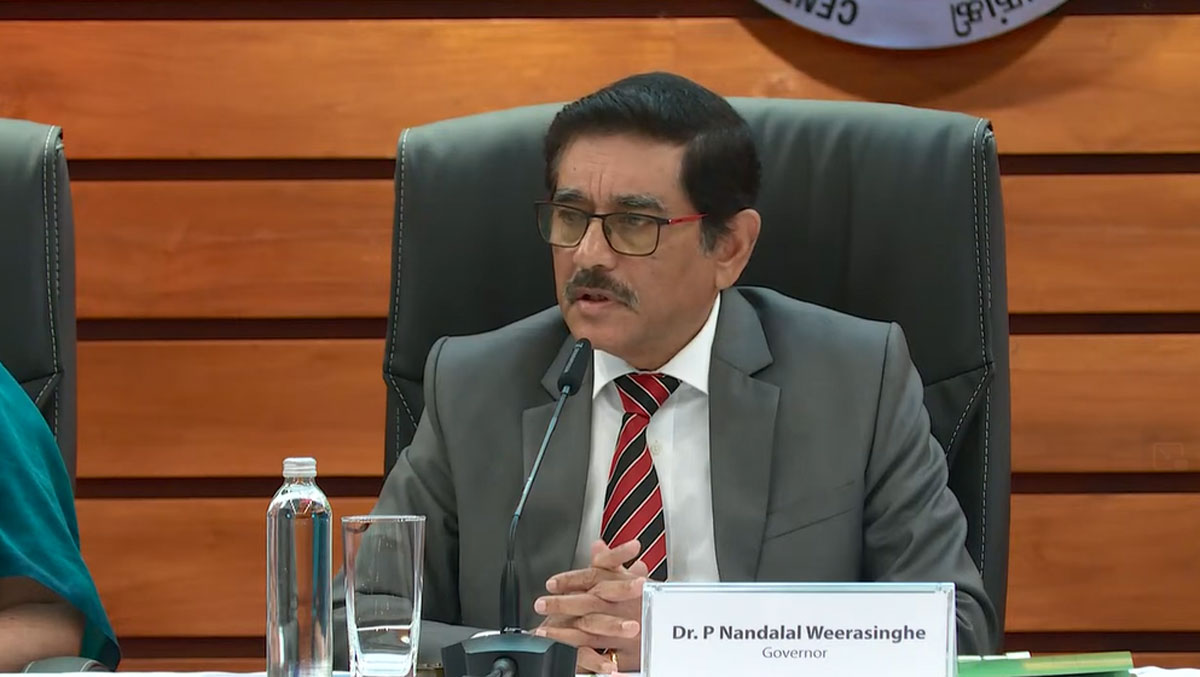
Sri Lanka is building foreign reserves slowly on purpose, Central Bank Governor Nandalal Weerasinghe said on Tuesday, because buying dollars faster would push the rupee around. He put the commitment given to the International Monetary Fund for the end of this year at around US$8 billion — with reserves stuck near US$6.9 billion and two months to go.
The Governor was speaking at a Colombo forum titled “From Resilience to Sustainable Growth,” organised jointly by the Colombo Stock Exchange and the Securities and Exchange Commission of Sri Lanka, EconomyNext reported at 9.04 p.m. Colombo time.
What he said
“We build reserves without creating volatility in the market.”
“We are allowing a smooth, gradual kind of a movement in the currency in line with the demand and supply in the market. That has to reflect in the currency.”
The argument is a standard one for a central bank running a flexible exchange rate: large, fast dollar purchases are themselves a source of currency movement, so an authority that wants an orderly rate has to buy in smaller amounts over longer periods. Weerasinghe put it directly:
“I don’t think we are building reserves and creating volatility in currency by building reserves. That’s why reserve building has been a little slow this year because of the large demand coming from petroleum bills.”
He said the Central Bank could have accumulated another US$2 billion had that money not gone on petroleum following the conflict in the Middle East.
The target has moved, and nobody has said so
This is the part the filing does not flag, and it is the most consequential thing in it.
| Date | Who | End-2026 reserve target |
|---|---|---|
| 20 August 2026 | Deputy Minister Anil Jayantha Fernando, in Parliament | US$9 billion, government “confident” of reaching it |
| 27 October 2026 | Governor Nandalal Weerasinghe, at the CSE/SEC forum | around US$8 billion, as committed to the IMF |
Two official figures for the same deadline, given nine weeks apart, a billion dollars apart. Neither source describes a revision, and this desk is not asserting that one was formally made — a minister’s confidence and a programme commitment to the IMF are not necessarily the same number, and the August figure may have been an aspiration above the floor agreed with the Fund. But the direction is clear, and no filing reviewed by this desk records the difference being explained.
The Governor’s own arithmetic accounts for the gap exactly. Reserves stood at roughly US$6.9 billion at end-September. Add the US$2 billion he says went on petroleum instead of accumulation, and the result is US$8.9 billion — essentially the August target. On his account the $9 billion was reachable, and oil is where it went.
Where reserves actually stand
EconomyNext reports reserves stagnant at around US$6.9 billion as of the end of September. That is consistent with this desk’s own record: Central Bank data put September reserves at US$6.85 billion, itself little changed from the August level.
Reaching US$8 billion from US$6.9 billion in October, November and December would require roughly US$1.1 billion of net accumulation in a quarter — against a year in which the Governor has just described accumulation as deliberately slow. The filing does not say whether the Central Bank still expects to meet it.
On the rupee
Weerasinghe noted that the rupee collapsed in March 2022, when usable reserves bottomed out at about US$20 million, and has since recovered from 360 to the dollar to around 330 levels.
That tracks the current market. The rupee closed at 332.25/332.20 to the dollar in spot trading on Tuesday, the same day he spoke.
Not reported
The filing does not say whether the US$8 billion figure refers to gross official reserves or to usable reserves — a distinction that matters in Sri Lanka’s case, because the headline number has at times included a swap facility with the People’s Bank of China that is not freely usable. It does not say whether the end-year target counts that swap.
It does not give the Central Bank’s dollar purchases for October, name the IMF review at which the reserve target is assessed, or say what happens if the target is missed. It does not date the Middle East conflict he refers to or quantify the petroleum bill itself, beyond the US$2 billion of foregone accumulation.
No other speaker at the forum is quoted, and the filing does not say whether the Governor took questions.
On sourcing: this report rests on a single verified newsroom. The Daily Mirror’s breaking-news listing on Tuesday carried no filing on the Governor’s remarks or on the CSE/SEC forum, and EconomyNext’s own Tuesday output was the only coverage of it this desk could find; the NewsFirst and Hiru News rails carried nothing on it. Ada Derana has returned a CloudFront block for 45 consecutive days and could not be checked. The comparison with the August parliamentary figure is drawn from this archive’s own earlier reporting, not from EconomyNext.