Dengue cases have risen in seven of Sri Lanka’s nine provinces under the prevailing wet weather, and the National Dengue Control Unit will run special mosquito eradication programmes in 13 districts from 9 to 14 November.
Director of the National Dengue Control Unit Dr. Kapila Kannangara said cases had increased in the Western, Southern, Sabaragamuwa, Uva, Northern, Eastern and Central provinces, NewsFirst reported at 9:40 a.m. Colombo time on Sunday.
Mosquito larval density has increased in around 130 divisional secretariat divisions, he said. The eradication drive will run in 13 districts over six days in the second week of November.
The year’s toll
About 105,500 dengue cases have been reported nationally so far in 2026, with the death toll at 79.
Both figures continue a climb through the second half of the year, but the pace of new infection has slowed markedly. This site recorded 93,635 cases and 71 deaths on 22 August, 98,249 cases in mid-September and 104,094 cases on an account published 22 October.
Set end to end, those milestones give:
| Period | Cases added | Rate |
|---|---|---|
| 22 Aug → 17 Sep (26 days) | ~4,600 | ~177/day |
| 17 Sep → 22 Oct (35 days) | ~5,850 | ~167/day |
| 22 Oct → 1 Nov (10 days) | ~1,400 | ~140/day |
So the national count is still rising, but more slowly than at any point this site has measured — even as the rains arrive and larval density climbs. That is the pattern the control unit itself described in October: breeding sites increasing while reported infections fall, which is why it is acting ahead of the case curve rather than behind it.
Eight deaths have been added since the August count.
This closes a question left open in October
On 16 October the control unit warned that dengue was rising again with the rains and said a new control programme would follow “within two weeks”. A later update to that article recorded 13 districts as the intended scope but noted that the filing did not say which districts, or when.
Sunday’s filing supplies the missing date: 9–14 November, across the same 13 districts. The programme is arriving later than the two-week horizon suggested in mid-October, and the district list is still not published.
A measurement caution carried forward
The figure of about 130 divisions should be read with care. In this filing the unit is the divisional secretariat division — an administrative unit of local government.
This site’s September reporting on dengue prevention week used the Medical Officer of Health division, the public-health unit, which does not map one-to-one onto divisional secretariats. An earlier NewsFirst dengue filing in October also gave “130” in a way that conflated a breeding index with a count of divisions. The number carried here is the one today’s filing states explicitly — a count of divisional secretariat divisions with increased larval density — and it should not be compared directly against MOH-division counts published earlier in the year.
Dr. Kannangara was described as the unit’s acting director in October reporting and as its director here; the filing does not address the change in designation.
Update — a second newsroom settles the unit
The caution above can now be narrowed. The Daily Mirror published its own account of the same statement at 12:19 p.m. Colombo time, and it independently gives the unit as “around 130 Divisional Secretariat divisions” — the same unit, in its own words, from a newsroom that did not take it from NewsFirst.
That matters because an earlier NewsFirst dengue filing in October had rendered the same figure as Medical Officer of Health divisions in one place and as a breeding index in another. Three different readings of one number is the kind of drift that produces a wrong fact months later. Two independent newsrooms now agree on the divisional secretariat reading, so that is the one to carry forward — and comparisons against MOH-division counts published earlier in the year remain invalid.
The Daily Mirror confirms every other figure in this report without variation: the same seven provinces in the same order, 105,500 cases, 79 deaths, the 13-district scope, and Dr. Kannangara as Director of the unit — which also corroborates the designation point immediately above. It independently confirms the 9–14 November dates for the eradication drive, which closes the question left open in October on a second source rather than one. It still does not name the 13 districts. It raises this article’s credibility rating to Corroborated.
What the unit is asking
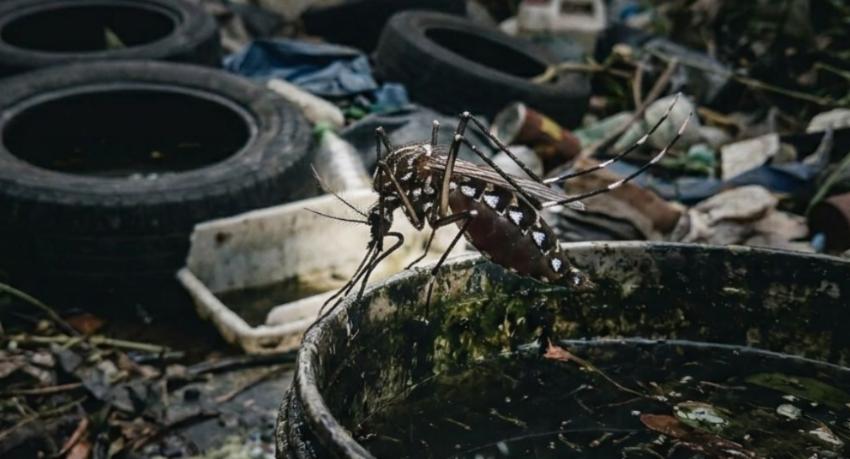
The control unit has urged the public to destroy potential mosquito breeding sites to prevent further spread. Aedes aegypti breeds in small volumes of clean standing water — discarded containers, tyres, roof gutters and plant saucers — and the accumulation of such sites during sustained rain is the mechanism behind the seasonal rise.
The appeal coincides with a wet forecast: the Met Department expects showers over five provinces and two districts this afternoon, with falls above 50 millimetres at some places.
Not reported
The filing does not name the 13 districts, so readers cannot tell whether the drive covers the same seven provinces in which cases have risen. It does not say what the programmes will involve — inspections, fogging, larvicide, prosecutions — or who will carry them out. It gives no case or death figures by province or district, and no comparison against the same period in 2025.
Two verified sources. This report was first written from NewsFirst and has since been corroborated by the Daily Mirror, both verified newsrooms, which filed independent accounts of the same NDCU statement within three hours of each other. Ada Derana remains unreachable behind a CloudFront block.