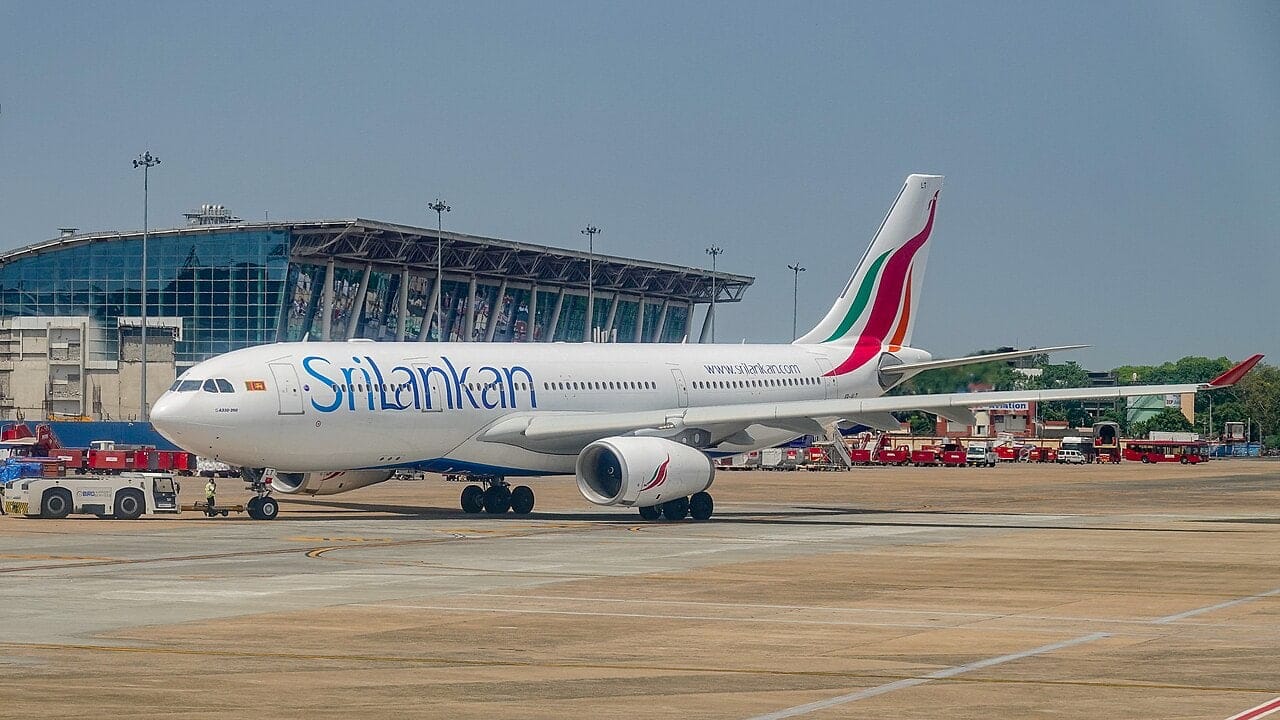
SriLankan Airlines recorded a loss before tax of Rs 35.6 billion in the first quarter of the 2026/27 financial year, and its total liabilities of Rs 561.4 billion now exceed its assets of Rs 209.9 billion by Rs 351.5 billion.
The figures come from the Finance Ministry’s mid-year report, first reported by EconomyNext and the Daily FT on 3 November.
Revenue rose, and the loss grew anyway
Total revenue for the period was Rs 82.8 billion, up from Rs 62.6 billion a year earlier — a rise of about 32 per cent. The loss widened regardless, because costs rose faster.
Total operating costs increased 40.4 per cent to Rs 95.2 billion, driven by a 93.0 per cent surge in aircraft fuel expenditure to Rs 41.2 billion. EconomyNext reports an operating loss of Rs 12.5 billion, compounded by foreign exchange losses.
Against the corresponding quarter of 2025/26, when the airline posted a net loss of Rs 12.0 billion, the deterioration is roughly threefold. A net income of Rs 3.4 billion from SriLankan Catering reduced the group’s net loss to Rs 32.2 billion.
What the taxpayer has already absorbed
During the first six months of 2026 the government serviced the first and second instalments of selected Bank of Ceylon and People’s Bank loans under tripartite arrangements, and released US$30 million for short-term funding.
Separately, following the restructuring of US$175 million in guaranteed bonds, the restructured value of US$126.5 million was absorbed into the government’s debt stock with effect from 20 March 2026.
In June 2026 the Cabinet approved a Strategy and Restructuring Committee to review the airline.
The CEO on fuel: supply, not only price
Chief Executive Officer Vipul Misra told the Daily Mirror the crisis had also reduced the availability of aviation fuel.
“When crude oil prices increase, refineries prioritise turning out more and more petrol and diesel. There is less focus on aviation fuel. When aviation fuel availability is reduced, it creates further price hikes, affecting the industry. It is not merely the rise in crude oil prices that has an impact.”
Misra said an assessment of losses arising solely from the Middle East crisis had been compiled and his office was awaiting its vetting. That assessment is the genuinely new element in Friday’s filing — the quarterly figures themselves had been public since Tuesday.
A partial offset
The airline suspended flights to several regional destinations as airspace restrictions took hold, then resumed them as restrictions eased. The Finance Ministry notes that the rerouting of regional air traffic through Sri Lanka generated some additional aviation activity and passenger movements, partially offsetting the damage to the wider sector — though not enough to change the carrier’s own result.
Against the rest of the state sector
The Daily FT reports the same mid-year document showing 51 major state-owned enterprises returning a combined profit of Rs 259.3 billion in the first half of 2026, up from Rs 227.8 billion a year earlier, with state banks leading the gains and Treasury subsidies supporting the Ceylon Petroleum Corporation. SriLankan Airlines is moving against that trend.
Update, 7 November: the quarter against the record
NewsFirst, reporting the same Finance Ministry document on Saturday, set the quarter against the airline’s full loss history. It puts cumulative losses at more than Rs 630 billion, against an annual profit of Rs 4,899 million in 2008, the year the government took control of the carrier.
The year-by-year series it gives runs: Rs 9,996mn (2009), Rs 6,034mn (2010), Rs 202mn (2011), Rs 17,208mn (2012), Rs 26,857mn (2013) and Rs 31,365mn (2014), then Rs 41,700mn (2019), Rs 44,139mn (2020), Rs 49,704mn (2021), Rs 163,583mn (2022) and Rs 71,306mn (2023). NewsFirst does not give figures for 2015 to 2018 or for 2024 and 2025, so the series is not continuous and does not by itself sum to Rs 630 billion.
On the fuel figure, NewsFirst attributes the 93 per cent rise to the Middle East conflict and gives the same Rs 12.5 billion operating loss. It adds the airline’s debt burden to the structural weaknesses, liquidity constraints and maintenance costs already cited.
NewsFirst also recounts governance disputes attached to that record: the appointment of Nishantha Wickremesinghe as chairman after the 2008 takeover and allegations concerning management of airline resources during his tenure; the appointment of Kapila Chandrasena as chief executive in July 2011, concerns raised in the J.C. Weliamuna report and audit reports, his removal in 2015 and reappointment during the 52-day government of October 2018; and the Airbus deal, in which allegations were presented in court concerning a payment of Rs 100 million to Namal Rajapaksa, now in remand custody. These are allegations and matters before the courts, not findings. This desk has separately covered the Airbus bribery warrants.
Not reported
None of the three filings from 3-6 November gives a passenger or load-factor figure for the quarter, states the size of the foreign exchange loss separately, names the members of the Strategy and Restructuring Committee or gives it a reporting deadline, or says when the West Asia loss assessment will be published once vetted. No figure is given for what the conflict-specific losses are expected to total.
The quarter covered ends in June 2026, so the fuel-price effects of more recent events in the region are not captured in these accounts.