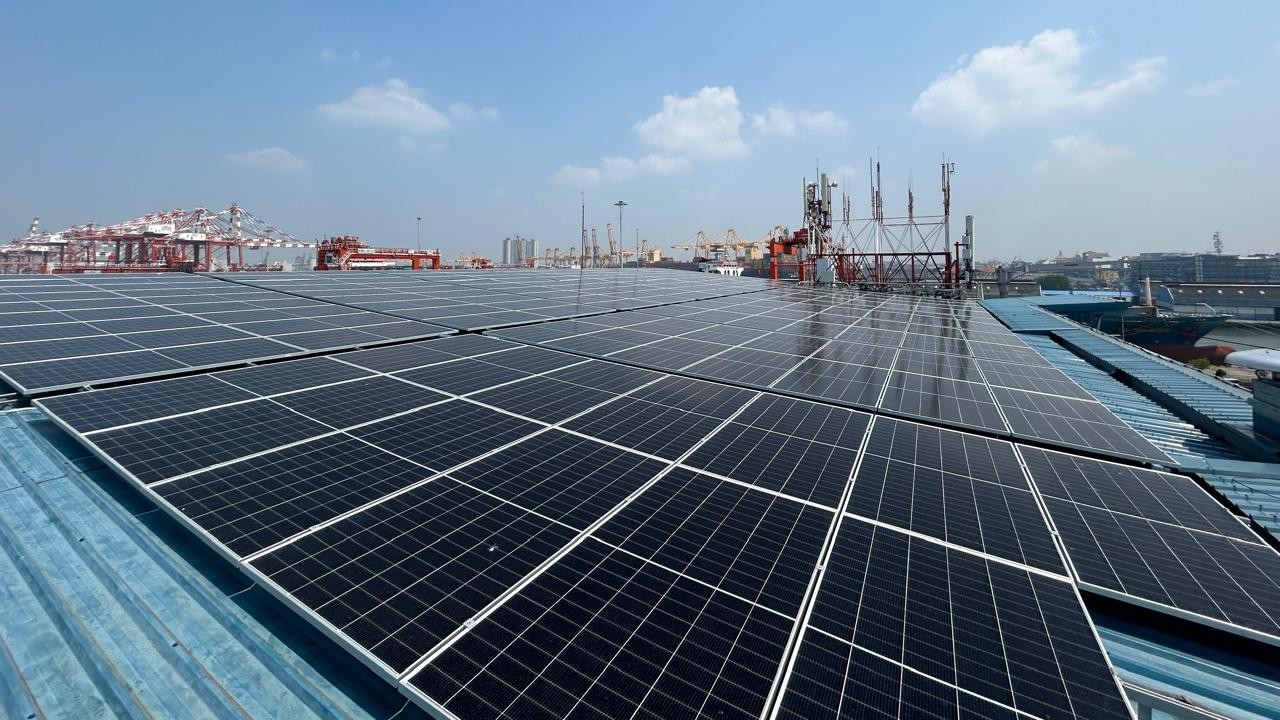
Households installing rooftop solar will be paid a subsidy of Rs 25,000 for every kilowatt of battery storage they add, up to a maximum of Rs 250,000, President Anura Kumara Dissanayake announced while presenting the 2027 Budget in Parliament on Thursday.
The subsidy applies to domestic consumers newly installing rooftop solar systems and is capped at 10 kilowatts of battery capacity. The government has allocated Rs 3,500 million for the scheme, EconomyNext reported from the speech.
Alongside the grant, the government will remove the 10 per cent Ports and Airports Development Levy (PAL) charged on imported batteries used to store solar energy, the Daily Mirror reported.
“We must move toward batteries. If we don’t move in that direction, this cannot be transformed,” the President told Parliament.
Storage is the point
The measures target storage rather than generation — the constraint that decides how much rooftop solar the grid can absorb. Sri Lanka has added rooftop capacity faster than the network can take it at midday, and batteries shift that output to the evening peak.
Separately, the President said Rs 26.5 billion will be allocated to stop recurrences of national grid failures, together with a wider regional monitoring programme to prevent breakdowns, Hiru News reported. Sri Lanka has had repeated islandwide outages, most recently traced to faults in the transmission system.
The budget also sets a date for floating solar. From January 2027 the government will invite private investment in floating solar power plants, with a stated expectation of securing 500 megawatts through them, according to Hiru News.
A figure to treat with care
EconomyNext’s transcript of the speech carries an internal inconsistency in the President’s worked example: he is quoted describing the removed tax as worth “approximately between 4,000 and 5,000 rupees” on “a one-megawatt battery”, then applying that same saving to someone who installs “a one-kilowatt battery” for a combined benefit of about Rs 30,000. Only the per-kilowatt reading is consistent with the Rs 25,000-per-kilowatt subsidy. LankaNewz has not reproduced the megawatt figure as a separate claim.
Not reported
Neither filing states when the battery subsidy opens for applications, how it will be administered, whether it is limited to net-metering or net-plus customers, or what happens to the allocation if uptake exceeds Rs 3,500 million.