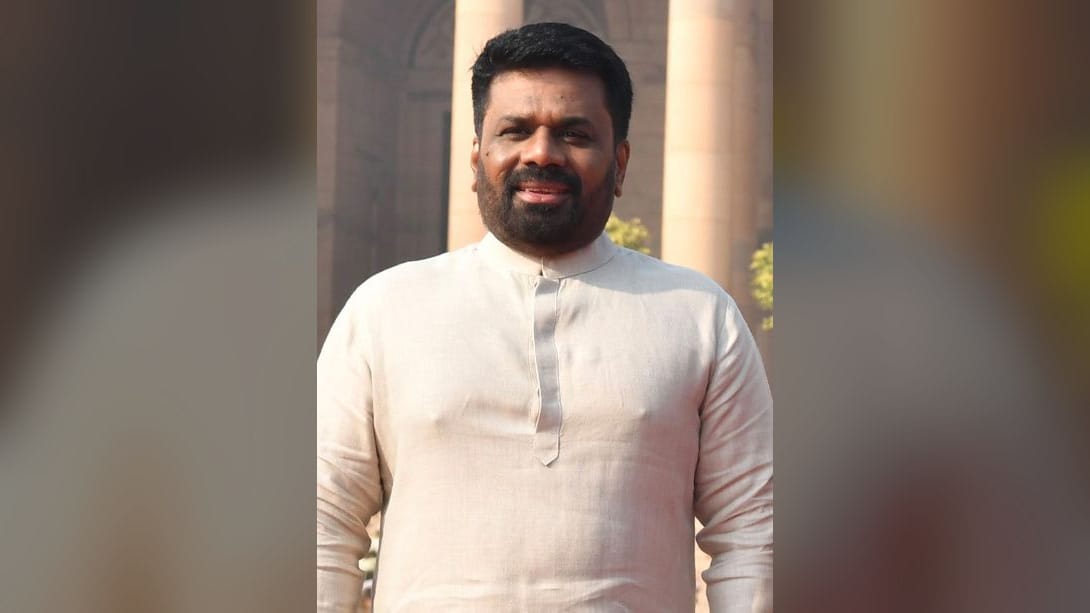
President Anura Kumara Dissanayake said on Friday that the public has a complete right to criticise those who govern, but that criticism should be made within a framework of civility.
He was speaking at the 37th Il Maha Viru Samaruwa — the November heroes’ commemoration — at the Viharamahadevi Open Air Theatre in Colombo, Hiru News reported. The photograph accompanying the filing shows a Janatha Vimukthi Peramuna backdrop marked 1989–2026; the JVP, which the President leads, is the core party of the governing National People’s Power.
What he said
Dissanayake framed public criticism of rulers as something his own movement set out to create, and contrasted it with what he called an older habit of deference.
“They are not accustomed to a society that questions the ruler,” he said. “They are accustomed to the old habit. What is the old habit? The habit of being subservient to the ruler. Our expectation is a people who question the ruler. A people who criticise the ruler.”
He then set a limit. “When you set out to build that, there is a civility to it, there is a framework, there is a box. One must stay inside that box. But the critic has been unable to keep even his own box of civility. However, we are not perturbed.”
On letting criticism stand
The President said the public itself rejects criticism made outside those bounds, and described being asked why he tolerates it.
“All criticism that is not presented within that framework of civility is rejected by the people of this country,” he said. “Some people call and ask us, brother Anura, why do you allow them to abuse you like that? Let them abuse as much as they want. Some ask why we allow such things to be said. Say as much as you like.”
“Those are not things a civilised society approves of,” he added. “What we say is: criticise, abuse — we need to build a new relationship among ourselves. That is the kind of transformation the ruler and the people need.”
Update: a second account of the same speech
A NewsFirst filing on Friday night covers the same address and is considerably sharper in what it reports. Under the headline “They Built a Criminal State; We Are Changing It”, it describes the President as having launched a strong attack on the Opposition, accusing rival political groups of protecting those responsible for corruption and criminal activity, and warning that undisciplined protests could create instability, NewsFirst reported.
“There will be no protection for fraudsters and the corrupt anymore,” he said, according to that account. “They engaged in corruption, and they now seek to protect those responsible. We have put an end to corruption and are working to bring the corrupt to justice.”
Dissanayake said his government remained committed to building a just society and that the struggle had not ended with the change of government. “Before 2024, we fought to secure political power to achieve that goal. Since 2024, we have been fighting to fulfil that very mission.”
On the Opposition and the balance of power
He questioned why political groups that contested the 2024 presidential election separately were now being pushed to unite, and said the calls for unity reflected a recognition that the National People’s Power had established itself with no immediate prospect of defeat. He put the balance of political power at an 80-to-20 divide in the government’s favour.
“When a group becomes weakened, it often loses its sense of direction. It no longer knows what to do. It has no clear line, no target and no plan. It becomes disoriented,” he said. “Today, a significant section of the weaker political camp has fallen into precisely that state.”
The limit on protest
Where the Hiru filing records the President declining to be perturbed by abuse, the NewsFirst account gives the condition he attached to it in terms of political action rather than tone.
“We welcome criticism of the Government when it is guided by a vision and carried out in a disciplined and organised manner,” he said. “However, protests that leave people wondering what harm might be caused to the country and its people the following day cannot be justified.”
He referred to recent protests and confrontations, including fasts unto death and people brandishing poles, described such actions as conspiratorial, and called on the public to resist being drawn into what he termed political anarchy. He said the NPP and the JVP must strengthen their role as an organised political movement.
Other lines in the NewsFirst account
He criticised the use of racism and religious extremism for political gain — “We stand for national unity and the religious rights of all communities” — and attacked reliance on superstition and occult practices in politics, arguing the country’s future should rest on technology, science and knowledge. Without naming organisations, he accused some media institutions of representing a destructive political camp, and referred to the involvement of some Buddhist monks in the political divide.
Context
The remarks come at the end of a week in which the government has drawn sustained criticism over the 2027 Budget presented on Thursday, from opposition MPs, professional bodies and trade unions. Neither filing connects the two, and the President named no one. Hours later, Opposition Leader Sajith Premadasa told Parliament the Budget was “not a budget”.
His remarks on superstition also land in a specific context: the President had himself referred to charms and sorcery during the Budget speech, and Premadasa answered that passage directly in the debate.
Not reported
Neither filing says who the President was referring to on the question of civility — no individual, party, outlet or platform is named in that passage. Neither gives an attendance figure for the commemoration, reports other speakers, or records a policy announcement, and neither indicates that any regulatory or legal measure is contemplated. The NewsFirst account names no media institution and no monk, and specifies no location for the protests and fasts it refers to. Neither filing records a response from any opposition party.
Sourcing
Correction to an earlier sourcing note: this article was first published as a single-source report, stating that a sweep of the Daily Mirror, NewsFirst and EconomyNext rails had found no other verified newsroom carrying the speech. That is no longer accurate. NewsFirst filed its own account at 10.51pm Colombo time, after that sweep was made, and it has been added above. The article now carries two verified sources.
The two accounts are complementary rather than contradictory: Hiru’s covers the President’s framing of criticism and civility, NewsFirst’s covers his attack on the Opposition over corruption and protest from the same address. Neither reports the material the other leads on, so each is a partial account. The Hiru quotations are translated from Sinhala; the NewsFirst quotations are that newsroom’s own English rendering, and the two use different transliterations of the event’s name — Il Maha Viru Samaruwa and Il Maha Weer Samaruma.