A man swimming in the sea at Ettalong Beach in the Australian state of New South Wales was struck by lightning on Saturday afternoon and left in a critical condition, Hiru News reported late on Sunday, crediting the Australian Broadcasting Corporation.
The strike happened at about 3 p.m. on 14 November, while the man was swimming in the water close to the shore.
Bystanders at the beach pulled him from the sea and administered cardiopulmonary resuscitation until emergency services reached the scene. He was taken to a hospital in Sydney, where his condition was described as critical but stable.
What the weather was doing
Hiru’s headline states the man was struck “under a clear sky” — the detail that makes the incident unusual. Its own report, however, does not describe the weather at all, so that claim rests on the headline alone.
The photograph Hiru published with the story offers some support for it. The main frame shows a calm stretch of water between two headlands under bright conditions, with a distinct dark cloud mass sitting on the horizon to one side. An inset shows New South Wales police officers and paramedics moving a stretcher trolley along a sand track behind the beach.
That is consistent with a strike originating from a storm cell some distance away rather than from cloud directly overhead — but neither the distance nor any meteorological assessment appears in the reporting available here.
Why it matters locally
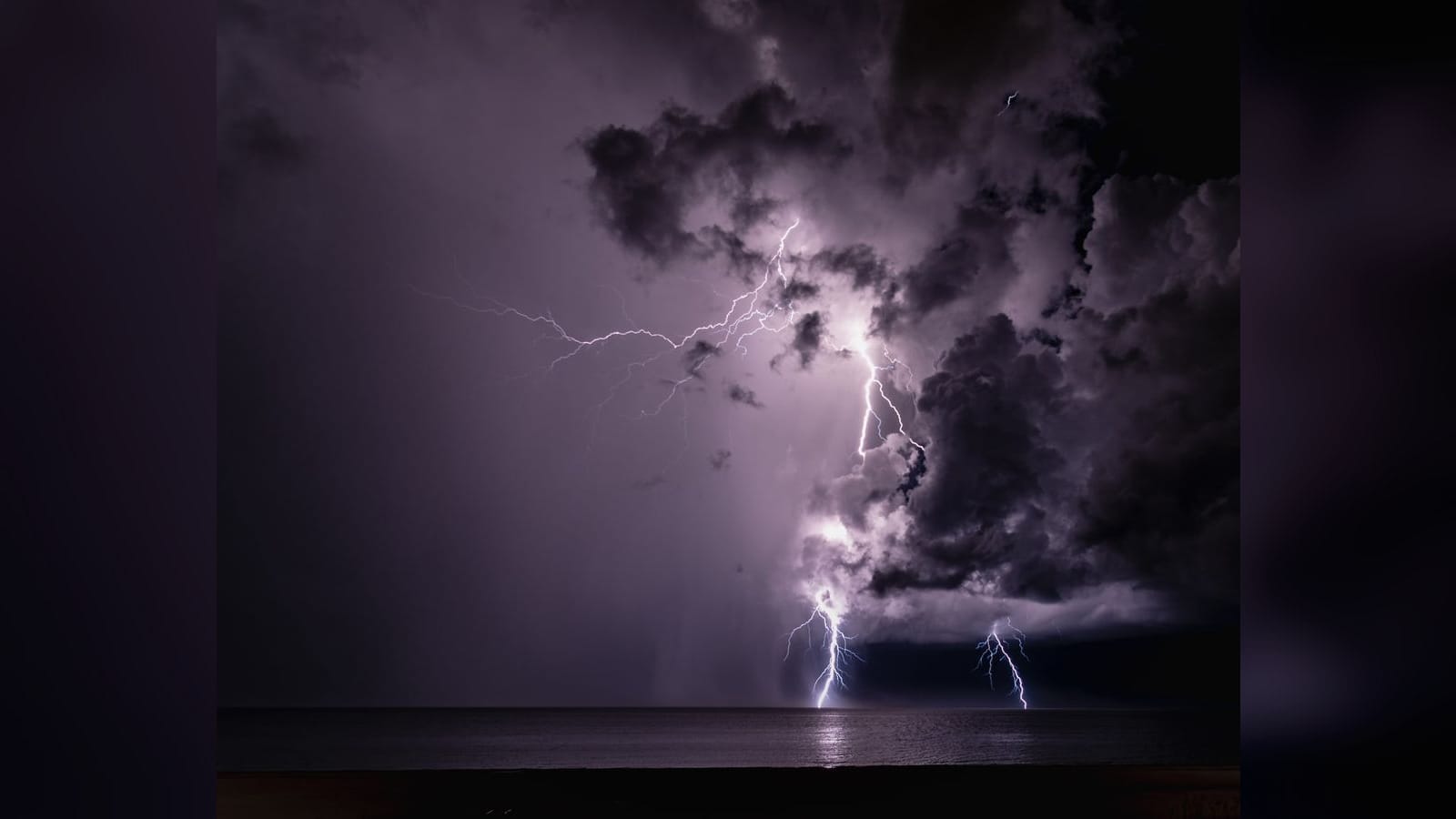
Lightning is a recurring hazard in Sri Lanka, and the island is currently under severe weather warnings as a system in the Bay of Bengal deepens — see our coverage of the Met Department’s red warning. Open water and exposed beaches carry elevated risk during unsettled conditions, and the Ettalong case is a reminder that an apparently bright sky overhead is not on its own evidence that a storm is far enough away to be safe.
Sourcing note
This article is published on a single verified source. Hiru News credits the ABC, but abc.net.au did not respond on any fetch route from this desk, so the original report could not be read directly and is not listed as a source. No other verified newsroom this desk can reach — including Al Jazeera, CNN and SBS Australia — carried the incident at the time of writing.
Accordingly, several details that circulated in search results, including the man’s exact age, the precise time, the hospitals involved and a figure for how far lightning can travel from a storm cell, are not reproduced here, because they could not be confirmed against a fetched source.
Not reported: Hiru’s account does not name the man, give his age beyond the headline’s description of him as a young man, identify the hospital, say how long he was in the water, or indicate whether any warning had been issued for the area.