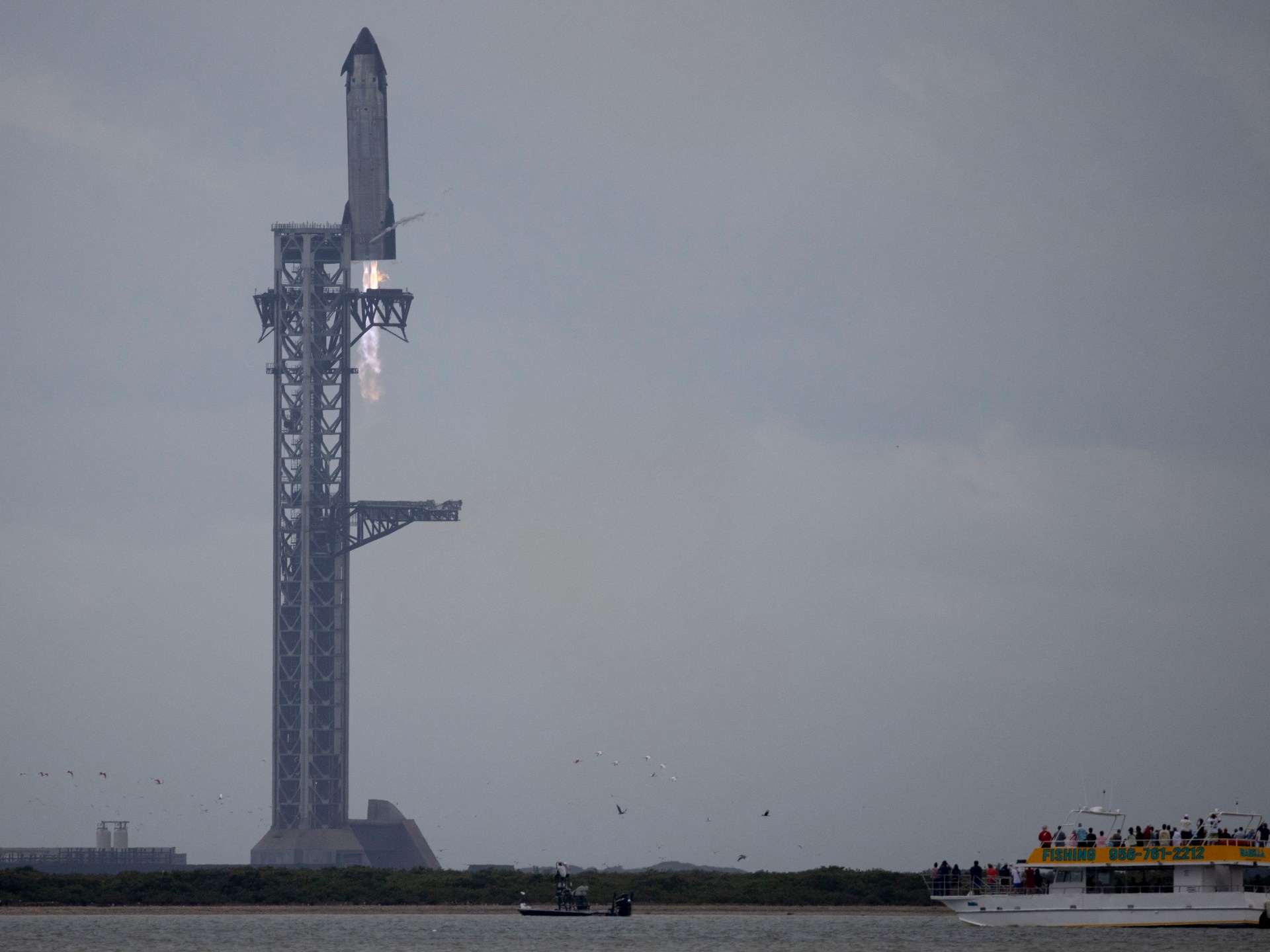
SpaceX has caught the upper stage of its Starship rocket in the arms of its launch tower for the first time, completing a manoeuvre no operator has previously attempted on a vehicle returning from orbit.
The catch took place on Saturday, 14 November, at Starbase in Boca Chica, Texas, about 22 hours after the rocket left the ground on Friday, Al Jazeera reported.
The flight
The upper stage — the part SpaceX calls the Ship — reached orbit and circled the Earth 14 times at an altitude of 265km (165 miles) before returning. On the way it released 26 advanced Starlink satellites.
It then descended onto Launch Pad 2 and was caught between the tower’s mechanical “chopstick arms.” Al Jazeera describes it as the first time the upper stage of a rocket has been brought back to a pinpoint landing after flight so that it could potentially fly again.
Hiru News, citing the BBC, reported that the stage arrived a few minutes later than scheduled, that a large crowd at the launch site cheered as it was secured, and that a commentator on the live broadcast expressed astonishment at the result. Hiru puts the catch at about 3.20pm but does not say in which time zone.
The half that failed
SpaceX had intended to catch both stages on this flight and did not. The Super Heavy booster was lost on its way back down.
“Its engines stopped firing too soon on the way back down,” SpaceX’s Kate Tice said, according to Al Jazeera. The booster’s guidance system sensed it was not in the right position and automatically initiated what Al Jazeera calls “the watery detour and self-destruction.” Hiru’s account matches: the lower stage was steered out towards the sea, where it caught fire close to sea level.
The company has caught Super Heavy boosters on three earlier test flights, so the booster was the better-understood half of the attempt and the Ship was the harder target — it flies higher and faster, and on this flight it came all the way back from orbit.
Why it matters
This was the 15th flight of a full-scale Starship since 2023 and only the vehicle’s second trip to orbit. Recovering the upper stage intact is the remaining step towards the fully reusable system SpaceX has said it is building, which the company expects to cut the cost of reaching orbit substantially.
Update: the Daily Mirror carries the Reuters account
The Daily Mirror republished Reuters’ report on Sunday, adding scale and cost figures the earlier filings did not carry.
Reuters puts the mission at 22.5 hours and 14 Earth orbits, and the vehicle at 171 feet (52 metres) tall. Starship deployed 26 Starlink satellites on Friday night while cruising at about 161 miles (260km) altitude, then fired an engine to begin its descent while flying eastward over the Pacific, slowing from an orbital speed of roughly 17,000 miles per hour. It hooked onto the tower arms by two small fittings near its top and hung a few hundred feet off the ground. Musk and SpaceX engineers began inspecting it within hours; “Ship 42 looks great!” Musk wrote on X.
“That was the missing link, the holy grail of spaceflight,” SpaceX mission commentator Dan Huot said of the catch.
The two accounts differ slightly on altitude — Al Jazeera gives 265km (165 miles), Reuters 260km (161 miles) — and on mission length, 22 hours against 22.5. Both are within rounding of each other and neither filing adjudicates; the orbit count of 14 and the satellite count of 26 match exactly.
The money, and what is still not reusable
SpaceX has spent more than $15 billion developing Starship. NASA has provided $3.2 billion of a contract valued at more than $4 billion, won in 2021, to return humans to the moon under the Artemis programme. For comparison, the company’s workhorse Falcon 9 has launched over 700 times since 2010, but only its first stage is reusable — the second stage is discarded into the ocean each flight.
Reuters notes two limits on Saturday’s milestone. SpaceX has still not recovered both Starship stages on a single mission, which would be the first-ever return of a complete orbital launch system. And the heat shield is not yet fully reusable: the hundreds of black hexagonal tiles that protect the vehicle on re-entry still require refurbishment, and SpaceX is trying to engineer tile designs that need little or none. NASA’s Space Shuttle, retired in 2011, was only partially reusable for the same reason — its external tanks were discarded and the orbiter needed extensive refurbishment between flights.
Not reported
No filing gives the condition of the recovered stage beyond Musk’s remark, says whether this particular Ship will fly again, or gives a date for the next flight. None states the launch time on Friday in a named time zone, which is why the Hiru clock figure above is left unconverted. Reuters does not say why the Super Heavy booster’s engines shut down early, or whether the cause has been identified.