Iran denounced US plans to announce new sanctions on Saturday, ahead of a Treasury Department briefing due on Monday that Washington has said will impose the heaviest financial penalties in its history.
Foreign Ministry spokesman Esmaeil Baghaei said in a post on X that the imminent announcement amounted to “an assertion of extraterritorial sovereignty over every independent member state of the United Nations”. He added: “Such secondary sanctions find no foundation in international law.” In a separate statement reported by Al Jazeera, Baghaei described the end result as “the complete erosion of sovereignty” and “a recipe for an abysmal return to full-scale classic colonialism”.
Warning to the region
Mohsen Rezaei, secretary of Iran’s Supreme National Security Council, told state television that Tehran would target the interests of countries that help the United States.
“We are telling all nearby countries not to join the U.S. economic war, otherwise we will consider them as enemies,” Rezaei said. Al Jazeera reported him warning of a “seismic” retaliation and describing Iran’s approach as a three-stage sequence beginning with attempts to de-escalate with neighbouring states.
Treasury Secretary Scott Bessent is due to hold a press conference at 2 p.m. EDT (1800 GMT) on Monday, after pledging “the toughest sanctions in history”. He has urged cooperation from China, which buys more than 80% of Iran’s shipped oil according to 2025 data from analytics firm Kpler. Beijing has called for diplomacy.
President Donald Trump, who has warned of consequences for any country providing “any type of lifeline” to Iran, said on Friday that Washington was watching “what happens” in the conflict. “They would love to make a deal, but they’re not ready to make the right deal, in my opinion,” he said.
Hormuz still bottled up
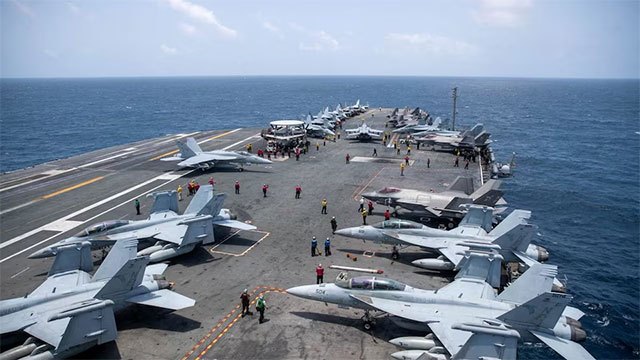
Nearly six months after the US and Israel launched airstrikes on February 28, the two sides are neither firing at each other nor moving towards talks, Reuters reported.
Only four commodity ships sailed through the Strait of Hormuz on Thursday, ship-tracking data showed, none of them large crude carriers or liquefied natural gas tankers. The United States has effectively blockaded Iranian vessels in their ports, leaving thousands of seafarers stranded aboard hundreds of ships.
Iran has granted passage to a number of Iraqi oil tankers after repeated requests from Baghdad, its state news agency reported.
Update: foreign minister calls Washington ‘desperate’, August 23
Iran’s Foreign Minister Abbas Araghchi dismissed the threatened sanctions as a sign of desperation in a video posted on Telegram on Sunday, Reuters reported.
Describing what he called “repetitive scenarios”, Araghchi said: “The fact that they (US leaders) have moved on from military operations … to bring up the same old plans shows that they are desperate.” He said Washington must speak to Iran respectfully to find “a solution based on justice and honour”.
“We have never been afraid. All of their actions — whether blockades or other military moves they have made — have failed, and this new issue of theirs will fail as well,” he said.
Pakistan’s army chief to visit Tehran
Iran said Pakistan’s army chief, Asim Munir, would visit Tehran on Monday as part of efforts to restore peace and security in the region, but gave few details. Pakistan has been mediating in the conflict, and a Pakistani government source said Munir would address recent developments including the threatened US sanctions.
The visit is timed to coincide with Bessent’s press conference.
Signals from Tehran
Parliament speaker Mohammad Baqer Qalibaf said on Saturday that Tehran had received “numerous messages” from neighbouring countries about new regional security arrangements and economic cooperation, without naming them. He accused Washington of endangering the security of its own regional allies for Israel’s sake, and argued that an independent, “homegrown” regional order would deliver peace.
President Masoud Pezeshkian has meanwhile pressed for a diplomatic settlement. “It would be better to end the war today, when we are powerful and have dignity, and the whole world acknowledges our victory,” the ISNA news agency quoted him as saying on Friday.
Reuters noted that US attacks have severely damaged Iran’s economy and devastated its navy and air force, but that Tehran retains enough missile and drone capability to impede tanker traffic and strike regional rivals. Trump has yet to achieve the objectives he set at the start of the war, including dismantling Iran’s nuclear programme — the state of which remains uncertain, with UN inspectors shut out since 2025.