Latest figures (Wednesday, September 2): Nepal Police report 1,127 dead and 4,858 missing, with a first district-by-district breakdown showing 81 per cent of bodies recovered downstream of the flood’s origin. Jump to the latest update. The account below is preserved in the order it was reported.
Nepal’s National Disaster Risk Reduction and Management Authority put the death toll from last Wednesday’s floods at 734 on Sunday, and separately reported an increase in flood levels near the Bhote Koshi River, telling communities along its banks to stay alert four days after the same river carried a wall of water and debris through the country’s north.
The Bhote Koshi was one of two rivers down which the torrent travelled on Wednesday, sweeping past tourist and pilgrimage towns in northern Nepal. Ada Derana reported the warning on Sunday morning. The authority did not say what is driving the rise, how high the water has come, or which settlements are at risk.
The toll has moved again
The death toll in Nepal has risen to 734, the disaster authority said on Sunday morning. That is 59 more than the same authority’s Saturday figure of 675, which had itself followed the 626 reported separately by Nepal police earlier that day. China’s separate Sunday update raised the Tibet toll from seven to 16, taking the regional total to 750 — see the update below.
The number of people missing in Nepal stood at 2,426 after Saturday morning’s sharp increase, and has since been revised to 2,498. That list includes 517 foreigners and 933 workers on hydropower projects along the affected river. It also includes 45 Nepali Army soldiers, 40 police officers and 19 immigration and customs officers — a detail that has not appeared in earlier counts and indicates how many of the missing were on duty when the water arrived.
Seven bodies recovered from rivers in India are still excluded from the Nepali toll.
Identification has become the bottleneck
The figures being published are not converging, and the reason is now visible. The Kathmandu Post reported on Sunday that only 20 of 669 recovered bodies had been identified by relatives as of Saturday evening, and that 211 of them were found as mutilated, partial or severed remains. Nepal Police spokesperson Deputy Inspector General Abi Narayan Kafle said many had been buried under mud and water for two to three days.
Bodies have been carried dozens of kilometres downstream — as far as Rupandehi, Chitwan and Pokhara — and mortuaries across the Narayani river basin have reached capacity. Nawalparasi East has moved 41 bodies to Pokhara and eight to Palpa.
The government has issued an emergency directive allowing district authorities to bury unidentified remains once storage runs out, after recording DNA, thumbprints, dental records and photographs against a permanent tracking number for each body. In Chitwan, where 233 bodies have been recovered and four identified, a burial site has been selected at Devghat.
The two numbers in circulation are not measuring the same thing. Saturday’s 675 came from the disaster authority and counts people killed; the 669 the Kathmandu Post attributes to police counts bodies actually recovered. A body recovered is not yet a death confirmed, and a death confirmed is not always a body recovered, so the gap between the two is a stage-of-counting difference rather than either agency being wrong. Sri Lanka’s newsrooms have carried the disaster authority’s number, which is the series that has now reached 734.
Context
Nepal has put the cost of rebuilding at $4-5 billion, close to a tenth of its economy. Sri Lanka has extended $1 million in humanitarian assistance and is now preparing to send relief teams.
No other verified newsroom had filed the Bhote Koshi flood-level warning at the time of writing.
Update: toll reaches 734, and no survivors are found at the Tibet border
Nepal’s disaster authority put the death toll at 734 on Sunday morning, Ada Derana reported. China issued its own update raising the number of dead in Tibet from seven to 16 and revising its missing down from 558 to 546, Hiru News reported. Taken together, the two sides of the border account for 750 dead and more than 3,000 unaccounted for on the fourth day of the search.
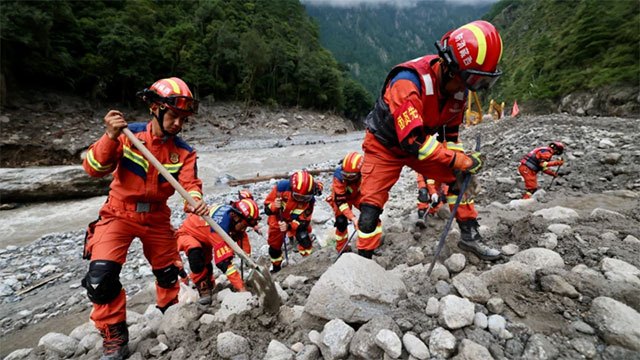
Chinese authorities said search teams combing the mud and debris at the border had found no survivors so far. Of the 546 people missing in Tibet, 261 are foreigners from 23 countries, among them 15 British nationals — nearly half the missing on the Chinese side, against roughly a fifth on the Nepali side, where 517 of the 2,498 missing are foreign. The area being searched is around Gyirong Port, the main crossing for trekkers travelling from Kathmandu to Mount Kailash, which explains the concentration of foreign nationals there.
Chinese state media said the danger from the lake that formed behind the landslide debris has subsided for now. Authorities warned that the risk of further mudslides remains and said monitoring stations have been set up to alert rescue teams working along the border.
More than 3,700 people have been rescued in Nepal. The government says over 100 hydropower workers may still be alive inside tunnels, and that rescue work is running at several sites rather than one — Energy Minister Biraj Bhakta Shrestha said “rescue efforts are going on in multiple tunnel sites,” correcting earlier reports that placed all of the trapped in a single location. Rescuers broke through the mud at Trishuli 3A on Saturday and began pumping air into the tunnel; a camera is being sent in. Brigadier General Raja Ram Basnet said teams were contending with four to five feet of mud and few places to land a helicopter.
Indian and Chinese tunnel-rescue specialists have joined the effort, India bringing “rat-hole” miners experienced in Himalayan tunnel collapses. A Nepali Army official said its helicopters were managing about 500 trips a day into the disaster zone. Poor weather and terrain have repeatedly interrupted flying.
The United States announced more than USD 3.6 million in humanitarian aid on Saturday, including three months of emergency food assistance for up to 10,000 households.
The wider regional response — India’s glacier monitoring, a Nepal-China data-sharing agreement and a warning from the UN climate chief is covered separately.
Update: Sunday evening — 781 dead by one count, 794 bodies by another, and burials under way
Nepal’s National Disaster Risk Reduction and Management Authority put the number killed at 781 with 2,502 missing as of 5.45 p.m. local time on Sunday, while Nepal Police separately reported 794 bodies recovered at the same hour, Hiru News reported. Tibet’s figures were unchanged at 16 dead and 546 missing.
Read within its own series, the disaster authority’s count has moved 675 on Saturday, 734 on Sunday morning and 781 on Sunday evening — 47 added over the day. The police series, which counts bodies recovered rather than deaths confirmed, has moved from 626 on Saturday to 794.
Earlier on Sunday, AFP reported the Disaster Ministry’s figure as 762 bodies recovered with more than 2,700 missing, of whom 589 were foreigners, carried by Ada Derana. A Reuters wire published around midday and carried by the Daily Mirror gave a combined Nepal-and-Tibet toll of 750 with 3,044 missing — the morning figure of 734 plus Tibet’s 16, and already superseded by the time it appeared.
Wire copy has begun rounding to “at least 800 killed” across Nepal and Tibet. That figure is the police recovered-bodies count plus Tibet’s dead (794 + 16), not the disaster authority’s confirmed deaths plus Tibet’s (781 + 16 = 797). The two are different measures and should not be read as a single series.
Unidentified remains are being buried, not cremated
Nepal has begun burying bodies it cannot identify, after taking DNA samples and marking each one so families can retrieve them later. In Hindu-majority Nepal the dead are traditionally cremated on funeral pyres, so the burials are being treated as long-term storage rather than final rites.
“Following standard and accepted protocols, such as those of ICRC, the mortal remains of the dead, especially those not recognisable, have been temporarily buried,” Foreign Secretary Amrit Bahadur Rai told reporters. “Medical teams took DNA samples from every victim prior to the burial so that families can match-reference later, and would be allowed to exhume for necessary rituals.”
Rai said the decision was forced by capacity and public health. “Many dead bodies have been collected, and they have started decomposing. To preserve public health, we had to bury the decomposing bodies.” He appealed for international help with cold storage: “We have requested different countries for freezers; we will need more than a thousand.”
This is the directive flagged a day earlier by the Kathmandu Post now in execution.
Who the missing foreigners are
Hiru News published a breakdown by nationality that no other outlet covering Sri Lanka has consolidated. India’s Ministry of External Affairs has confirmed at least 320 Indian nationals missing. China’s foreign ministry reports nearly 100 Chinese nationals missing in Nepal. The US State Department reports 90 Americans, and Nepali police 62 Ukrainians.
Fifty-one Malaysians travelling with a single tour operator are unaccounted for, along with 41 Australians and 30 Canadians. Nepali police report 33 British nationals missing; Chinese state broadcaster CCTV separately reports 15 British nationals missing in Tibet, and it is not clear whether the two figures overlap. Smaller numbers have been reported by South Korea, South Africa, Portugal, the Netherlands and New Zealand.
A fresh flood warning, and the first returns home
Authorities warned of possible new flooding on Sunday after water levels rose again in the Bhotekoshi, Ada Derana reported. Flood warning notices were sent to residents’ phones early in the day while crews worked to clear the highway linking Kathmandu to one of the worst-hit areas — answering the question left open at the top of this article, where the authority had given no detail on what was driving the rise.
In Dhading, among the worst-affected districts, residents began returning to ruined houses to salvage what they could, shovelling mud off balconies and window frames. One man came back for his chickens and found them alive. “Everything is finished. Nothing is left. Not even our home,” resident Sharmila Tamang told the Associated Press.
Update: Monday — 289 foreign tourists rescued, 591 still out of contact
Nepal’s Tourism Board says 289 foreign nationals have been rescued since the floods struck on Wednesday, and that a further 591 remain out of communication, Ada Derana reported early on Monday, carrying BBC copy. The board gave the figures as of 6 p.m. Sunday local time — the same hour as the disaster authority’s 781 dead and the police count of 794 bodies recovered.
The board’s acting chief executive, Hikmat Singh Ayer, said those rescued had been travelling towards Gosainkunda and Kailash Mansarovar. That is the same trekking and pilgrimage corridor that runs up to the Tibet border at Gyirong Port, which is why foreign nationals are so heavily represented on both sides of it.
Radio Nepal, the state broadcaster, published the board’s breakdown of the 289: 180 Indians and 89 Chinese, four Maltese, two each from Italy, Russia, Turkey and the United States, and one each from Bulgaria, Portugal and Switzerland. Those itemised figures total 284, five short of the 289 the board states. The board’s earlier release on Saturday evening had listed 21 rescued tourists “whose nationalities and identities remain undisclosed” as a separate line; Sunday’s release carries no equivalent line, which would account for a gap of this kind.
Read as a series, the board’s own numbers are moving in two directions at once. On Saturday evening it reported 261 tourists rescued and 320 unreachable. By Sunday evening the rescued figure had risen by 28, to 289 — while the unreachable figure had risen by 271, to 591. Rescues are being logged faster than before, but tourists are being added to the missing list faster still.
That leaves three counts of missing foreigners in circulation, and they do not agree. The disaster authority’s list of 2,498 missing includes 517 foreign nationals. AFP put the Disaster Ministry’s figure at 589 foreigners among more than 2,700 missing at midday on Sunday. The tourism board’s 591 counts tourists specifically. The two higher figures are close enough to suggest they are tracking much the same population; the disaster authority’s is the outlier. No agency has reconciled them.
Update: Monday — 903 dead in Nepal, and the missing count nearly doubles to 4,247
Nepal’s disaster authority put the death toll at 903 on Monday, Ada Derana reported carrying BBC copy, and the number missing at more than 4,200. Hiru News, carrying CNN, gave the precise missing figure as 4,247, of whom 592 are foreign nationals. Tibet’s numbers were unchanged from Sunday at 16 dead and 546 missing.
The sharper movement is in the missing rather than the dead. The count of unaccounted-for in Nepal has gone from 2,502 on Sunday to 4,247 on Monday — an increase of 1,745, or roughly 70 per cent, in a single day. The death toll over the same period rose by about 120. A jump of that size in the missing column this late in a search usually reflects registration catching up with reality, as families reach reporting points and employers file lists, rather than new people being swept away.
Nepal has now rescued 10,451 people, the disaster authority said.
The 919 figure is both sides of the border, not Nepal
Hiru’s headline number of 919 is the combined Nepal-and-Tibet death toll — Nepal’s 903 plus Tibet’s 16 — and its body says so explicitly. Nepal’s own figure is 903. The equivalent combined missing figure is 4,793. This is the same cross-border arithmetic that produced the earlier “at least 800” wire rounding, and the two should not be read as one national series.
There is also a small unexplained discrepancy in the CNN copy, which describes the 903 as rising “from 788 previously recorded.” No figure of 788 appears anywhere in the disaster authority’s published series, which ran 675 on Saturday, 734 on Sunday morning and 781 on Sunday evening. LankaNewz has not been able to establish where 788 comes from, and no outlet has explained it.
The foreign-missing counts have converged
The disaster authority now puts foreign nationals among the missing at 592. That closes a gap this article flagged on Sunday, when its own figure of 517 sat well below the Disaster Ministry’s 589 (via AFP) and the Tourism Board’s 591. All three now sit within three of one another, which suggests the agencies are finally counting the same population. The disaster authority was the outlier, and it has moved.
Tunnel search declared the highest priority
Nepali authorities have made the search for workers trapped inside hydropower tunnels the “highest priority”, NewsFirst reported. At least 933 workers are missing across hydropower projects along the Trishuli river, which runs through several districts of the affected area. Rescue crews and foreign specialists are working to reach workers feared trapped alive after mud buried the facilities. It is not established how many of the 933 are in tunnels as opposed to elsewhere on the project sites.
The tunnel operation itself — 11 projects in Rasuwa and Nuwakot, the switch to controlled blasting, and the first bodies recovered from inside two tunnels — is covered separately.
Update: Tuesday — the cross-border toll passes 1,000 as the missing count falls
Nepal’s disaster agency put the number of confirmed deaths at 987 on Tuesday, with 3,916 people missing, including 583 foreigners, Ada Derana reported carrying wire copy. China’s most recent update, issued Sunday, remains 16 dead and 546 missing, including 261 foreigners.
Taken together the two sides of the border account for 1,003 dead — the first time the cross-border toll has passed a thousand. Nepal’s own figure is 987.
At least 11,814 people have been rescued so far, according to Nepali authorities. Helicopters and other aircraft are being used to reach communities cut off where roads and bridges were destroyed.
The missing count has fallen sharply
Nepal’s missing figure dropped from 4,247 on Monday to 3,916 on Tuesday — down 331. The foreign-national component fell from 592 to 583. No outlet explained the reduction. A falling missing count during an active search usually reflects people being located alive or reclassified as dead, but the confirmed dead rose by only 84 over the same period, so the two movements do not account for one another on the published figures.
This is the first time in this series that the missing count has moved downward. Every previous revision raised it.
The hydropower numbers were revised too
Tuesday’s report puts the workers missing from hydropower projects at “at least 900” across 12 projects, of whom about 500 are believed trapped inside tunnels. Monday’s figures were 933 workers across 11 projects, with no separate estimate for how many were inside tunnels as opposed to elsewhere on the sites — a gap this article and the tunnel report both flagged as unreported. It has now been answered, at roughly half.
Brig. Gen. Raja Ram Basnet, the Nepali army spokesperson, said teams assisted by foreign experts were working at several projects to reach people in blocked tunnels. Army visuals showed rescuers entering dark, debris-filled tunnels, wading through mud and water and climbing over rocks.
What caused it
The 26 August disaster began with a glacial collapse high in the Himalayas that sent rock, ice and meltwater into the valleys below. Scientists studying satellite imagery said the collapse appears to have involved the failure of bedrock beneath a glacier, and the rockfall was powerful enough to register as a magnitude 5.2 seismic event. The resulting surge entered rivers running through Tibet and Nepal, which rose rapidly and carried away homes, roads and bridges.
On the Chinese side, rescuers are working around the Gyirong Port border crossing, which was completely destroyed, using search dogs to look for signs of life in gaps among the rocks and debris.
Bimal Sharma, a helicopter pilot flying rescue missions since the disaster began, described Timure — a border town near Tibet he has known for years — as unrecognisable. “It felt like I was flying over an entirely different landscape,” he said. Of those he has rescued: “I can see the pain in their eyes. It’s heartbreaking.”
A Sri Lankan-origin Australian family of four is among the 43 Australians still unaccounted for.
Update: Wednesday — 1,127 dead, and the missing count climbs again to 4,858
Nepal Police put the death toll at 1,127 on Wednesday morning, Ada Derana reported carrying The Kathmandu Post, which published the same figures directly.
The count is as of 5am and, for the first time in this series, is broken down by district:
| District | Bodies recovered |
|---|---|
| Chitwan | 348 |
| Nawalparasi East | 217 |
| Nawalparasi West | 190 |
| Nuwakot | 155 |
| Gorkha | 66 |
| Dhading | 59 |
| Rasuwa | 45 |
| Tanahun | 38 |
| India | 9 |
The figures sum exactly to 1,127. Excluding the nine recovered in India, the toll within Nepal is 1,118.
The dead are being found far downstream
The breakdown redraws the geography of the disaster. Rasuwa, where the flood originated, accounts for just 45 bodies — four per cent of the total. Together with Nuwakot, the two districts that dominated the first week of reporting account for 200, or under a fifth.
The remaining 918 bodies, 81 per cent, were recovered in the six districts downstream — Dhading, Gorkha, Tanahun, Chitwan and the two Nawalparasi districts, which lie along the Trishuli and Narayani rivers as the water ran south toward the Indian border. Chitwan alone holds more than three times Rasuwa and Nuwakot combined.
The Kathmandu Post’s own summary line makes the same point: the toll “continues to climb as search teams recover bodies downstream.” Nine bodies crossing into India is consistent with that reach.
The missing count has reversed direction
Nepal’s missing figure has risen from 3,916 on Tuesday to 4,858 on Wednesday — up 942, and now higher than the 4,247 recorded on Monday.
That undoes the fall recorded a day earlier, which this article noted as the first downward revision in the series. Neither Nepal Police nor either outlet explained the movement in either direction. Confirmed deaths rose by 140 over the same period, so once again the two figures do not account for one another.
The rescued figure is not comparable to Tuesday’s
Police said 6,541 people have been rescued. That is lower than the 11,814 reported on Tuesday, but the two are not the same measure: Wednesday’s number is Nepal Police’s own count of people its officers recovered, while Tuesday’s was the national total across all agencies. It should not be read as a fall.
7,912 police personnel have been deployed for search and rescue, relief distribution and management of recovered bodies.
Identification has fallen further behind
Postmortem and legal identification procedures have been completed for 1,113 of the 1,127 bodies — but that is process, not identity. 911 bodies remain unidentified, and their details have been uploaded to the Nepal Police website so families can try to recognise missing relatives.
That leaves roughly 216 bodies identified, of which 95 have been handed to relatives. The bottleneck flagged earlier in this account has widened rather than eased: the number of bodies recovered has grown faster than the capacity to name them.
Nepal Police attributes the flood to an ice-rock avalanche, and says it has damaged settlements, roads, border trade facilities and hydropower infrastructure across several districts.
Sources
-
Nepal flood death toll rises to 1,127 as 4,858 remain missing — Ada Derana, September 2
-
Nepal flood death toll rises to 1,127 as 4,858 remain missing — The Kathmandu Post, September 2
-
More than 1,000 dead from catastrophic Nepal-China floods — Ada Derana, September 1
-
Death toll in Nepal floods rises to 903 — Ada Derana, August 31
-
Nepal Floods Death Toll Crosses 900, 4000+ Remain Missing — NewsFirst, August 31
-
Nearly 300 foreign nationals rescued — Nepal Tourism Board — Ada Derana, August 31
-
Bhotekoshi flash flood: 289 foreign tourists rescued so far — Radio Nepal, August 30
-
Bhotekoshi flood: 261 tourists rescued, 320 still missing — Radio Nepal, August 30
-
Death toll in Nepal and Tibet floods exceeds 800 — Hiru News, August 30
-
Nepal begins burials as flood death toll rises to 762 — Ada Derana, August 30
-
Nepal warns of possible fresh flooding as victims reel under devastation — Ada Derana, August 30
-
Nepal-Tibet death toll 750 from Himalayan flood, 3,000 missing — Daily Mirror, August 30
-
Death toll rises to 734 in Nepal deadly floods — Ada Derana, August 30
-
Nepal’s disaster response agency warns of flood level increase — Ada Derana, August 30