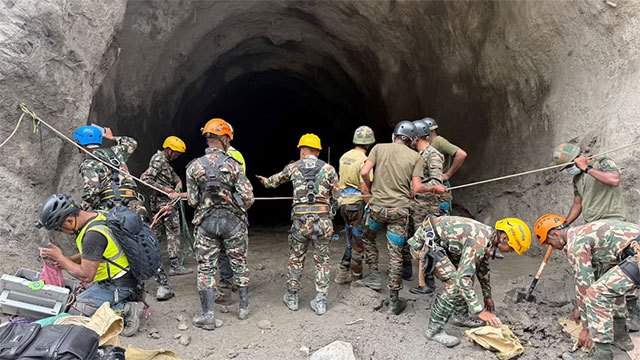
Nepali rescue teams, working alongside Chinese and Indian specialists, stepped up efforts on Monday to reach hundreds of workers believed trapped inside hydropower tunnels blocked by last week’s Himalayan flood, Ada Derana reported carrying Reuters copy.
The search is concentrated on 933 workers thought to be trapped at 11 hydropower projects in Rasuwa and Nuwakot, the two worst-hit districts. Many of them were working inside about half a dozen tunnels when the torrent of ice, rock and mud came down the valley on Wednesday.
Teams recovered three bodies after entering two tunnels. Other sections remain buried in mud and are still being searched.
Crews are now blasting their way in
The Nepali army said search-and-rescue teams were using controlled blasts, excavators and searchlights to clear water and mud. Photographs and video released by rescuers showed earth-moving equipment digging under floodlights at night, and soldiers using torches in a pit dug to find a way into one tunnel.
“A large amount of debris has been deposited and that is posing us a big challenge to open the tunnels,” army spokesperson Raja Ram Basnet said. “Our main focus is on opening the tunnels.”
That marks a change in method. Two days earlier, Dharam Raj Uprety, who heads Nepal’s national disaster management authority, had ruled the option out. “It’s very tough because there’s a lot of debris and we cannot blast things to make our way through,” he said on Sunday, in an earlier Reuters filing carried by Hiru News. Neither report explains what changed. Uprety put the number of Nepali troops assigned to tunnel work at about 10,000.
The scale of the tunnel search has also widened sharply. Sunday’s account described operations at five hydroelectric projects and around 350 people feared trapped at the Upper Trishuli complex, of whom 35 to 40 were thought to be inside Tunnel 3A. By Monday the count stood at 933 across 11 projects. Upper Trishuli 3A and 3B are interconnected plants on the Trishuli river spanning Nuwakot and Rasuwa — the same two districts named in Monday’s report.
Rescuers reached the mouth of one tunnel on Sunday and began clearing debris, the first breakthrough in the effort. The army released a photograph of two men caked in mud after being pulled from a tunnel entrance.
Nepal accepted foreign help only for the tunnels
Nepal has said it does not need outside assistance for general search and rescue, but has drawn on India and China for tunnel expertise specifically — both airlifted specialised teams. That distinction is consistent with Kathmandu’s earlier decision to turn back several foreign rescue contingents.
Hydropower building has boomed in Nepal since the turn of the century as the country sought to use its Himalayan rivers to end chronic power shortages and sell electricity to India. The steep terrain means projects depend on tunnels to carry water between rivers and powerhouses, which is why so many workers were underground when the flood arrived. Sunday’s filing said the disaster knocked out roughly 10 per cent of Nepal’s generating capacity.
Work has been halted repeatedly by bad weather and by fears that a lake formed on the Nepal-China border could send fresh water downstream, a risk assessed as receding late last week. Chinese state broadcaster CCTV said on Monday that glaciers around the crater left by the collapse remain unstable, and that drone footage showed landslide deposits along both riverbanks that could form new lakes.
The toll, and a dispute over warnings
Nepali authorities put the confirmed dead at 903 on Monday and the missing at 4,247, a figure that includes the 933 hydropower workers. China reported 16 dead and 546 missing in Gyirong County. Those numbers are covered in full in our running account of the toll.
Nepal’s foreign ministry said about 590 foreign nationals from 39 countries were still missing, and that more than 10,000 people had been rescued from the flood zone, including 323 foreigners. The Red Cross estimates more than 90,000 people were affected. Prime Minister Balendra Shah called the flood an “unprecedented and devastating natural disaster” and said a full damage assessment was still not possible.
Two Nepali officials told Reuters that China had not shared much information on glacier risks and water levels after a meeting earlier this year meant to strengthen cooperation, and said they feared the gap could hamper future preparedness. China’s foreign ministry responded that it had continuously supplied Nepal with meteorological and hydrological data and would keep supporting the relief effort. CCTV said the flood was caused by glacier instability “under the long-term effects of global warming”.
Neither report said how many of the 933 workers are believed to be inside tunnels rather than elsewhere on the project sites, how long anyone trapped could survive, or whether contact has been established with any of them.
Update: the figures were revised later on Tuesday
A later Ada Derana filing revised the hydropower numbers. It puts the workers missing at “at least 900” across 12 projects — one more project than Monday’s count — and says about 500 of them are believed to be trapped inside tunnels.
That answers the question left open above. Roughly half the missing workers are thought to be underground; the rest were elsewhere on the project sites when the flood arrived.
Brig. Gen. Raja Ram Basnet, the army spokesperson quoted earlier, said teams assisted by foreign experts were working at several projects to reach people in blocked tunnels. Army visuals showed rescuers entering dark, debris-filled tunnels, wading through mud and water and climbing over rocks in search of signs of life.
The same filing took the cross-border death toll past 1,000 for the first time and recorded the first fall in the missing count. Those figures are in our running account of the toll.
Neither the survival window for anyone trapped nor whether contact has been established with any worker has been reported.
Update, September 2: an official says 46 are alive in a chamber at Rasuwagadhi
A week after the flood, a senior Nepal Electricity Authority official said he believes dozens of workers are still alive inside a tunnel complex — the first specific survival claim of the operation.
“We think 46 people are trapped in a room-like structure in the tunnel,” Amshu Kiran Shahi, a board member of the Nepal Electricity Authority, told Reuters in a filing carried by Ada Derana.
“We are very confident that they must be alive after one week because … they have food and water over there in the building.”
The site is the Rasuwagadhi Hydroelectric Project, a 111-megawatt facility in the hard-hit Rasuwa district, in a mountain valley about five kilometres from the border with China.
That partly answers the question left open above about the survival window — but not the one about contact. Shahi’s confidence rests on what is known about the chamber and its supplies, not on communication with anyone inside. No report describes contact being established with any trapped worker.
The army has already tried once
“This is the only project where it’s possible to walk through the tunnel. The army tried doing that three days ago, but they didn’t find the room,” Shahi said. “We are going in again.”
Army spokesman Raja Ram Basnet, quoted earlier in this article on the switch to controlled blasting, said rescuers are searching for survivors at other locations too, where powerhouses have spaces and rooms in which people could shelter.
At Upper Trishuli 3A — the complex that dominated Sunday’s account — Shahi said it took rescue workers almost six days simply to locate the tunnels through thick mud. “We are expecting (survivors) in there because we are told there is a dry space inside. We are trying to break into the tunnel now,” he said.
The foreign expertise has widened well beyond the Indian and Chinese teams described above. “We are using every technology available in Nepal right now, and we are taking help from the Indians, Chinese, Koreans. We have experts from Australia too,” Shahi said.
The hydropower count, a third time
Reuters put the running totals at 279 people rescued from hydropower projects swamped by the flood, with at least 639 still missing, some of them believed to be in tunnels.
Set against the earlier figures, the hydropower caseload has now been reported three ways in three days: 933 workers across 11 projects on Monday, “at least 900” across 12 projects with about 500 in tunnels on Tuesday, and 279 rescued plus 639 missing — 918 in total — on Wednesday. The Wednesday pair is consistent with the earlier totals, but no outlet has said whether the 279 were pulled from tunnels or simply accounted for.
Al Jazeera, reporting the same day, is more precise on that point and gives a lower missing figure. It says more than 270 workers were rescued from the tunnel sites, “not inside”, and puts the outstanding caseload at about 600 workers, some believed stuck in tunnels beneath the hydropower stations. The rescued, on that account, are people who were on the project sites rather than underground — which would mean no one has yet been recovered alive from inside a blocked tunnel.
Al Jazeera also put Nepal’s confirmed dead at 1,114 and the missing at nearly 4,000, with 16 dead and 546 missing in Tibet. Nepal Police figures published the same day are higher; the toll is tracked in full in our running account.
The scale of what has to be moved
The United Nations Development Programme has put a preliminary figure on the obstruction. The disaster created at least 2.2 million tonnes of debris — building material, rock and sediment — which the agency likened to the mass of six Empire State Buildings.
That estimate covers the whole flood zone rather than the tunnels alone, but it is the first quantification of why an operation with 10,000 troops, foreign specialists and controlled blasting has taken a week to reach a single chamber.
Still not reported
No outlet has said how the 46 figure was arrived at, whether anyone inside has been heard or seen, how much food and water the chamber is thought to hold, or what the projected timeline is for breaking through. Nor has any outlet reconciled Reuters’ 639 missing with Al Jazeera’s roughly 600.