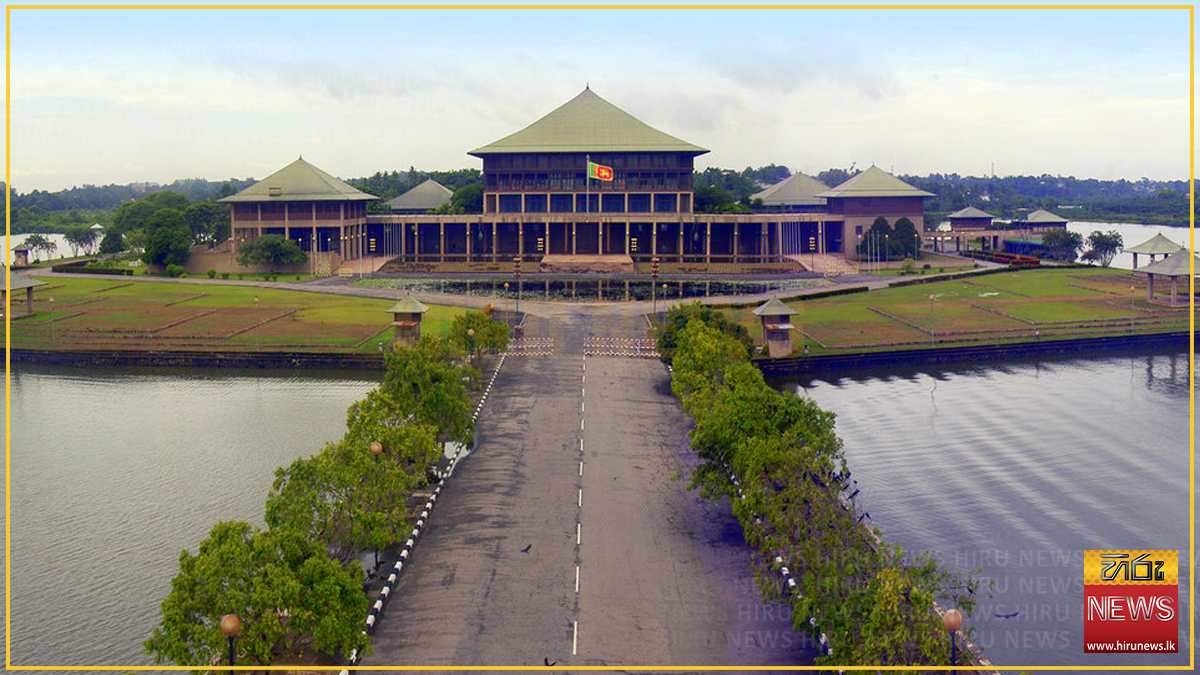
The Supreme Court’s determination on the Government’s proposed 22nd Amendment to the Constitution is expected to be placed before Parliament by the Speaker during the sitting week that began on Tuesday, September 8, Hiru News reported.
The report attributes the timing to unnamed reports rather than to the Speaker’s office or the court, and does not name a day. Parliament sits from Tuesday until Friday, September 11.
Once the Speaker receives the determination, it is announced to the House. Until that moment the ruling is confidential — neither the petitioners nor the Government are told what it says.
What the court has already decided
The five-judge bench concluded its consideration of the petitions after two days of argument, with Chief Justice Preethi Padman Surasena announcing that the court’s determination on the Bill’s constitutionality would be communicated confidentially to the Speaker. The bench directed all parties to file written submissions by 3.00 p.m. the following day.
A record 67 petitions were filed against the Bill — the largest number ever brought against a constitutional amendment in Sri Lanka.
The Bill would raise the retirement age of Supreme Court and Court of Appeal judges. The Bar Association of Sri Lanka opposed it and refused to file written submissions after being denied an oral right of reply.
A discrepancy in the dates
Hiru places the court’s announcement that its determination would go to the Speaker on the 3rd. Ada Derana and NewsFirst, in reporting the same hearing at the time, recorded Chief Justice Surasena making that announcement as the bench rose on Wednesday, September 2, with written submissions then due at 3.00 p.m. on Thursday the 3rd.
The two accounts may be describing different moments — the announcement in open court, and the point at which the record closed once submissions were in — but no outlet reconciles them.
What turns on the answer
The determination decides how the Bill can be passed. If the court finds any clause inconsistent with the Constitution, the Bill may require a two-thirds majority, a referendum, or both.
Opposition Leader Sajith Premadasa has grounded his demand for a referendum in articles 3, 4 and 83 — article 83 being the entrenchment clause that requires a referendum for any Bill inconsistent with article 3, the sovereignty of the people. President Anura Kumara Dissanayake has said the amendment will be approved by Parliament soon after the court communicates its determination, and has vowed not to reverse it.
A separate petition was filed last week over the court’s alleged failure to hear one challenge, and the Commonwealth Lawyers Association has raised concerns about the composition of the bench.
The same sitting week
The determination is expected in the week Parliament also sits with Namal Rajapaksa attending from remand custody, under an escort arranged with the Department of Prisons.
Update (September 19): it did not arrive that week — and the Speaker now has it
The determination was not placed before Parliament during the September 8–11 sitting week this article anticipated. Eleven days on, a minister has confirmed both why the expectation was premature and where the document now sits.
The Supreme Court has already forwarded its determination to the Speaker, who is expected to present it to Parliament next week, NewsFirst reported on Saturday morning.
The statement came from Minister of Housing, Construction and Water Supply Susil Ranasinghe, speaking to reporters after an event in Anuradhapura — not from the Speaker’s office or the court.
This closes the question left open above. This article noted that no outlet said “whether the Speaker has already received it.” A minister now says the court has sent it. The remaining unknown has moved from receipt to tabling.
The timing now matches the debate already scheduled
Ranasinghe said time has been allocated in Parliament for a debate on the 22nd Amendment. That is consistent with the two-day debate Parliament set for September 24 and 25, announced two days after this article was published.
Both fall in the same sitting week, which puts the sequence in order: the Speaker tables the determination, and the House debates the Bill in the days that follow. The eleven-day slip from “this week” to “next week” therefore aligns the determination with a debate date that had not yet been fixed when the original expectation was reported.
A minister concedes the referendum possibility
Ranasinghe added that if required, a referendum will be held on the amendment.
That is a notable concession from the Government side. This article set out that the determination decides how the Bill can be passed — two-thirds, a referendum, or both — and that Opposition Leader Sajith Premadasa has demanded a referendum under articles 3, 4 and 83. A government minister now publicly accepting that a referendum may be necessary narrows the distance between the two positions, at least in principle.
He said he hoped the public would support the amendment, citing an expectation that those responsible for corruption, particularly the misuse of public funds, be held accountable.
That framing is worth noting against the Bill’s actual content. The 22nd Amendment as described in this article’s reporting raises the retirement age of Supreme Court and Court of Appeal judges — a judicial-tenure measure. The minister’s public case for it rests on anti-corruption accountability, a rationale the Bill’s operative provision does not directly state.
Later the same day: a date, and a contradiction
A second NewsFirst filing on Saturday afternoon puts the tabling on Tuesday, September 22, with the Speaker expected to receive the determination on Monday the 21st — which conflicts with Ranasinghe’s morning claim that the court had already forwarded it. That story, and the full timetable through to the debate, is covered separately in Supreme Court determination on 22A to be tabled in Parliament on September 22.
Not reported
No outlet says which day next week the determination will be tabled, whether the court’s full text will be published rather than summarised to the House, or what the determination actually says — it remains confidential until announced. Neither the Speaker’s office nor the Supreme Court has confirmed the transmission that Ranasinghe describes, and NewsFirst carries no second source for it. No outlet asks the minister what would trigger the referendum he referred to, who decides, or whether the Government has planned for one. Ranasinghe holds no justice or constitutional-affairs portfolio, and no outlet explains why the housing minister is the one setting out the timetable.