CEAT Kelani Holdings (CKH) has retained its National Long-Term Rating of ‘AA+(lka)’ with a Stable Outlook from Fitch Ratings for a sixth consecutive year, Hiru News reported.
‘AA+(lka)’ is the second-highest rating on Fitch’s Sri Lankan national scale and denotes a very strong capacity to meet financial commitments relative to other domestic issuers.
What Fitch credited — and what it flagged
In affirming the rating, Fitch pointed to CKH’s established leadership in the domestic pneumatic tyre manufacturing sector and a resilient financial profile as the key strengths.
Against that, it named the company’s exposure to price-sensitive, cyclical and highly competitive end-markets.
The Stable Outlook rests on two expectations: that CKH holds its market position amid rising input costs and intensifying competition from imported tyres, and that it preserves adequate credit metrics despite periods of weaker earnings and elevated investment requirements.
Fitch expects the company to keep its lead on the strength of its brand and an extensive dealer network, and says adaptive pricing should help absorb market volatility. It also expects planned production facility upgrades to improve product quality, particularly in the radial tyre segment.
The near-term risk is specific: margin pressure from rising prices of both imported and locally sourced raw materials, and higher conversion costs driven by increased energy prices.
The chairman’s framing
CKH Chairman Chanaka De Silva said a credit rating “is ultimately a measure of confidence in an organisation’s ability to make sound decisions today while remaining financially equipped to pursue its ambitions for tomorrow,” adding that holding the rating “through successive cycles reinforces the importance we place on disciplined stewardship, operational adaptability and investment in the long-term strength of the business.”
Two ratings, two scales
This affirmation lands on the same day that Fitch upgraded Sri Lanka’s sovereign rating to ‘B-’ with a Stable Outlook. The two numbers are not comparable and should not be read as a contradiction.
A national-scale rating like ‘AA+(lka)’ ranks an issuer against other issuers within Sri Lanka, with the sovereign effectively anchoring the top of the scale. An international-scale rating like ‘B-’ places the sovereign against issuers worldwide. A company can sit near the top of the national scale while the country it operates in sits deep in speculative grade internationally.
From the photograph
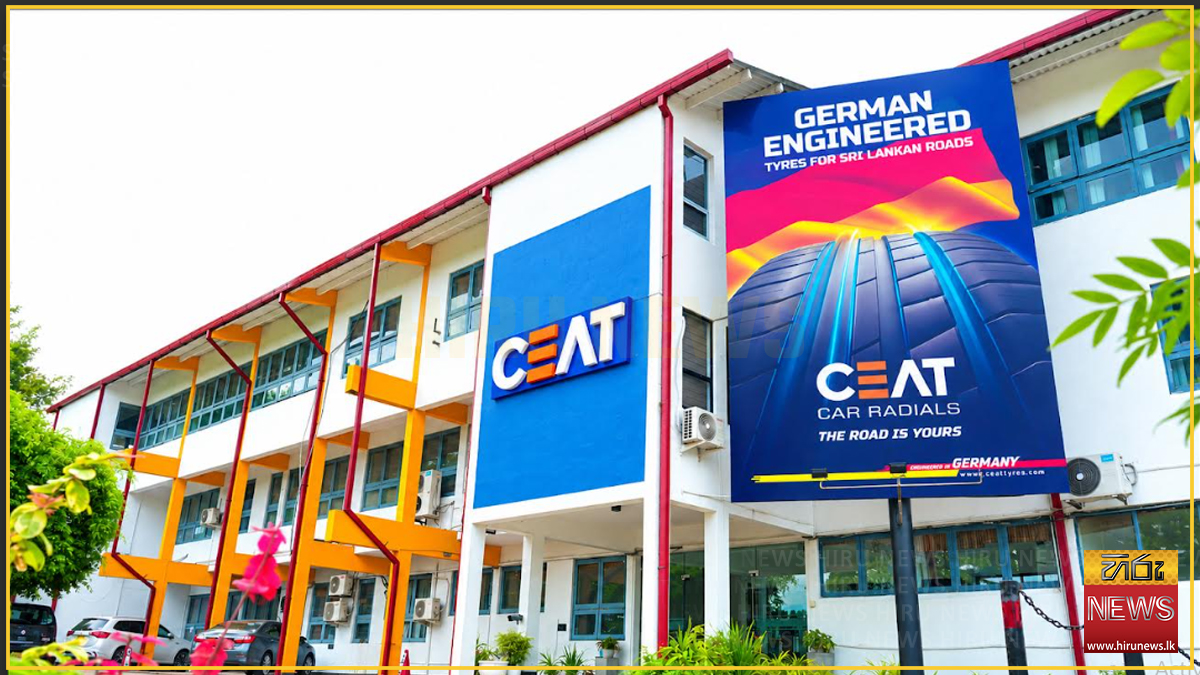
The image Hiru published with the report shows the CEAT Kelani facility with a billboard marketing the company’s car radials as “German Engineered — Tyres for Sri Lankan roads.” That positioning sits directly alongside Fitch’s note that planned upgrades target the radial segment, and its warning about competition from imported tyres — the brand is being defended on engineering provenance in the same category where imports compete hardest.
Not reported
Hiru does not give the date of the Fitch rating action or a link to the agency’s commentary, and reports no financial figures — no revenue, profit, leverage or coverage ratios, and no quantification of the “elevated investment requirements” Fitch cites.
There is no figure for the scale or cost of the planned facility upgrades, no market-share number, and no indication of how much of the raw material base is imported versus local. The report carries no comment from Fitch beyond the rationale, and no independent analyst view.
One wording note: Hiru’s URL slug describes the rating as “AA,” while its headline and body correctly give AA+. The distinction is one full notch on the national scale.