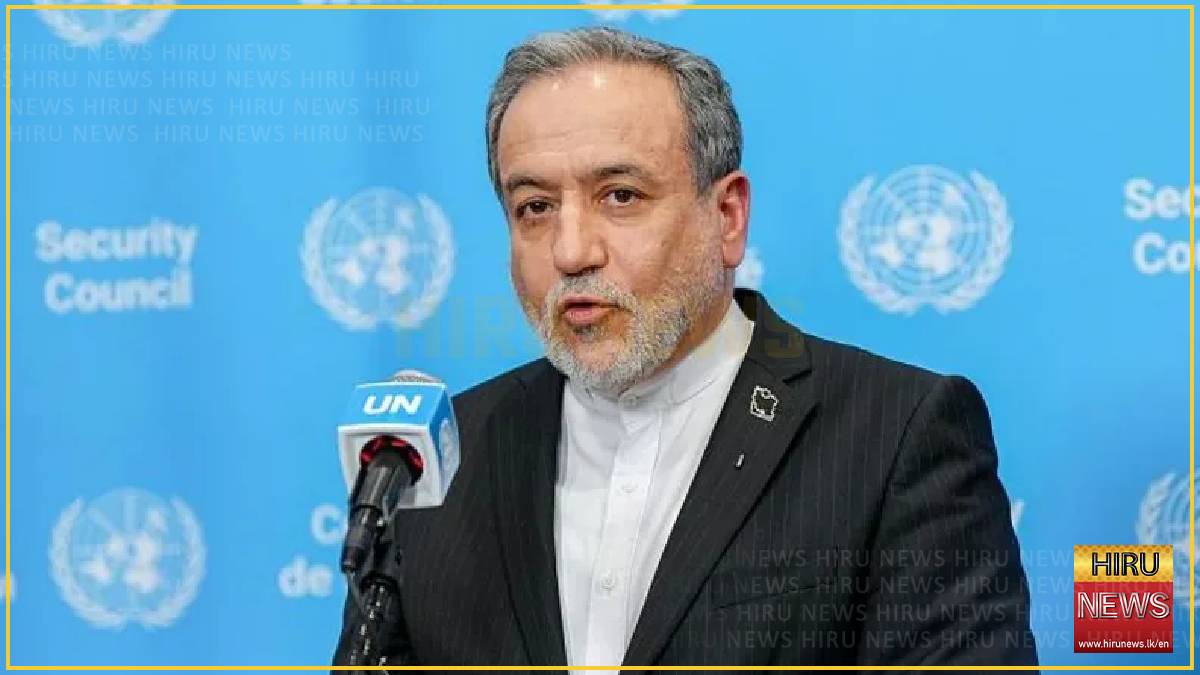
Iran has proposed a deal that would see the Strait of Hormuz reopened within seven days, Foreign Minister Abbas Araghchi said at the United Nations in New York on Friday — an offer the Wall Street Journal reports President Donald Trump has already rejected.
Araghchi said the strait could reopen “if the necessary conditions are met,” and that those conditions are already contained in the memorandum of understanding signed in June. The plan was delivered to Washington through Qatari mediators.
“The choice now rests with the United States,” he said, in an account carried by the Daily Mirror and Hiru News from BBC reporting. “If there is seriousness in the US side to come to a deal and reopen the Strait of Hormuz, everything is now prepared.”
Washington says it is “not in a rush”
A US official told the BBC that positive discussions were under way through mediators, including on nuclear issues — but added that the US was “in a very strong position with control of the Strait of Hormuz, so we are not in a rush.”
The Wall Street Journal went further on Friday, reporting that Trump has turned the proposal down and told aides he expects to resume bombing after the November congressional elections, Hiru reported, carrying Reuters copy. The Journal cited unnamed US officials and said Trump was privately sceptical Iran would meet his demands. Reuters said it could not independently confirm the report. Earlier in the week Trump had threatened to “annihilate the Islamic Republic.”
Update — Trump posts a “Trump Strait” map
Trump’s first public response to the Iranian offer came not as a statement but as an image: a map of the Strait of Hormuz relabelled “Trump Strait”, posted to his Truth Social account, Hiru News reported.
The two accounts date the post differently. Al Jazeera places it on Friday night; Hiru, carrying wire copy, says Saturday. Neither gives a time.
It is not the first time Trump has floated the name. Al Jazeera notes he threatened in August to designate the strait US territory, part of a months-long pattern of asserting American ownership over the waterway that Iran has repeatedly rejected.
What Iran actually asked for
Al Jazeera’s account is more specific than the Sri Lankan reports about the terms attached to the seven-day offer. Alongside reopening the strait within a week, Iran’s plan called for:
- the release of $12 billion in frozen Iranian assets
- the lifting of sanctions on Iranian oil
- an end to the US naval blockade of Iranian ports
- a halt to all hostilities, including in Lebanon
The Wall Street Journal reported that Trump “quickly ruled it out,” citing unnamed US officials who said he was sceptical Iran would meet its side. No White House official has commented publicly; a US official told Al Jazeera that Washington saw itself as “being in a strong position” over Hormuz.
What the June MOU contains
The 14-point memorandum, signed on 18 June, states that Iran will never have a nuclear weapon and that the US, Iran and their allies would end military operations on all fronts. It provides for an end to the US naval blockade and for sanctions relief, and commits Iran to use its best efforts to ensure safe passage of commercial vessels through the strait and to hold talks with Oman on future shipping arrangements.
Araghchi said acceptance would trigger wider talks “on mutually agreed subjects,” with hostilities ending on all fronts including Lebanon. President Masoud Pezeshkian told CBS News the ceasefire “will begin from the very day they accept it,” and said Iran would now allow UN nuclear inspectors into the country.
Why it matters in Colombo
The war began on 28 February with US and Israeli strikes; Iran retaliated against Israel, US bases in the Gulf and Arab Gulf states, and blocked the Strait of Hormuz. Around 20 percent of the world’s oil and liquefied natural gas passed through the strait before the closure, which has driven sharp swings in energy prices — the direct channel through which the seven-month conflict reaches Sri Lanka’s fuel import bill and inflation outlook.
The offer follows Iran’s seven conditions for talks conveyed through Qatar earlier this month, and comes as Saudi Arabia’s allies line up against mounting Houthi attacks.
Not reported
In his own remarks Araghchi did not itemise what Washington must do, saying only that “the actions that the United States should take are not new. They are all already in the MOU” — though Al Jazeera’s reporting sets out the four specific demands listed above. No US official has publicly confirmed or denied the Journal’s account of a rejection, and no date is given for any further round of mediated talks. Nothing in any account indicates whether the “Trump Strait” post was intended as a formal answer to the offer or is being read as one. Note that Reuters renders the foreign minister’s name Araqchi; this report uses the BBC spelling.
Update (September 27): Trump confirms the rejection; Iran says mediators have told it nothing
Trump confirmed the rejection publicly on Saturday, and in blunter terms than the Journal’s account. “They want to make a deal to open the Hormuz Strait immediately because they’re losing so badly,” he told reporters at the White House, in Reuters copy carried by the Daily Mirror.
Iran’s response on Sunday was to insist the offer still stands. “Our conditions are clear, and any move toward reopening the Strait of Hormuz is contingent on these conditions being met,” Foreign Minister Abbas Araqchi wrote on social media. “Only a negotiated solution can get them out of this deadlock.”
The most substantive new detail is a gap between Trump’s public position and what Iran has formally been told. Araqchi said the mediators handling the talks have not officially relayed any US rejection to Tehran: “We are waiting for the mediators to convey the definitive views to us, and we will make a decision based on them.” On the record, then, Iran is treating the proposal as still live.
Reuters adds that Iran has also engaged Saudi Arabia over the strait, and that a senior Iranian official said Tehran would show no flexibility on its nuclear programme even if Washington accepted the peace deal — granting no concessions on enriching uranium or on shipping its highly enriched stockpile out of the country. That sits alongside President Masoud Pezeshkian’s statement to CBS that Iran is ready for talks but will not accept “bullying or coercion,” and has already agreed “we’re not supposed to develop nuclear weapons.”
Russia offers to help
Foreign Minister Sergey Lavrov told the General Assembly on Saturday that Russia is ready to help stabilise the strait and the wider Gulf, Hiru News reported, carrying AFP and CBS copy. “We need trust in the relationships between the Gulf states, the Arab states and Iran. We need stable regional architecture,” he said. Lavrov did not say how Russia would assist.
A revised death toll
Araghchi put the toll from the US and Israeli campaign at more than 5,000 killed, including hundreds of women and children, at a press briefing in New York, Hiru reported from Reuters and the semi-official Fars agency. He listed residential areas, schools, hospitals, energy facilities, sports and cultural complexes and transport infrastructure among the civilian sites struck, and called the killings of former Supreme Leader Ali Khamenei and other senior officials “flagrant crimes and in violation of international law.” The figure is well above the 3,375 Iranian state media gave earlier in the war. It is Iran’s own count and has not been independently verified.
Reuters also notes that the Saudi-led coalition in Yemen said it intercepted two ballistic missiles and two drones fired by the Houthis towards the kingdom early on Saturday.
Sources
- Iran insists on diplomatic solution after Trump rejects peace plan — Daily Mirror, September 27
- Russia ready to help on Strait of Hormuz, foreign minister says — Hiru News, September 27
- Iran’s FM says over 5,000 people killed in U.S., Israeli attacks — Hiru News, September 27
- Iran offers US deal to reopen Strait of Hormuz in seven days — Daily Mirror, September 26
- Iran offers US deal to reopen Strait of Hormuz in seven days — Hiru News, September 26
- Trump rejects Iranian peace proposal, WSJ reports — Hiru News, September 26
- Trump posts map naming ‘Trump Strait’ off Iran after rejecting Hormuz deal — Hiru News, September 26
- Trump ‘rejects’ Iran’s seven-day ceasefire proposal. What’s next? — Al Jazeera, September 26