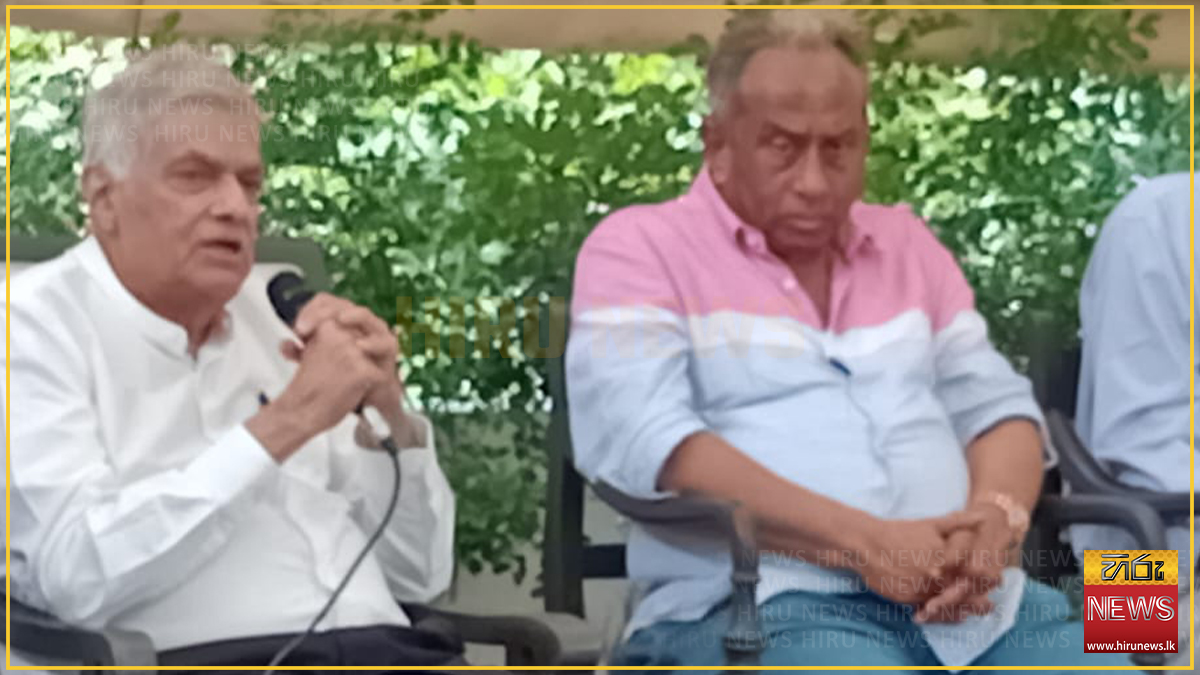
Former president Ranil Wickremesinghe has given his account of why Ven. Galagoda Aththe Gnanasara Thera was granted a presidential pardon, saying the decision followed objections from Buddhist monks to the prospect of the monk being disrobed in prison.
Wickremesinghe was speaking at a meeting of United National Party lawyers at the party’s political office on Flower Road, Colombo. Both the Daily Mirror and Hiru News reported the remarks on Saturday.
According to both accounts, the question arose after the Court of Appeal sentenced Gnanasara Thera to prison over the obstruction of proceedings at the Homagama Magistrate’s Court. Hiru reported that the monk’s robe was not removed when he was first imprisoned.
Wickremesinghe said he holds a letter sent by the then justice minister to Most Ven. Kotapitiye Rahula Thera containing an assurance that the robe would not be stripped. The two outlets name different ministers as the author of that letter — the Daily Mirror reports it was sent by Wijeyadasa Rajapakshe, while Hiru reports it was sent by Thalatha Atukorala. Neither account resolves the discrepancy.
About a year into the sentence, Wickremesinghe said, a delegation of monks met him and set out the Sangha’s customary disciplinary procedures. They argued that disrobing a monk over an offence that did not amount to a parajika offence — the gravest class of monastic breach — could create serious religious and constitutional concerns. The Daily Mirror reported the monks also said that insulting or obstructing a court was not conduct befitting a member of the Sangha, and that discipline could be imposed through the relevant religious authorities instead.
That left a choice, he said, between keeping the monk imprisoned with his robe removed or granting a pardon after about a year in custody. Wickremesinghe said he discussed the matter with then president Maithripala Sirisena, who held the constitutional power to pardon, and that it was also raised in Cabinet and with several ministers.
He added that written reasons are not routinely given for presidential pardons, noting that prisoners often receive sentence reductions or release on occasions such as Independence Day and Vesak.
The explanation lands while the same sentence is being served again. Gnanasara Thera returned to Welikada Prison on 5 October after the Court of Appeal ordered the balance of his six-year contempt term to take effect, and the removal of his robes on that occasion has since prompted a presidential committee on how jailed monks are held and a six-day protest walk from Kandy to Colombo.
Not reported: neither outlet gives the date of the pardon, names the monks in the delegation, or says whether Wickremesinghe intends to release the letter he says he holds.
Update, 14 October: Sirisena says the pardon was constitutional
The former president who actually signed the pardon has now spoken. Maithripala Sirisena said he granted the pardon to Ven. Gnanasara Thera in accordance with the powers vested in him under the Constitution, the Daily Mirror reported on Wednesday morning.
This is the first on-record account from Sirisena since Wickremesinghe set out the circumstances above, and it is the closest the saga has come to a direct answer from the decision-maker. It is also very short.
What he actually said
The Daily Mirror’s filing carries a single direct quotation, and it is not about the pardon:
“I was someone who gave up powers under the 19th Amendment to the Constitution. I also reduced my term of office. However, everything was reversed by those who came to power later,” Sirisena told the media.
The assertion that the pardon was granted “in line with the Constitution” is reported in the paper’s own words rather than quoted from him. The quotation supplied addresses his record on executive power generally — the 19th Amendment and his shortened term — not the exercise of the pardon itself. Readers should note the gap between the headline claim and the evidence offered for it.
The paper does not say where or on what occasion he spoke.
The claim runs against a Supreme Court finding
Sirisena’s position is that the pardon was constitutional. The Supreme Court has held that it was not. This newsroom reported on 10 September that the Supreme Court invalidated the pardon, after which the Court of Appeal ordered the balance of the six-year contempt sentence to take effect and Gnanasara Thera returned to Welikada Prison on 5 October.
The filing does not report Sirisena addressing that ruling, nor whether he accepts it, disputes it, or regards his constitutional authority as a separate question from the pardon’s validity.
What he does not corroborate
Sirisena does not confirm or contradict Wickremesinghe’s account above — that the pardon followed a delegation of monks warning of religious and constitutional consequences if the robe were stripped, that the matter was discussed between the two men, and that it was raised in Cabinet. Nor does he address whether he called for reports from the Attorney General, the trial judge and the Minister of Justice before granting it, which is the procedural objection that has attached to this pardon since 2019.
This update is single-sourced. Searches of Hiru News, NewsFirst, ft.lk, Island and Colombo Gazette returned only older editions on the pardon, and Ada Derana has been unreachable to this desk for twenty-five consecutive days. The Daily Mirror renders the monk’s name “Galabodatte Gnanasara Thera”, against the Galagoda Aththe used elsewhere in this article and by the other outlets covering the case.