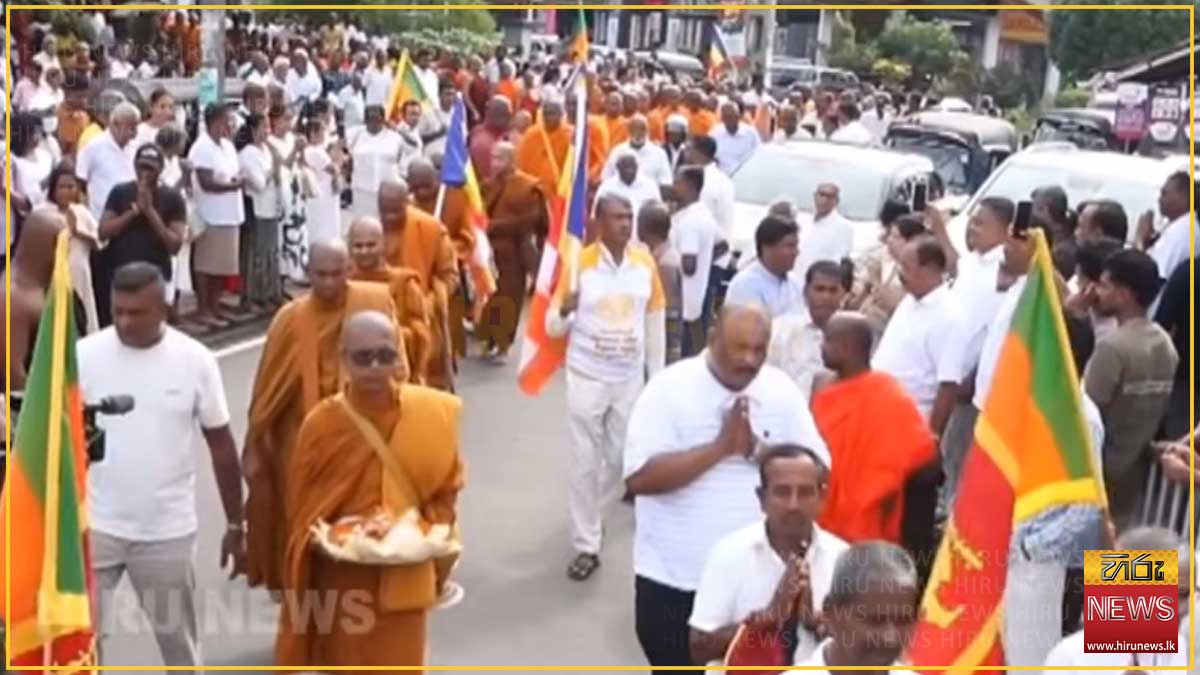
Update — Thursday evening: the march ended in a sit-in
The questions this report left open were answered within hours. The march ended at the Presidential Secretariat, where the monks held a pirith chanting, met two Secretariat officials and then the President’s Chief of Staff, and — when the talks produced no agreement — pitched tents and said they would stay until morning. Police moved on the tent at about 9.25 p.m.
Hiru’s reporters put the turnout at more than 3,000 monks. The government asked for a month to deal with the demand; the monks asked for a week. This desk has covered the standoff in full: Monks camp outside the Presidential Secretariat after talks on Gnanasara’s release end without agreement.
The six-day foot march demanding the release of Ven. Galagoda Aththe Gnanasara Thera walked its final leg into Colombo on Thursday, Hiru News reported, closing a campaign that began at the Temple of the Sacred Tooth Relic in Kandy on 10 October.
Hiru reports that the march completed its fifth day on Wednesday, setting out from Nittambuwa and finishing at Kadawatha, and was due to cover the remaining stretch from Kadawatha into Colombo on Thursday. That matches the schedule this desk published when the walk began — six daily stages down the Kandy road, ending in Colombo on 15 October.
The demand has changed
The significant thing Hiru carries is not the arrival but what the organisers now want.
Ven. Ulapane Sumangala Thera — the monk who launched the campaign at the Maha Maluwa in Kandy — told supporters as the march closed at Kadawatha on Wednesday evening that, just as it had been decided to let imprisoned monks wear the robe when taken outside, steps should be taken to release Gnanasara Thera by the time the march reached Colombo.
That is an escalation, and it is pinned to something that happened the day before. On Wednesday the Justice Minister announced that the prison-rules committee had recommended an interim order amending Departmental Order 550, giving monks full permission to wear their robes whenever they leave prison premises. The campaign set out under the slogan “Do not touch the robe.” Within a day of substantially winning that point, its founder was asking for the prisoner.
No English-language filing this desk could read reports that demand.
Who police say is marching
NewsFirst reported separately on Thursday afternoon that heavy congestion had built up in the Orugodawatta and Maligawatta areas as a protest march entered the city, and attributed the congestion to the Police Traffic Division, which it says described the event as “a march organized by a group that includes several opposition political parties.” NewsFirst headlined it an opposition-led march.
Both areas sit on the northern approach into central Colombo — the road a walk arriving from Kadawatha would take.
That characterisation is not the one every other account gives. Hiru, the Daily Mirror and this desk’s earlier reporting all describe the walk as organised by the Maha Sangha, under the names “Justice for the Robe” and Nidahase Pada Yathra, and the only organiser named anywhere is a monk. Hiru’s own footage of the march shows monks leading the procession with Buddhist and national flags and lay supporters in white; no party banner is visible in it.
Whether these are two descriptions of one march or two separate events on one afternoon is not resolved by any filing. NewsFirst does not name a single party, and does not mention Gnanasara Thera, the Maha Sangha or the Kandy walk. Hiru does not mention opposition parties.
What makes the discrepancy worth recording rather than smoothing over is that who is behind this campaign is itself contested ground. The NPP has said the agitation over the robes is opposition-driven, and three opposition leaders — Udaya Gammanpila, Patali Champika Ranawaka and Wajira Abeywardena — held separate press conferences on the robes issue on 12 October. A police traffic notice calling the march an opposition event lands inside that argument, whichever way it is meant.
A second explanation for the congestion
The Daily Mirror reported at 2.06 p.m. on Thursday — about an hour and a half before the NewsFirst filing — that several roads in Colombo had flooded after heavy rainfall, with the Met Department warning of further heavy showers across the Western Province and advising motorists of flooded roads and reduced visibility.
That is a separate filing about the weather and carries nothing about the march, which is why it is cited here but is not counted among this article’s sources. It does mean Colombo traffic on Thursday afternoon had two live causes, and the NewsFirst report attributes the congestion to only one of them.
The week behind it
The march has drawn trouble on the way in. On Thursday morning police rejected a viral claim that a marcher had been attacked with a helmet by a mob, saying the injured man had no connection to the walk and was hurt in a traffic argument, and said they would report a monk to court over the video.
Gnanasara Thera is serving a six-year sentence for contempt of court in the Eknaligoda case.
Not reported
Neither of the two filings below says how many people took part, or reports where the march ended — the question this desk flagged as unanswered when the walk began. Both were answered the same evening by later reporting and are set out in the update at the top of this article: the endpoint was the Presidential Secretariat, and Hiru’s reporters counted more than 3,000 monks. No petition or formal handover took place; what happened instead was two rounds of talks that failed.
What remains unanswered here is the organiser question. NewsFirst names no opposition party and gives no source for its description beyond the Traffic Division, and no outlet has since reconciled that characterisation with the Maha Sangha attribution every other account gives. No filing reports whether police permission was obtained for the march, how long the Orugodawatta and Maligawatta disruption lasted, or whether any incident occurred along the route into the city.
Ada Derana also reported the march reaching the Presidential Secretariat, to judge by its headlines. That domain has been unreachable from this desk for twenty-seven consecutive days, the report could not be read, and it is not cited here — the headline is noted, not relied on.
Sources: NewsFirst, Hiru News. The Daily Mirror’s flooding report is cited above for the weather only and is not a source on the march.