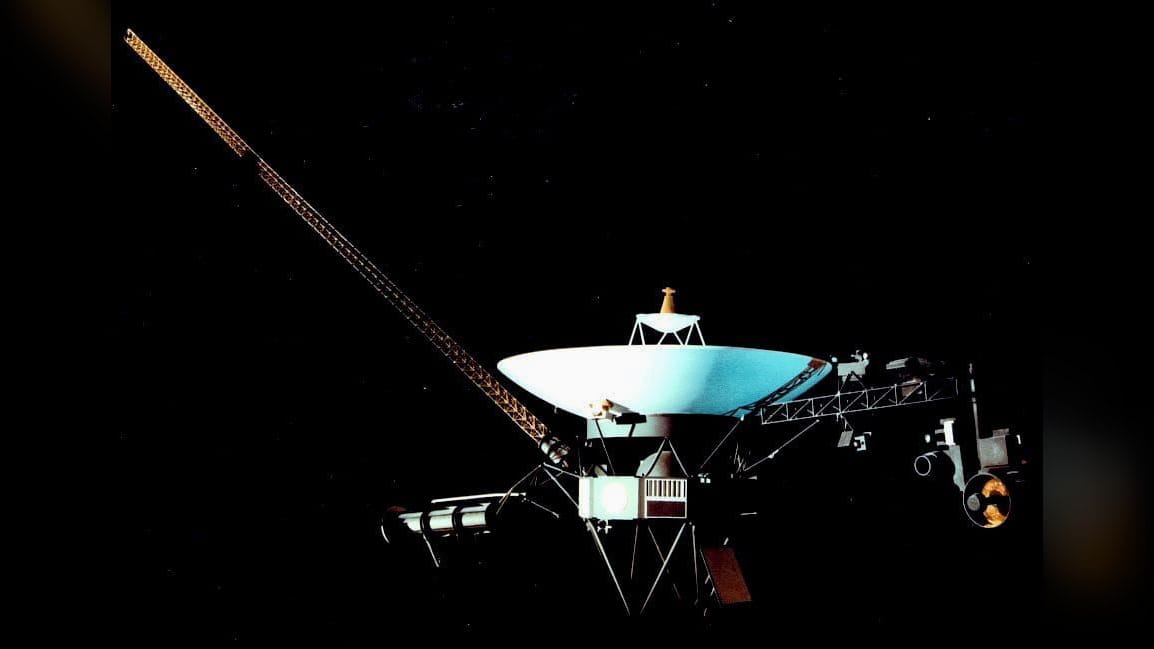
Voyager 1 will on Wednesday become the first object built by human beings to travel one light-day from Earth — far enough away that a radio command sent from the ground takes a full 24 hours to arrive.
Hiru News reported overnight that the milestone falls today, describing it as a threshold no other human-made object has crossed.
What one light-day means
A light-day is a measure of distance, not of time: it is how far light travels in 24 hours. At roughly 299,792km per second, that works out to about 25.9 billion km — some 16.1 billion miles, or around 173 times the distance from the Earth to the Sun. That figure is this desk’s arithmetic from the speed of light, and it matches Al Jazeera’s report that the probe will have covered “at least 16 billion miles” since launch.
The practical consequence is the one Hiru emphasises. A signal leaving Earth now would not reach the spacecraft until this time tomorrow — and a reply would not arrive back until the day after that.
Forty-nine years in flight
Voyager 1 launched in 1977 and completed its Saturn flyby in 1980, ending its primary planetary mission. The plutonium-powered probe is now travelling at roughly 36,000 miles per hour through interstellar space, the vast gap between stars.
Even at that speed the scale remains forbidding: NASA expects the spacecraft to need about 18,000 years to cover a full light-year, and roughly double that again before it comes near another star.
Both Voyagers still return data every day, including readings on the strength and direction of the magnetic field and on the surrounding pressure, dust and galactic cosmic rays. They are kept alive by a skeleton team of NASA engineers who send commands about once a week, and more often if a probe runs into trouble. In October the team briefly lost contact with Voyager 1 and has not yet established why.
Voyager 2, launched shortly before its twin, is expected to reach one light-day in 2035.
‘A national treasure’
Project manager Suzanne Dodd called Voyager 1 “a national treasure”, telling the Associated Press that the two probes’ work is comparable to that of weather satellites. The mission’s cultural reach has been wider still: Voyager 1 took the “Pale Blue Dot” photograph of Earth in 1990.
“All of us — everyone on Earth — have been touched by these missions,” the Planetary Society’s Bill Nye said in a statement.
Hiru reports that a special message is to be transmitted to the spacecraft to mark the occasion.
This desk reported last week on SpaceX catching a Starship booster in mid-air — a reminder that the gap between the two ends of spaceflight, a 1970s probe still reporting from interstellar space and a reusable rocket being caught on its way home, is now nearly half a century wide.
Sourcing note and what is not reported
Neither filing gives the exact moment the threshold is crossed, so this article does not state one. Al Jazeera’s piece is dated 14 November — advance coverage of a scheduled event that occurs today, rather than a report of something that has already happened.
One figure needs flagging: Al Jazeera prints the probe’s speed as “roughly 36,000 miles per hour (58km/h)”. The metric conversion is an evident slip — 36,000mph is about 58,000km/h — and this desk has used the imperial figure the outlet reports.
No Sri Lankan newsroom other than Hiru was carrying the milestone at the time of writing; the Daily Mirror and NewsFirst rails were swept and neither had filed on it.