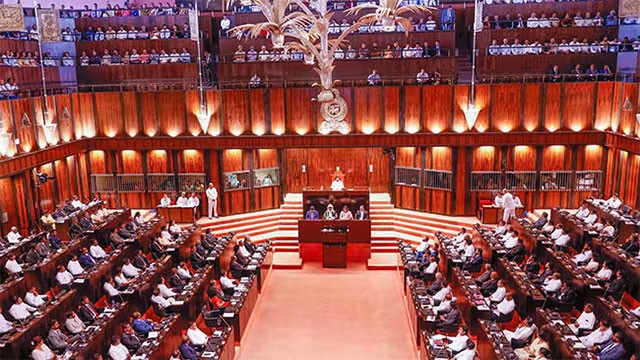
The 22nd Amendment to the Constitution and a companion Bill on the judicial service were presented to Parliament on Tuesday, putting the government’s contested plan to raise the retirement age of judges to its first test in the legislature.
Minister of Justice and National Integration Harshana Nanayakkara presented both Bills, Ada Derana and NewsFirst reported. The measures were gazetted on August 7.
NewsFirst reported that Nanayakkara gave clarifications on the amendment in the House, responding to a question raised by Opposition Leader Sajith Premadasa.
What the two Bills would change
If the 22nd Amendment passes, the retirement age of Supreme Court judges would rise from 65 to 67, and that of Court of Appeal judges from 63 to 65.
The companion Bill would raise the retirement age of judges serving in the High Courts, District Courts and Magistrates’ Courts to 62.
Ada Derana, Daily Mirror and NewsFirst all named that second measure the “Judicature (Amendment) Bill” in their reports on the tabling, and LankaNewz has adopted that form. Hiru News, reporting in Sinhala, renders it as the Judicial Organization (Amendment) Bill, and an earlier Ada Derana report used both names in a single article.
Opposition objects at the first reading
The Opposition, led by the Samagi Jana Balawegaya, raised objections when the Bills were taken up. MPs held up posters carrying a newspaper cartoon of President Anura Kumara Dissanayake and shouted slogans in the chamber as the measures were presented.
The decision to object came at an Opposition parliamentary group meeting on Monday evening at the Opposition Leader’s office, according to Hiru News.
The group also proposed filing petitions against both Bills. Pivithuru Hela Urumaya leader Udaya Gammanpila told a news conference in Colombo on Monday that his party also expects to file a petition challenging the constitutionality of the Bills, Hiru News reported.
The challenge window
Once a Bill is presented, Ada Derana said, a one-week period is available for it to be challenged before the Supreme Court. The court must then communicate its determination to the Speaker within three to 21 days of considering the petitions.
That one-week figure differs from Ada Derana’s own report a day earlier, which described a 14-day window. The outlet has not reconciled the two accounts.
First petition filed the same day
Hours after the tabling, a petition was filed in the Supreme Court seeking a determination that the proposed amendment is inconsistent with the Constitution, Ada Derana reported.
The petitioners are T.M.S. Pasindu Silva, Treasurer of the Bar Association of Sri Lanka, and the association’s Assistant Secretary. They are asking the court to rule that the Bill, if it is to be enacted, must first pass by a two-thirds majority in Parliament and then be approved by the people at a referendum.
Ada Derana reported the petition as the first filed against the Bill. By the end of the day the count had reached six petitions, including challenges from the SJB, Sarvajana Balaya, Prof. G.L. Peiris and the Free Lawyers organisation. The Opposition has separately proposed that a full bench of all 13 Supreme Court judges hear any challenges — a request opposition parties first made in early August.
Sustained opposition
The proposal has drawn objections from the Bar Association of Sri Lanka, which has warned it will pursue legal avenues, and from the Chief Prelates, who are consulting the three main Buddhist chapters. Cabinet Spokesman Nalinda Jayatissa said on Sunday the government expects enactment by September-end or October.
Sources
- 22nd Constitutional Amendment Bill tabled in Parliament — Ada Derana, August 18
- 22A On Judges Retirement Age Put To Parliament — NewsFirst, August 18
- විනිසුරු විශ්රාම වයස දීර්ඝ කිරීමේ 22 වැනි සංශෝධනය අද මැතිසබයට — Hiru News, August 18
- 22nd Constitutional Amendment challenged in Supreme Court — Ada Derana, August 18