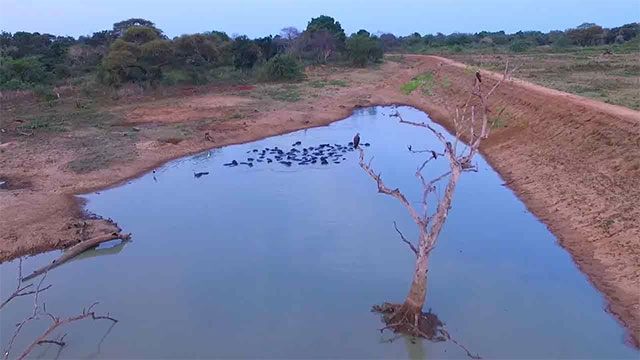
The combined storage of Sri Lanka’s 74 major reservoirs has fallen to about 36% of effective capacity, with several dry zone tanks now close to empty, the Irrigation Department says.
Director of Irrigation Engineer L. S. Sooriyabandara said water levels in the main wet zone reservoirs remain stable, but capacity in the dry zone is declining rapidly. Reservoirs in the Hambantota, Batticaloa, Monaragala, Mannar and Trincomalee districts have fallen below 30%, he said.
Daily Mirror, citing the Irrigation Department’s Water Management Branch figures for August 23, put the overall effective storage of the same 74 reservoirs at 35.8% and recorded no spilling at any of them.
A widening gap between tanks
The national average conceals a sharp split. Manankattiya in Anuradhapura was down to 1.5% of effective storage and Muruthawela in Hambantota to 1.6%, according to the department’s figures. Ethimale in Monaragala stood at 5.4% and Rottikulama in Ampara at 8.1%.
Others remain close to full: Wan Ela at 96.9%, Vakaneri at 96.2%, Deduru Oya at 94.6% and Rajangana at 85.5%.
Drinking water protected, irrigation curtailed
Sooriyabandara said dry weather is normal for August but that conditions have worsened this year because of the prevailing El Niño, with high temperatures accelerating evaporation from tanks and reservoirs. With demand rising as supply falls, he said, water in the worst-affected areas must be prioritised for drinking and environmental needs, leaving too little to release for cultivation.
Drinking water supplies have not been restricted so far, he said, but the volume released for agriculture has been limited in some areas. He urged the public to use water sparingly, and warned that the heat and dry conditions are raising the risk of fast-spreading wildfires.
The human toll
The Disaster Management Centre reports that seven districts and 23 Divisional Secretariat Divisions are affected by the dry conditions, with 81,865 people from 25,628 families hit — up from the 81,765 recorded on August 21. Drinking water is being distributed across 20 divisions, reaching 72,153 people from 23,048 families.
The reservoir figures follow weeks of dried-up small tanks and destroyed crops across Anuradhapura, Polonnaruwa and Monaragala, and come as forecasters warn Sri Lanka may be approaching a 43-year-old national temperature record.
Update: August 25 — Huruluwewa keeps falling
Hiru News reported on August 25 that storage at Huruluwewa, a major irrigation reservoir in Anuradhapura, has continued to decline under the dry conditions.
Water releases for cultivation during the last Yala season were halted on August 3, when the tank held roughly 15,750 acre-feet. It has since fallen to 14,895 acre-feet — a loss of about 855 acre-feet in three weeks with no irrigation drawdown to account for it, consistent with the evaporation losses the Irrigation Department described.
Against a total capacity of 55,000 acre-feet, Huruluwewa is now holding about 27% of its volume, below the 36% islandwide average but well clear of the near-empty Anuradhapura tanks such as Manankattiya.
Update: August 26 — one reservoir starts spilling again
The Daily Mirror published a fuller dataset on August 26, putting combined storage at 35% of capacity across the same 74 reservoirs. Present storage stands at 1,182,385 acre-feet and effective storage at 1,039,767 acre-feet, against a combined gross capacity of 3,114,407 acre-feet.
Those totals do not themselves produce the 35% headline: present storage is 38.0% of gross capacity and effective storage is 33.4% of it. The 35% figure is consistent with effective storage measured against effective capacity, a denominator the report does not publish. The same basis applies to the district percentages below, which is why they do not match the acre-foot figures quoted alongside them.
The reading continues a steady slide — 39% on August 4, 37% on August 14, 35.9% on August 22 and 35.8% on August 23.
One thing has changed direction. Ambewela in the Badulla range is now recorded as spilling, its depth at 18.08 feet against a full supply depth of 18.00 feet after 10.0 mm of preceding rainfall. The August 23 figures had recorded no spilling at any of the 74.
Where the water is, and is not
Across the 13 range districts, Kurunegala holds the most at 74.7% of capacity, followed by Puttalam at 64.0%, Kandy at 60.9%, Galle at 60.4% and Monaragala at 58.4%. The lowest are Ampara at 22.0%, Batticaloa at 25.8% and Trincomalee at 27.0%.
Monaragala’s range figure sits well above the sub-30% reading the Irrigation Director gave for Monaragala reservoirs two days earlier. The two are not necessarily in conflict: a range aggregate can stay high while individual tanks inside it run dry, as Ethimale did at 5.4%.
Anuradhapura’s 10 major reservoirs hold 275,358 acre-feet, or 45.1% of their 558,572 acre-foot capacity.
One tank explains much of the shortfall
Ampara has the largest combined capacity of any range — nine tanks totalling 1,052,221 acre-feet — but is storing only 243,393 acre-feet of it.
Most of that sits in a single body of water. Senanayaka Samudra, the country’s largest reservoir at 770,012 acre-feet gross, is at 18% of capacity. That one tank accounts for roughly a quarter of all national reservoir capacity, so its depletion pulls the islandwide average down substantially on its own. The national figure is not describing a uniform drawdown.