United States forces struck Islamic Revolutionary Guard Corps targets across southern Iran on Tuesday, and Iranian officials said one of the strikes killed at least four people at a wedding celebration. Iran raised that count to five the following day, and the US said it had not targeted civilians — both developments are in the update below.
US Central Command said its forces began striking IRGC targets at 12 p.m. Eastern Time, and announced at 6:33 p.m. that the wave was complete. The targets included air defence sites, radar systems, maritime assets and facilities, mine-laying capabilities and communications sites, CENTCOM said in posts on X reported by Ada Derana. It framed the operation as a response to attempted IRGC attacks on commercial shipping in the Strait of Hormuz and on American service members in the region.
The wedding strike
Iranian officials said at least four people, including a four-year-old, were killed and 50 injured when a US strike hit a wedding celebration in the south of the country. Ahmad Nafisi, deputy governor of Hormozgan province for political, security and social affairs, told state broadcaster IRIB the celebration was taking place in the village of Kouhestak, in Sirik county.
Al Jazeera reported the same incident, citing the Fars news agency, which said a strike hit a home in Sirik hosting a wedding and killed at least four. CENTCOM had not commented on the claim at the time either report was filed.
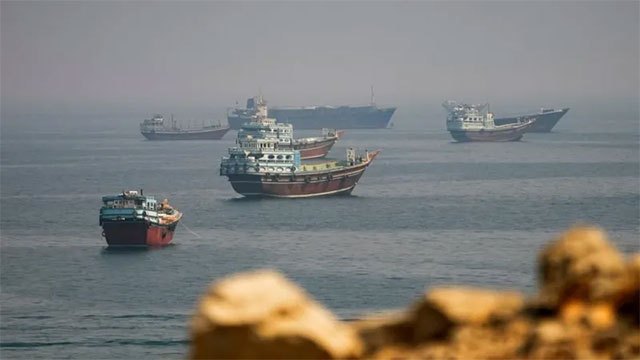
Iranian state media said explosions were heard east of Bandar Abbas and around Qeshm Island, both on the northern shore of the Strait of Hormuz, and that four projectiles hit the port cities of Chabahar and Konarak on the Gulf of Oman. Press TV said Jiroft Airport and a fishmeal factory on Qeshm Island were struck. Fars reported an explosion in Asaluyeh, the petrochemical hub serving the South Pars gas field, which the local governor confirmed without giving a cause.
Jordan intercepts 10 of 13 missiles
The strikes followed an exchange overnight into Monday, the first between the two countries in more than a month, after the US hit Iranian rocket launchers on Larak Island and Iran fired at American positions in Jordan and the United Arab Emirates.
Iran launched further missiles at Jordan on Tuesday. The Jordanian Armed Forces said it intercepted 10 and that another three fell in remote areas away from population centres, with no casualties. Al Jazeera put the same episode as 10 of 13 intercepted — the two accounts reconcile exactly — and identified the target as Camp Titin, a US Marines barracks. Jordan’s state broadcaster Al-Mamlakah said air raid sirens sounded in Mafraq and Aqaba.
Iran’s Armed Forces Central Headquarters said it would deliver “crushing and devastating blows” against the “American enemy”, IRIB reported.
Oil above US$94
Oil futures climbed above US$94 a barrel after CENTCOM’s announcement, Ada Derana reported; Al Jazeera put the move at more than four per cent. Al Jazeera also reported that a tanker was hit by three “unknown projectiles” while transiting Hormuz, and that US pump prices have passed US$4 a gallon, up from under US$3 before the war.
The escalation cuts against signals from the Trump administration that it was shifting from military action to economic pressure. Treasury Secretary Scott Bessent was promoting that approach at a G20 finance ministers’ meeting in North Carolina the same day, saying alternative shipping routes would eventually make the Strait of Hormuz “a worthless piece of water” and that sanctions would widen weekly.
President Donald Trump warned on Truth Social that Iran would be “hit again at a much harder and higher level” if it retaliated, while saying a larger attack was still “waiting in the wings”. He told Fox News the US had deliberately waited until Iran’s rebuilt radar network was nearly finished before striking it, and said Gulf allies were given advance notice.
For Sri Lanka, the price move is the immediate consequence. Fuel is the largest single line in the import bill, and the current account stayed in deficit for a fourth month in July as the trade gap reached US$6.5 billion, with energy imports the main driver.
Update: Wednesday — the toll rises to five and Washington answers the claim
Iran’s account of the Sirik strike hardened on Wednesday, and the casualty figures moved in both columns. Iran’s foreign ministry spokesman Esmaeil Baghaei said the “brutal” attack hit a residence in Kuhestak early on Wednesday, killing at least five people including a child, NewsFirst reported. Press TV also put the dead at five. The Iranian Red Crescent said more than 50 were injured and published footage of a building with its walls and windows blown out, along with pictures of children being treated in hospital.
Reza Shahidiyan, the governor of Sirik county, later told the state broadcaster IRIB that 63 people were wounded and that 50 of the casualties were women and children, Al Jazeera reported. Al Jazeera said the wounded were taken to a hospital in the nearby city of Minab and were in stable condition.
Read against Tuesday’s figures, the count has moved from four dead and 50 injured to five dead and 63 wounded. The location has been rendered as both Kouhestak and Kuhestak, and Tuesday’s account placed it as a village while Baghaei described it as a city; it is the same place in Sirik county.
The substantive change is that the United States has now addressed the claim. NewsFirst reported that the US military said it was aware of the reports but that it never targeted civilians — the first American response to Iran’s account, and a detail Al Jazeera’s report did not carry. It remains a denial of intent rather than of the strike.
Iran retaliated against Gulf states hosting American forces. Its military said it attacked US bases and assets in Jordan, Bahrain and Iraq, and Kuwait reported intercepting drones and missiles, according to Al Jazeera. The IRGC said the US would “regret” the strikes and, by early Wednesday, had fired a barrage of ballistic missiles at a US Marine base at Aqaba in Jordan in retaliation for Sirik specifically, NewsFirst reported, citing the semi-official Tasnim news agency. NewsFirst listed Kuwait among the countries where US targets were struck; Al Jazeera framed Kuwait as intercepting incoming fire rather than as a target hit.
Not yet reported as of Wednesday morning
Neither outlet reported Iranian casualty figures beyond the wedding claim, the number of sites struck, or whether the Chabahar and Konarak strikes caused damage to port infrastructure. CENTCOM has not issued a specific statement on the Sirik strike beyond the general denial that it targets civilians, and has not said whether it struck in or near Kuhestak. No outlet has reconciled the Red Crescent’s “more than 50 injured” with the county governor’s 63 wounded, or reported damage assessments from the Aqaba strike.
Update: Wednesday evening — the biggest exchange since July
By Wednesday the episode had become the largest exchange of fire between the two countries since July, with the United States striking Iran’s southern coast and Iran firing on American bases across four countries, Ada Derana reported, carrying Reuters copy. Washington threatened more devastating strikes.
“Last night was like the end of the world,” Mahmoud, 38, a municipal worker in Sirik county, told Reuters by telephone.
Al Jazeera put the American side of the exchange as dozens of military targets along Iran’s southern coast, naming Kuhestak, Konarak, Bandar Abbas, Jask, Asaluyeh and Qeshm Island, and areas near Ahvaz and Aghajari in Khuzestan province.
Iran’s stated aim has changed
Iran struck what it said were US assets in Bahrain, Jordan, Kuwait and Iraq, and said its objective is now to drive American forces out of the network of bases they have held across the Middle East for decades — a broader war aim than retaliation for any single strike.
“American evil in the region will be met with heavier, more widespread, and devastating responses, and any country that cooperates with the aggressive American army must accept its dangerous consequences,” Iran’s military command said.
Al Jazeera named the targets Iran claimed: Sheikh Isa Airbase in Bahrain; Prince Hassan airbase and a US Marine base in Jordan; the headquarters and residence of the American commander of Ali Al Salem airbase in Kuwait; and US facilities in Erbil province in northern Iraq.
The casualty claims do not agree. Iran said it killed US forces in Jordan and at a base in northern Iraq, and said its Kuwait attack set fire to a drone hangar and a ramp, destroyed several US drones and killed a number of American soldiers. US officials told Reuters that initial assessments found no casualties. Kuwait’s fire service said it extinguished a blaze at a residential complex hit by a drone but reported no casualties. Bahrain said Iranian drones were intercepted and destroyed. Qatar, which hosts the largest US airbase in the Gulf, said it holds Iran responsible for the attacks and their consequences.
Iranian casualties: the figures move again
This article’s earlier sections tracked the Sirik wedding toll from four dead and 50 injured to five dead and 63 wounded. Wednesday’s reporting moves both columns a third time, and in one case backwards.
Reuters put at least 12 deaths across Iran from the night of US strikes — the first figure covering more than the wedding, answering a gap flagged above. Of those, four including a four-year-old were said to have been killed at the wedding in Sirik. Reuters noted explicitly that “earlier reports put the death toll there at five”, and said Iranian media reported as many as 68 wounded at the site. Al Jazeera also gives at least four killed and more than 68 wounded there.
Al Jazeera puts the nationwide toll higher still, at at least 18 killed across Iran, including seven killed and eight injured at three locations in Khuzestan province.
So the wedding count now reads four dead in both Wednesday accounts, after a day at five, while the wounded figure has risen through 50, 63 and 68. The nationwide toll is 12 by Reuters and 18 by Al Jazeera. None of the outlets reconciles the earlier five-dead figure with the return to four, and Reuters said it was unable to independently verify the incident.
CENTCOM answers directly, and is named
The American denial noted above now has an author and a fuller text. US Navy Captain Tim Hawkins, a spokesperson for Central Command, said: “We are aware of reports, which originated from Iranian state media. The U.S. military never targets civilians, unlike the IRGC.”
Video filmed at the site by Iran’s West Asia News Agency showed rubble across rooms and a courtyard, and a pair of women’s dress sandals on a blood-soaked carpet. “I am just glad the casualties weren’t even worse,” said Ali Molahi, identified as the father of the bride.
Iranian officials compared the strike to one on a girls’ school that killed 160 people on the war’s first night. The Pentagon has not released the findings of its investigation into that attack, which would be the US military’s largest civilian casualty incident in decades.
The strait, and two dead crew
Iran said two tankers were struck by mines while being steered through the Strait of Hormuz by US personnel. Washington maintains it is still guiding ships through: Energy Secretary Chris Wright said more than 17 million barrels of oil exited on Monday.
Saudi Arabia’s national shipping company said on Wednesday that two Filipino crew members had been killed aboard an oil tanker in the strait two days earlier — the first reported deaths among merchant seafarers in this phase.
Both sides are being drained
The July pause came after President Donald Trump halted two weeks of bombing on warnings from his commanders that they were using up munitions and running out of meaningful targets. Trump, who has not achieved the aims he set when launching “Operation Epic Fury” in February — ending Iran’s nuclear programme, removing its ability to strike its neighbours, and creating conditions for Iranians to topple their government — again said victory was close.
“I like our position now much better, with almost total control of the Hormuz Strait, and their economy totally collapsing,” he said on Tuesday.
Sources told Reuters that Trump’s aides are trying to keep the war quiet to avoid a rout in November’s congressional elections. Polls show Americans oppose the war by more than two to one. Iran, for its part, is described as determined to emerge with sanctions lifted, blocked funds released and a grip on the strait that would let it charge fees on shipping carrying a fifth of the world’s oil.
The sanctions track widens
Treasury Secretary Scott Bessent, whose economic-pressure argument was noted above, named new targets on Wednesday: airlines, the maritime industry and digital assets, Hiru News reported, carrying Reuters. He had said on Tuesday that airline leasing companies could also be hit and that further Iranian bank sanctions could come this week.
Asked about Russian support for Iran, a day after President Vladimir Putin backed Tehran, Bessent issued a general warning. “My message to everyone is stay away. We all want this conflict to end, and the fastest way for the conflict to end is for no one to provide any support to this regime,” he told Fox News. “We are having very fulsome talks with anyone supporting the regime.”
What it costs Sri Lanka
Asian and European stocks fell after the strikes, and oil returned to levels not seen since July. That move is covered separately in our report on Brent crude passing US$96 with Goldman Sachs forecasting US$120. Fuel remains the largest single line in Sri Lanka’s import bill.
Still not reported
No outlet has published an independent assessment of damage at any of the bases Iran says it hit, or reconciled Iran’s claim of American dead with the US assessment of none. The 12-versus-18 split on Iranian deaths, and the return of the wedding toll from five to four, are unexplained. Reuters and Al Jazeera both note they could not independently verify the Sirik strike, and CENTCOM has still not said whether it struck in or near Kuhestak.
Sources
- US military carries out new strikes on Iranian targets — Ada Derana, September 1
- US launches new strikes against Iran as war escalates — Al Jazeera, September 1
- Iran says US bombed a Wedding Party in Sirik, Killing Five People — NewsFirst, September 2
- Iran says US bombed a wedding party in Sirik, killing five — Al Jazeera, September 2
- US pounds Iran, Tehran strikes back at bases in biggest exchange since July — Ada Derana, September 2
- Iran, US exchange new attacks: Who was hit in latest strikes? — Al Jazeera, September 2
- US weighs sanctions on airlines, digital assets over Iran ties — Hiru News, September 2